Step into Piazza della Rotonda and stand before the Pantheon, one of ancient Rome's most perfectly preserved architectural marvels. Completed around 126 AD under Emperor Hadrian, this monumental structure has endured for nearly two millennia. As you approach its grand portico, framed by massive granite Corinthian columns, prepare to explore a sanctuary that seamlessly bridges Rome's imperial past with its living cultural legacy.
Inside, your eyes are immediately drawn upward to the celestial oculus and the world's largest unreinforced concrete dome. From the tombs of Renaissance master Raphael to Italian monarchs, this self-guided audio tour reveals the brilliant engineering and timeless history encased within these ancient stone walls.
Listen to a sample
The opening of this tour, exactly as AllTours narrates it on site.
What you'll hear on this tour
Stop 1. The Great Eye to the Sky
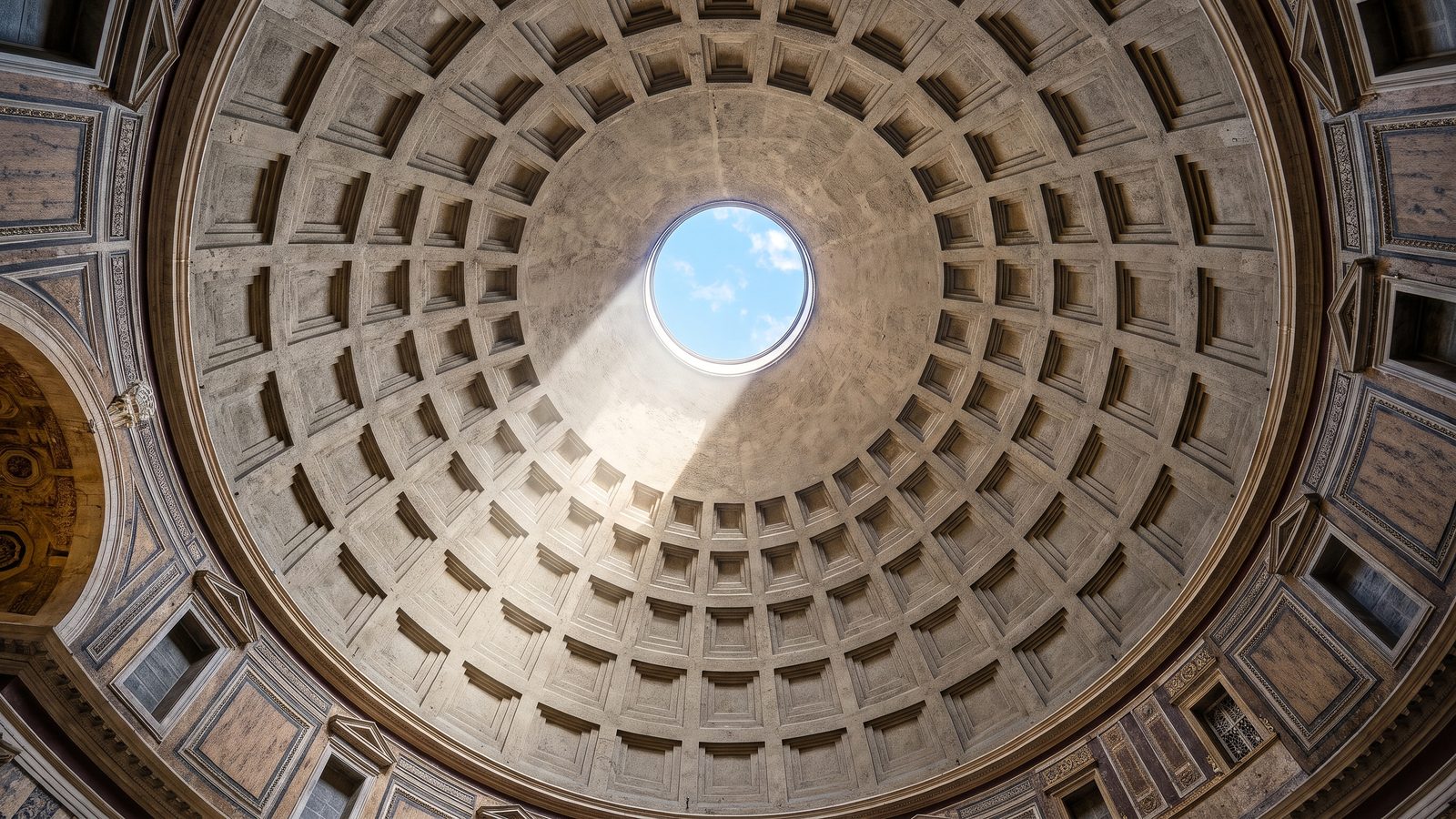
Look directly above you to marvel at the Oculus, an unglazed circular opening spanning nine meters in diameter. As the Pantheon's sole source of natural light, this open aperture acts as both a monumental skylight and an ancient ventilation system. Notice how sunlight streams through the void, casting dynamic shafts of light across the interior surfaces throughout the day. Rain drops straight to the slightly convex floor beneath your feet, where subtle drainage holes filter the water away. Conceived under Emperor Hadrian around 126 AD, this open crown represents a peak in Roman structural mastery, cleverly reducing weight precisely where the dome is most vulnerable.
Stop 2. The World's Largest Unreinforced Dome
Cast your eyes upward toward the breathtaking concrete dome, an architectural marvel built around 126 AD under Emperor Hadrian. Spanning 43.3 meters in diameter, it matches the exact interior height from the floor, forming a perfect mathematical sphere. Observe the five concentric rings of twenty-eight sunken panels, known as coffers, receding toward the top. These coffers do not just create geometric elegance; they significantly lighten the dome's colossal mass. Ancient builders used opus caementicium mixed with lighter volcanic materials near the top to maintain structural harmony. Today, it remains the largest unreinforced concrete dome ever constructed anywhere in the world.
Stop 3. Mastery of Ancient Roman Concrete
Consider the groundbreaking engineering that keeps this massive structure standing after nearly two thousand years. Roman builders poured concrete foundations nearly 4.5 meters thick and constructed rotunda walls over six meters deep. To handle the tremendous weight, engineers strategically varied the raw ingredients of their concrete mixture, blending heavy travertine at the base and lighter pumice near the apex. Hidden brick relieving arches within the walls further distribute structural stress outward. The recessed ceiling coffers reduce total mass by about twenty percent, while the open oculus at the top lightens the weakest point, showcasing an unparalleled command of physics and material science.
Stop 4. From Pagan Temple to Christian Basilica
Trace the remarkable transformation of this ancient sanctuary across two millennia. Marcus Agrippa built the first temple on this spot around 27 BC, though fires later destroyed it. Emperor Hadrian completely rebuilt the structure between 118 and 128 AD, choosing to preserve Agrippa's original inscription high on the portico. In 609 AD, Pope Boniface IV consecrated the building as Santa Maria ad Martyres, saving the pagan structure from medieval ruin. Over the centuries, its precious metals were stripped, including bronze taken in 1631 for St. Peter's Basilica. Later, it became a national mausoleum housing figures like the artist Raphael and King Vittorio Emanuele II.
Stop 5. Harmonious Geometry of the Rotunda
Stand in the center of the rotunda to appreciate the classical harmony of Roman design. Before entering, you pass through a monumental portico supported by sixteen monolithic Egyptian granite columns. Inside, the immense open space creates a feeling of absolute balance, where the sphere of the dome seamlessly aligns with the interior dimensions. Roman architects progressively lightened the concrete aggregate as they built upward, creating a flawless spatial experience. Below your feet, intricate floor patterns complement the grand proportions above. This seamless transition from a traditional rectangular porch into a colossal circular interior demonstrates the creative genius that defines imperial Roman building traditions.
Stop 6. An Architectural Blueprint for Millennia
Reflect on how this single building shaped global architecture for centuries. Consecrated as a church in 609 AD, the Pantheon survived while many ancient ruins crumbled into history. Renaissance genius Filippo Brunelleschi meticulously studied its design to engineer the famous dome of the Florence Cathedral in the fifteenth century. Centuries later, Neoclassical architects drew inspiration from its grand façade and proportions, most notably Thomas Jefferson when designing the University of Virginia's Rotunda. As you walk past the final resting places of Renaissance master Raphael and King Vittorio Emanuele II, you experience a living bridge connecting classical antiquity to modern monumental design.
Planning your visit
- Best time to go
- Early morning or sunny midday to catch the light shaft through the oculus
- Approximate duration
- about 45 minutes
- Where to start
- In front of the portico in Piazza della Rotonda
Access and conditions change seasonally — check the official site before you go.
Frequently asked questions
Is the Pantheon worth visiting?
Yes, the Pantheon is one of the best-preserved ancient Roman structures in the world, celebrated for its massive unreinforced concrete dome, open oculus, and rich history.
How long do you need at the Pantheon?
Most visitors spend around 30 to 60 minutes exploring the rotunda, viewing the tombs, and admiring the architecture.
Who built the Pantheon and when?
Marcus Agrippa built the initial temple between 27 and 25 BC, but Emperor Hadrian completely rebuilt it in its current form around 118 to 128 AD.
Keep exploring
Header image is an AI-generated illustration of Pantheon. AllTours.ai is an AI audio tour guide — point your camera at any landmark and hear its story.