Welcome to Parma, the elegant heart of Emilia-Romagna where centuries of Roman foundations, Farnese ducal grandeur, and Bourbon rule weave a rich historic tapestry. As you wander these ancient streets along the historic Via Aemilia grid, you uncover a city renowned worldwide for its Romanesque architecture, vibrant artistic heritage, and legendary gastronomy. From magnificent piazzas to quiet green spaces, Parma offers an unforgettable journey through Italian culture and refined living.
This self-guided audio tour allows you to experience Parma at your own pace. Discover iconic landmarks like the pink marble Baptistery, admire Renaissance masterpieces in grand galleries, and learn the secrets behind world-famous delicacies like Parmigiano Reggiano and Prosciutto di Parma as you explore this remarkable ducal capital.
Listen to a sample
The opening of this tour, exactly as AllTours narrates it on site.
What you'll hear on this tour
Stop 1. Savouring the Culinary Capital's Finest Flavours
As you stroll through Parma, the very air whispers of unmatched culinary artistry. You taste the delicate sweetness of world-renowned Prosciutto di Parma, each paper-thin slice reflecting months of careful aging under specific local microclimates and strict breeding standards. Next, you encounter Parmigiano Reggiano, revered as the King of Cheeses. You note its complex, nutty notes developed over years of patient aging under the watchful eye of a protective consortium. Finally, you discover the rare Culatello di Zibello, cured exclusively in the humid lowlands of the Po Valley. Each bite reveals an incredible heritage of dedication and artisanal excellence.
Stop 2. Pink Marble and Romanesque Grandeur
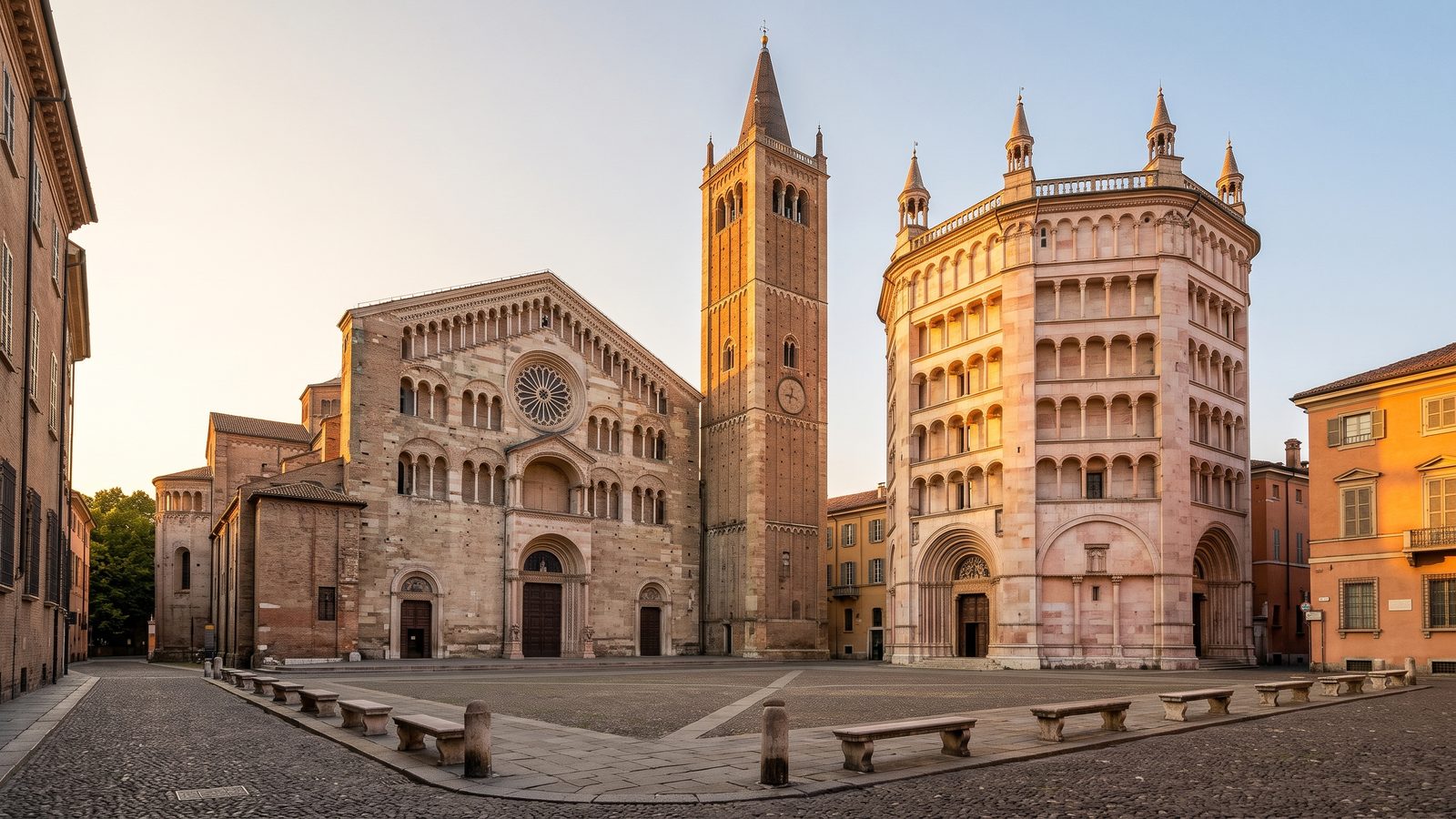
Standing in the heart of Parma, you absorb the architectural marvels surrounding you. The Baptistery immediately captivates your eyes with its striking octagonal form, a profound symbol of resurrection clad entirely in exquisite pink Verona marble. You examine the intricate sculptural reliefs carved by Antelami, seamlessly integrated into the structure to tell vivid biblical stories. Right beside it, you observe the Cathedral's robust Romanesque facade. You trace its graceful layered arches and iconic rose window, taking in centuries of evolving Italian craftsmanship that transformed stone into timeless spiritual art as you walk beneath these sacred walls.
Stop 3. Masterpieces of the Galleria Nazionale
You step into the grand halls of the Galleria Nazionale to immerse yourself in Parma's extraordinary artistic legacy. Inside, you encounter Correggio's luminous masterpieces, where ethereal light dramatically bathes every figure and captivates your gaze. Moving through the rooms, you stop before Parmigianino's elegant painting, Turkish Slave. Her enigmatic expression and captivating gaze seem to follow you across the floor, showcasing the refined grace of Mannerist art. Nearby, you discover Leonardo da Vinci's delicate sketch La Scapigliata, an intimate work revealing his profound understanding of human emotion and gentle beauty.
Stop 4. Strolling the Historic Ducal Park
You step into the expansive greenery of the Ducal Park, where the grandeur of an 18th-century French-style garden envelops you. Designed originally for the Bourbon court, this verdant sanctuary invites you to walk the very avenues once frequented by Duchess Louise Élisabeth. As you wander past meticulously sculpted hedges and classical statues, you realize this park was both a statement of aristocratic power and a sanctuary of refined taste. Here, the pulse of Parma slows, allowing you to discover tranquil hidden grottoes and listen to the serene flow of ancient fountains.
Stop 5. Tracing Centuries of Ducal Ambition
You trace Parma's deep history back to 183 BC, when Roman settlers founded Colonia Iulia Augusta Parmensis along the vital Via Aemilia, establishing the street grid you walk today. As you move forward through time, you witness how the powerful Farnese family reshaped the city in the 16th century into a magnificent ducal capital, commissioning grand palaces and the legendary wooden Teatro Farnese. Later, during the 19th century, Empress Marie Louise modernized Parma's civic infrastructure, leaving an indelible mark on its identity and creating the elegant city you experience today.
Stop 6. The Artisanal Soul of Parma
Here in Parma, you immerse yourself in a profound culture where food is celebrated as both fine art and a fundamental way of life. You observe the deep-rooted social fabric woven around Parmigiano Reggiano, recognizing it as a cherished daily ritual connecting generations of local families. As you talk with local shopkeepers, you discover how the painstaking aging of Prosciutto di Parma embodies the city's inherent patience, pride, and unwavering commitment to artisanal excellence. This passionate dedication to quality reflects the true, enduring identity of Parma and its people.
Planning your visit
- Best time to go
- Spring (April to June) and autumn (September to October) offer pleasant temperatures for walking and active local culinary markets.
- Approximate duration
- about 2 hours
- Where to start
- Piazza del Duomo, directly outside Parma Cathedral and the Baptistery.
Access and conditions change seasonally — check the official site before you go.
Frequently asked questions
Is Parma worth visiting?
Yes, Parma is highly worth visiting. Known as the heart of Italy's Food Valley, it combines world-class gastronomy—including Prosciutto di Parma and Parmigiano Reggiano—with Romanesque architecture, Renaissance masterpieces, and charming parks.
How long do you need at Parma?
A full day or a weekend (1 to 2 days) is ideal to explore Parma's historic center, visit top attractions like the Baptistery and Galleria Nazionale, and enjoy authentic regional dining.
What is the history of Parma?
Parma was established as a Roman colony along the Via Aemilia in 183 BC. It rose to global prominence as a ducal capital under the Farnese family in the 16th century and was later modernized under Empress Marie Louise in the 19th century.
Keep exploring
Header image is an AI-generated illustration of Parma. AllTours.ai is an AI audio tour guide — point your camera at any landmark and hear its story.