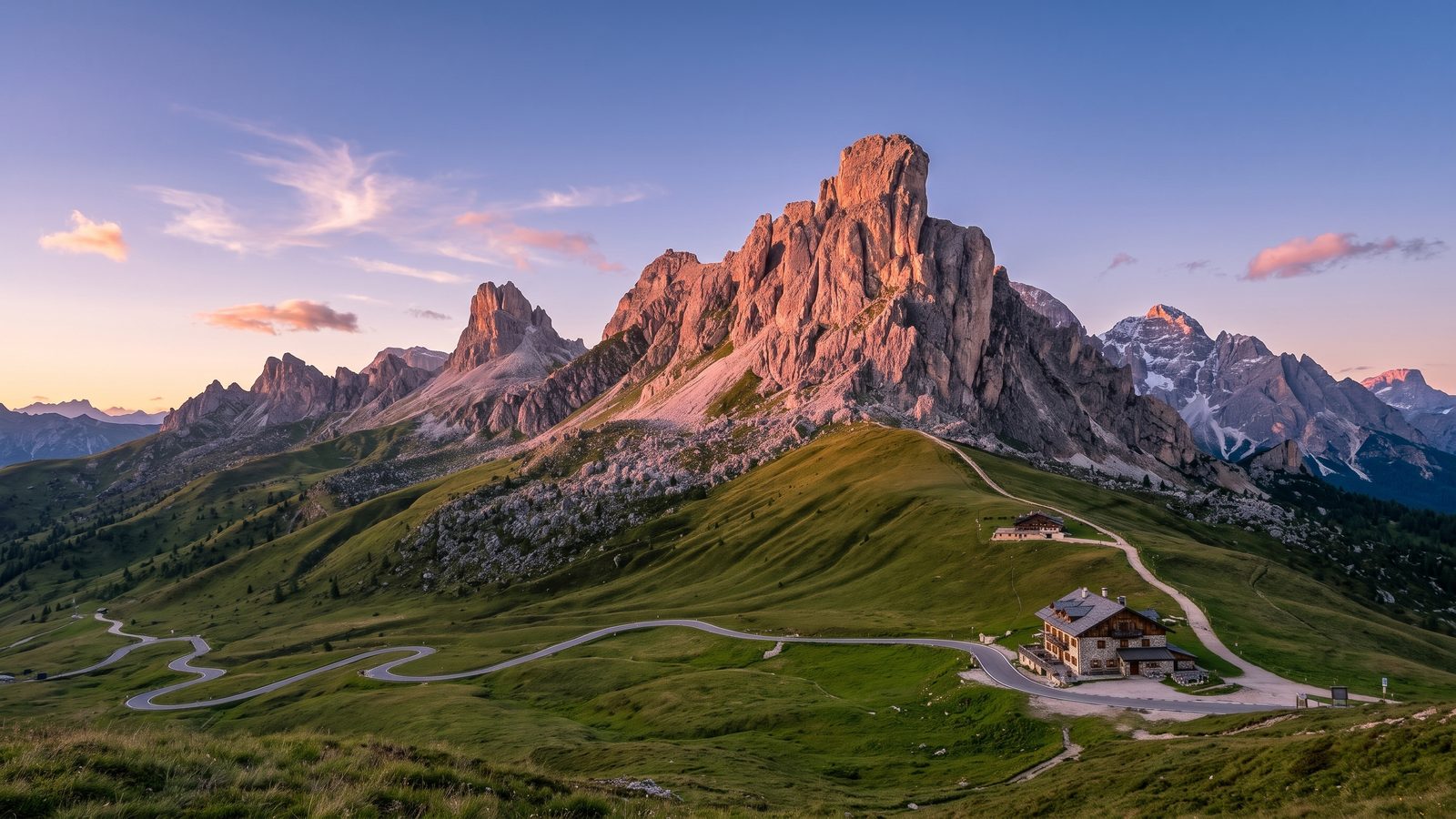
Welcome to Passo Giau, a breathtaking high mountain pass nestled in the Venetian Dolomites near Cortina d'Ampezzo. Standing at an elevation surrounded by the jagged spires of Averau and Nuvolau, you are stepping into a landscape shaped by millions of years of geological drama, historic battles, and legendary athletic feats. This self-guided audio tour brings the grandeur and heritage of the pass directly to life as you explore.
As you walk along these high alpine trails, listen to how ancient Triassic coral reefs transformed into pale dolomite peaks, how WWI soldiers built rock fortifications, and how modern cyclists conquer these dramatic hairpin turns. Soak in the sweeping panoramas and experience the magic of the Italian Alps at your own pace.
What you'll hear on this tour
Stop 1. Conquering the Legendary Giro Ascent
You stand on a hallowed stretch of asphalt that has forged champions for decades. Passo Giau is a legendary fixture of the Giro d'Italia, presenting a relentless test of endurance over nearly ten grueling kilometers. Starting from Selva di Cadore, the road climbs through twenty-nine sharp hairpin turns, carving directly into the rock face with an average gradient near 9.8 percent and steep sections exceeding 14 percent. As you look down the winding road, imagine cycling icons like Fausto Coppi and Marco Pantani pushing through the pain on these very slopes. Every hard-earned turn rewards riders with expanding panoramas, culminating in a triumphant 360-degree vista at the summit.
Stop 2. A Dramatic Coral Coast Uplifted
Look across the expansive landscape stretching around you. What appears as a dramatic mountain range is actually a geological marvel—the fossilized remnants of ancient coral reefs uplifted into pale grey and white spires. Notice how gentle, bright green high-alpine meadows filled with resilient wildflowers clash sharply against the formidable rock faces of Averau and Nuvolau. During the soft light of dawn or dusk, you can witness Enrosadira, a captivating atmospheric phenomenon that washes these mineral-rich peaks in shades of vibrant rose and fiery orange. Intricate rock layers reveal marine secrets millions of years in the making, creating an overwhelming sense of wonder in every direction.
Stop 3. Echoes of the Iron Front
Beneath the peaceful beauty of this pass lies a dramatic, conflict-filled past. Long before roads were paved, these paths served as humble shepherd trails for moving livestock between valleys. That solitude shattered during the First World War, when Passo Giau became a fiercely contested battleground along the Iron Front from 1915 to 1917. Italian Alpini and Austro-Hungarian Kaiserjäger troops transformed these peaks into a high-altitude fortress, blasting tunnels and building trenches directly into the solid rock. As you look at the surrounding crags, consider the immense human struggle of moving weapons, supplies, and wounded soldiers across treacherous, icy slopes in unforgiving conditions.
Stop 4. The Ocean Floor Raised to Heaven
Cast your gaze on the unique rock beneath your feet. You are standing on dolomite, formed roughly 250 million years ago during the Triassic period. Ancient reefs flourished in the warm waters of the prehistoric Tethys Ocean, where magnesium-rich currents gradually converted calcium carbonate sediments into this exceptionally hard mineral. Later, the massive tectonic forces of the Alpine Orogeny thrust these ancient seabed layers skyward, folding and faulting the rock faces visible across the horizon. Subsequent ice ages and glaciers carved wide U-shaped valleys and sharpened the elevated peaks, continuously stripping away rock to reveal millions of years of Earth's hidden marine history before your eyes.
Stop 5. Composing Light and Mountain Silhouettes
Step into the shoes of a photographer framing one of the world's most dramatic landscapes. Before dawn, the cool blue hour casts a quiet, mystical glow across jagged peak silhouettes, rewarding long exposures with delicate atmosphere. As sunrise breaks, you can capture the magic of Enrosadira when peaks like Nuvolau ignite with brilliant red and orange tones. Use a telephoto lens to compress the twenty-nine snaking hairpin curves winding up the pass, or switch to a wide-angle lens to contrast delicate alpine wildflowers against the massive bulk of Monte Pelmo. Under clear night skies, the Milky Way arches above illuminated mountain huts.
Stop 6. Trails Through Living World History
Lace up your boots and step onto an intricate network of alpine trails surrounding the pass. You can follow historic World War I mule tracks ascending toward Rifugio Nuvolau, feeling the crunch of loose scree underfoot as switchbacks reveal views of Monte Pelmo and the Marmolada glacier. Keep your eyes open for rare alpine flora, such as edelweiss clinging stubbornly to sun-drenched rock faces. If you seek a steeper challenge, paths lead toward the sheer rock walls of Monte Averau. Whether taking a short loop or a rugged climb, hiking here immerses you in a living geological museum defined by ancient ice and time.
Planning your visit
- Best time to go
- Late spring through early autumn (June to September) for hiking, cycling, and open roads; early morning or sunset for Enrosadira light.
- Approximate duration
- about 2 hours
- Where to start
- Rifugio Passo Giau, located at the summit of the SP638 mountain road.
Access and conditions change seasonally — check the official site before you go.
Frequently asked questions
Is Passo Giau worth visiting?
Yes, Passo Giau is widely considered one of the most magnificent mountain passes in the Italian Dolomites, offering dramatic 360-degree views of peaks like Averau and Monte Pelmo, rich WWI history, and legendary cycling routes.
How long do you need at Passo Giau?
Most visitors spend between 1 to 3 hours exploring the pass, taking in the panoramas, capturing photos, and enjoying short hikes along WWI trails to nearby mountain huts.
What happened at Passo Giau during World War I?
Between 1915 and 1917, Passo Giau was part of the WWI Iron Front, where Italian Alpini and Austro-Hungarian Kaiserjäger forces carved trenches, tunnels, and rock fortifications while enduring extreme high-altitude conditions.
Keep exploring
Header image is an AI-generated illustration of Passo Giau. AllTours.ai is an AI audio tour guide — point your camera at any landmark and hear its story.