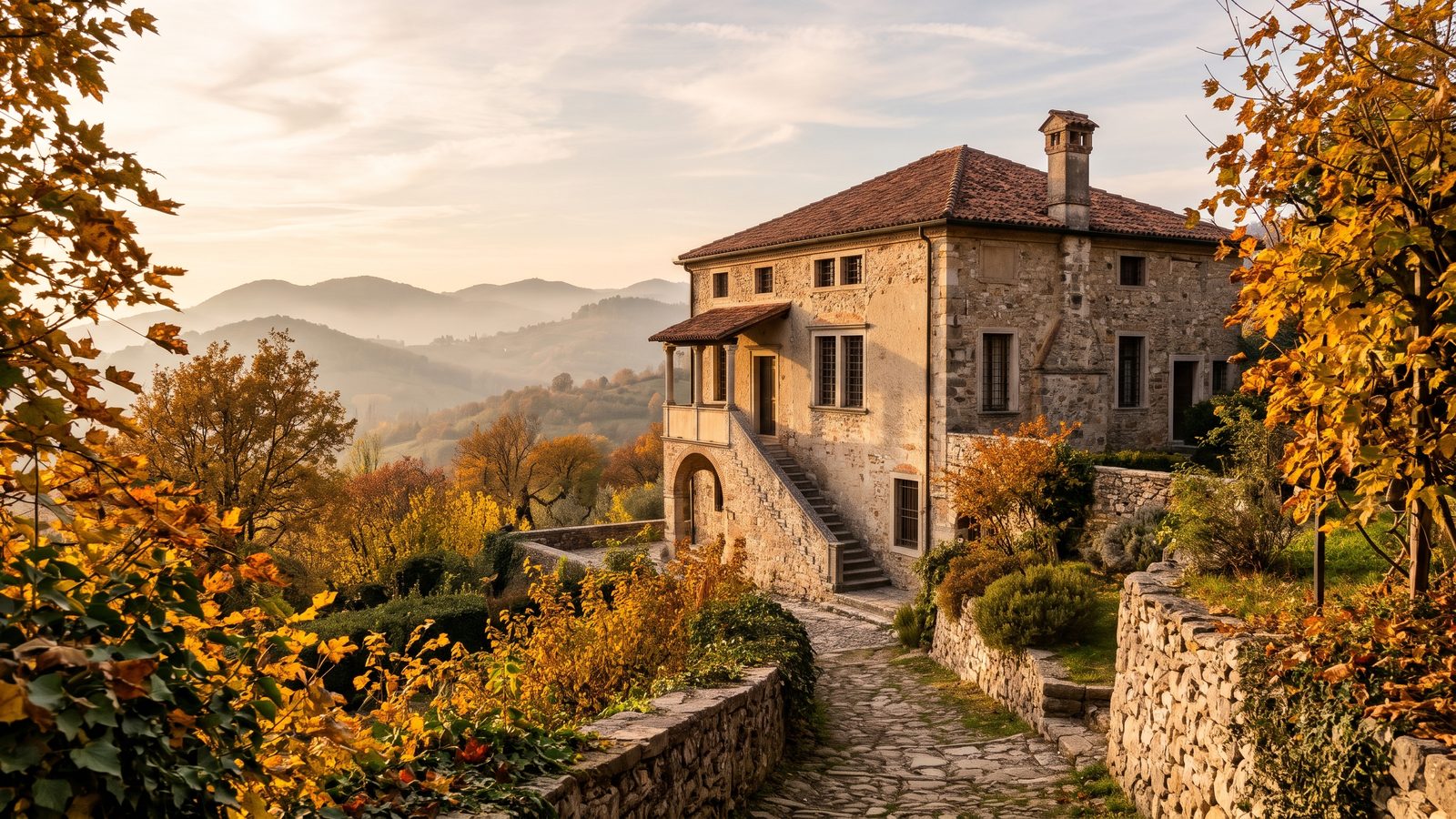
Welcome to Arquà Petrarca, a serene medieval village nestled in the volcanic Euganean Hills of the Veneto region. Here, Francesco Petrarch—one of Italy's grandest poets and a foundational father of humanism—spent his final years seeking quiet inspiration. As you explore his preserved house, village square, and idyllic surrounding landscape, you step back into the fourteenth century, experiencing the very sights and soul that birthed the Italian Renaissance.
Wander through ancient cobblestone paths, historic osterias, and sun-drenched vineyards. This audio tour connects Petrarch’s poetic genius with the authentic flavors, local wines, and enduring cultural heritage of the Euganean Hills, offering you a deeply immersive glimpse into the landscape that shaped modern Italian language and verse.
Listen to a sample
The opening of this tour, exactly as AllTours narrates it on site.
What you'll hear on this tour
Stop 1. Birthplace of the Italian Voice
You stand in the very village where the soul of the Italian language found its poetic voice. Through his iconic Canzoniere, Petrarch elevates the Tuscan vernacular from a regional dialect into a refined language of profound artistic expression. His choice to write in the volgare rather than Latin bestows immense prestige upon modern Italian, establishing foundational grammar and lexicon through works like Rerum vulgarium fragmenta. As you wander here, you recognize how his meticulous rhythmic precision and the classic Petrarchan sonnet structure shaped the literary voice of an entire nation. Long before Italy united politically, Petrarch's linguistic innovations gave its people a shared cultural cadence and emotional depth.
Stop 2. Liquid Gold of Volcanic Hills
You gaze across volcanic slopes where viticulture has flourished since the Roman Empire, long before Petrarch sought refuge in these hills. As you sip local wine, you taste the distinct minerality imparted by the ancient volcanic soil. Indigenous grapes like Serprino yield crisp, effervescent white wines, while fragrant Moscato Giallo becomes the aromatic Fior d'Arancio dessert wine. Local winemakers continue to practice time-honored techniques passed down through generations. You are not simply tasting a beverage; you are experiencing centuries of tradition and absorbing the sun-drenched terroir that inspired one of history’s greatest poets as he looked out over these carpeted vineyards.
Stop 3. A Culinary Journey Through History
Your journey transforms from scenic sight to savory delight as you savor traditional dishes reflecting the Euganean landscape. You taste centuries of history in bigoli al ragù d'anatra, a rich duck ragout pasta that has graced local tables since Petrarch’s era. Verdant olive oil, pressed from ancient trees, finishes fresh salads and creamy baccalà mantecato. You encounter risi e bisi, a vibrant rice and pea dish celebrating the spring harvest, and brodo di giuggiole, a sweet jujube fruit broth served as a historic curiosity. Paired with local Serprino or robust Colli Euganei Rosso, every meal connects you directly to the slow food traditions of surrounding volcanic farms.
Stop 4. Historic Flavors at Il Lauro
You step into Il Lauro, a dining spot housed inside a restored fourteenth-century building that once welcomed medieval travelers. The aroma of sage and roasted meats greets you alongside ancient stone walls. Here, you dine from hand-painted ceramic plates depicting scenes from Petrarch's Canzoniere. You taste signature dishes like Pappardelle al Cinghiale, a slow-cooked wild boar ragu recalling robust medieval banquets. From your table, you enjoy sweeping views of vineyards and olive groves stretching toward the horizon—the very scenery that inspired endless verse. Coupled with local wines cultivated since Roman times, your dining experience becomes a living bridge to the region's rich past.
Stop 5. The Village's Social Heartbeat
You step onto flagstones worn smooth by centuries of locals inside the village’s ancient osteria, known simply as 'The Bar.' You are standing in the social heartbeat of Arquà, where generations have gathered under low, vaulted ceilings and rough-hewn wooden beams. Imagine Petrarch's contemporaries and servants stopping here after tending vineyards and olive groves to share news from Padua or discuss the harvest over robust local wines. Within these sturdy stone walls, local legends took root, gossip spread, and daily life unfolded since the fourteenth century. As you take in the atmosphere, you feel connected to a living chronicle of village history.
Stop 6. In the Footsteps of Petrarch
You arrive in Arquà Petrarca, a tranquil medieval village nestled among the rolling Euganean Hills. Here, in his cherished final sanctuary, Francesco Petrarch found the peace and inspiration that fueled his immortal poetry. You explore his preserved home and view his tomb resting in the village square, physical testaments to a literary titan who helped launch humanism and the Renaissance. As you walk these peaceful paths, you feel how the natural beauty and calm atmosphere of the hills continue to whisper stories of the poet's enduring legacy, inviting you to experience the landscape that nurtured the birth of modern Italian culture.
Planning your visit
- Best time to go
- Spring or early autumn in the late afternoon for pleasant weather and golden light over the hills.
- Approximate duration
- About 1.5 to 2 hours
- Where to start
- Start in the central village square near Petrarch's tomb before heading up toward Petrarch's House.
Access and conditions change seasonally — check the official site before you go.
Frequently asked questions
Is Petrarch's House worth visiting?
Yes, Petrarch's House is well worth visiting for literature lovers, history enthusiasts, and travelers looking to experience an authentic medieval village in the picturesque Euganean Hills.
How long do you need at Petrarch's House?
Most visitors spend between 1 and 2 hours exploring the house, village square, and surrounding scenic streets at a relaxed pace.
Why did Petrarch move to Arquà?
Petrarch moved to Arquà in his final years seeking peace, tranquil beauty, and a quiet retreat from city life to write and study amidst the natural landscape of the Euganean Hills.
Keep exploring
Header image is an AI-generated illustration of Petrarch's House. AllTours.ai is an AI audio tour guide — point your camera at any landmark and hear its story.