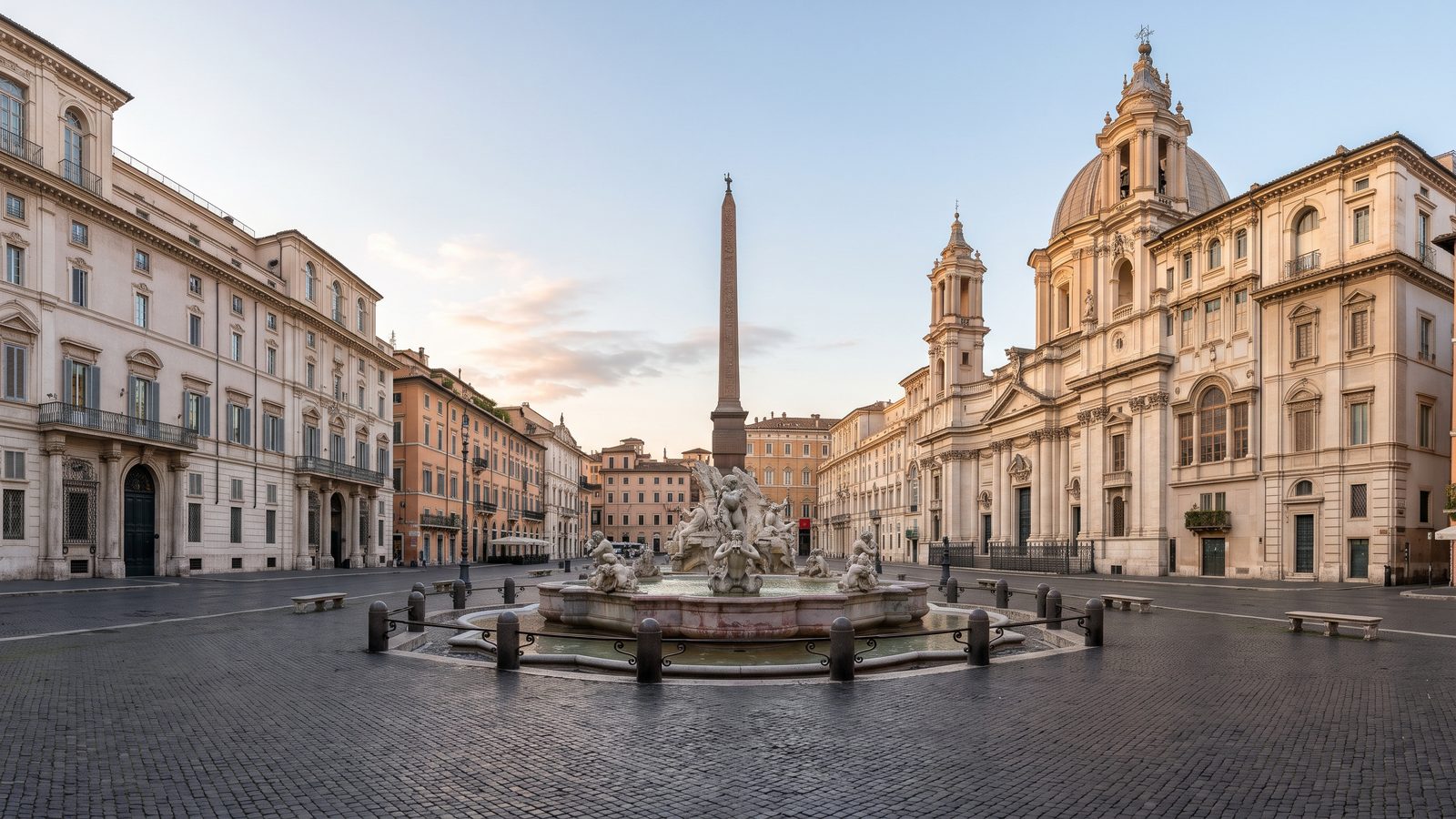
Step into Piazza Navona, one of Rome's most vibrant public spaces, where theatrical Baroque architecture meets ancient Roman history. Originally built as Emperor Domitian's 1st-century stadium, this unique oval square now serves as an open-air museum. As you walk past bustling cafes, street artists, and majestic fountains, you encounter the genius of Gian Lorenzo Bernini and Francesco Borromini, whose artistic rivalry transformed this ancient arena into a monumental masterpiece.
With this self-guided audio tour, you explore the piazza at your own pace. Discover the dramatic allegories carved into Bernini’s Fountain of Four Rivers, admire the concave facade of Sant'Agnese in Agone, and trace the evolution of Rome’s grandest Baroque gathering place.
Listen to a sample
The opening of this tour, exactly as AllTours narrates it on site.
What you'll hear on this tour
Stop 1. Bernini's Fountain of Four Rivers
You stand before Gian Lorenzo Bernini's undisputed masterpiece, the Fountain of Four Rivers, completed in 1651 for Pope Innocent X Pamphili. Carved primarily from travertine, this colossal fountain supports an authentic Egyptian obelisk brought from Maxentius's Circus. As you look closer, four marble river gods emerge, each representing a distinct continent: the Nile, Ganges, Danube, and La Plata. Water bursts forth beneath them as dynamic figures reach and recoil with typical Baroque energy. Notice the Nile god's veiled head—an allusion to its unknown source in antiquity, though Roman legend humorously suggests he shields his eyes from Borromini's nearby church facade.
Stop 2. From Roman Stadium to Baroque Stage
You trace the long evolution of Piazza Navona, beginning in 86 AD when Emperor Domitian constructs his massive Circus Agonalis here. Designed for athletic contests and chariot races, the ancient stadium accommodates roughly 30,000 spectators within its masonry elliptical structure. Centuries later, those ancient foundations dictate the elongated oval shape you see under your feet today. Under Pope Innocent X in the 17th century, the site undergoes a dramatic Baroque makeover, adding magnificent family palaces, churches, and fountains. Remarkably, for centuries this square serves as Rome's main market and hosts summer mock naval battles when flooded every August.
Stop 3. The Drama of Roman Baroque
As you wander through Piazza Navona, you experience a quintessential showcase of Roman Baroque design. Transformed during the 17th century under Pope Innocent X, this space reflects the Catholic Church's theatrical and emotive response to the Reformation. You feel the intense movement and emotional engagement built directly into the stone and marble surrounding you. Across from Bernini's energetic fountain stands Francesco Borromini's church of Sant'Agnese in Agone, featuring a captivating concave facade and dramatic dome. The dynamic interplay between Bernini's water features and Borromini's soaring architecture captures the grand theatricality, dramatic tension, and artistic rivalry that define this glorious era.
Stop 4. An Architectural Oval Homage
You observe how the piazza’s elongated oval shape meticulously preserves the exact footprint of Emperor Domitian’s 1st-century stadium. Dominating the center is Bernini’s travertine rock base and obelisk, while directly opposite stands Francesco Borromini’s Sant'Agnese in Agone. You admire Borromini’s iconic concave facade, flanked by twin bell towers and crowned by an imposing dome. This innovative architectural design stands in direct yet harmonious contrast to Bernini’s central fountain. Next to the church, you see the imposing Palazzo Pamphilj, designed by Girolamo Rainaldi for Pope Innocent X, which further defines the square’s monumental scale, ornate detailing, and grand Baroque envelope.
Stop 5. The Trio of Sculptural Fountains
You explore the three magnificent fountains that line the length of the piazza. At the center stands Bernini’s grand Fountain of Four Rivers with its Egyptian obelisk and marble river gods. To the south, you find the Fountain of the Moor, originally designed by Giacomo della Porta in 1575 and later enhanced by Bernini in 1653 with a central figure wrestling a dolphin. At the northern end rests the Fountain of Neptune, which also begins with Della Porta's 16th-century basin. You admire its 19th-century additions by Antonio della Bitta and Gregorio Zappalà, depicting Neptune battling an octopus among mythological Nereids.
Stop 6. Clash of the Masters
You witness one of art history's greatest rivalries playing out directly across this open-air gallery. Gian Lorenzo Bernini's Fountain of Four Rivers showcases four colossal river gods writhing around a central obelisk under the Pamphilj dove emblem. Directly facing it, Francesco Borromini's concave facade for Sant'Agnese in Agone creates an extraordinary stone dialogue, drawing your gaze upward toward its majestic dome. Framing both ends of the square are Giacomo della Porta's original 1570s basins, later completed with dynamic 19th-century sculptures. Together, these masterpieces showcase the pinnacle of High Baroque movement, drapery, and theatrical expression in marble and travertine.
Planning your visit
- Best time to go
- Early morning for quiet photos and fewer crowds, or late afternoon during golden hour when sunset illuminates the warm travertine and Baroque facades.
- Approximate duration
- about 45 minutes
- Where to start
- The center of Piazza Navona, directly in front of the Fountain of Four Rivers.
Access and conditions change seasonally — check the official site before you go.
Frequently asked questions
Is Piazza Navona worth visiting?
Yes, Piazza Navona is one of Rome's most famous public squares, renowned for its ancient Roman origins as Domitian's stadium, magnificent Baroque fountains by Bernini, stunning architecture by Borromini, and vibrant street life.
How long do you need at Piazza Navona?
Most visitors spend 30 to 60 minutes exploring the three fountains, admiring the architecture of Sant'Agnese in Agone, taking photos, and enjoying the lively atmosphere.
What was Piazza Navona's original purpose in ancient Rome?
Piazza Navona was originally Emperor Domitian's stadium built in 86 AD, known as the Circus Agonalis, which hosted athletic competitions and chariot races for around 30,000 spectators.
Keep exploring
Header image is an AI-generated illustration of Piazza Navona. AllTours.ai is an AI audio tour guide — point your camera at any landmark and hear its story.