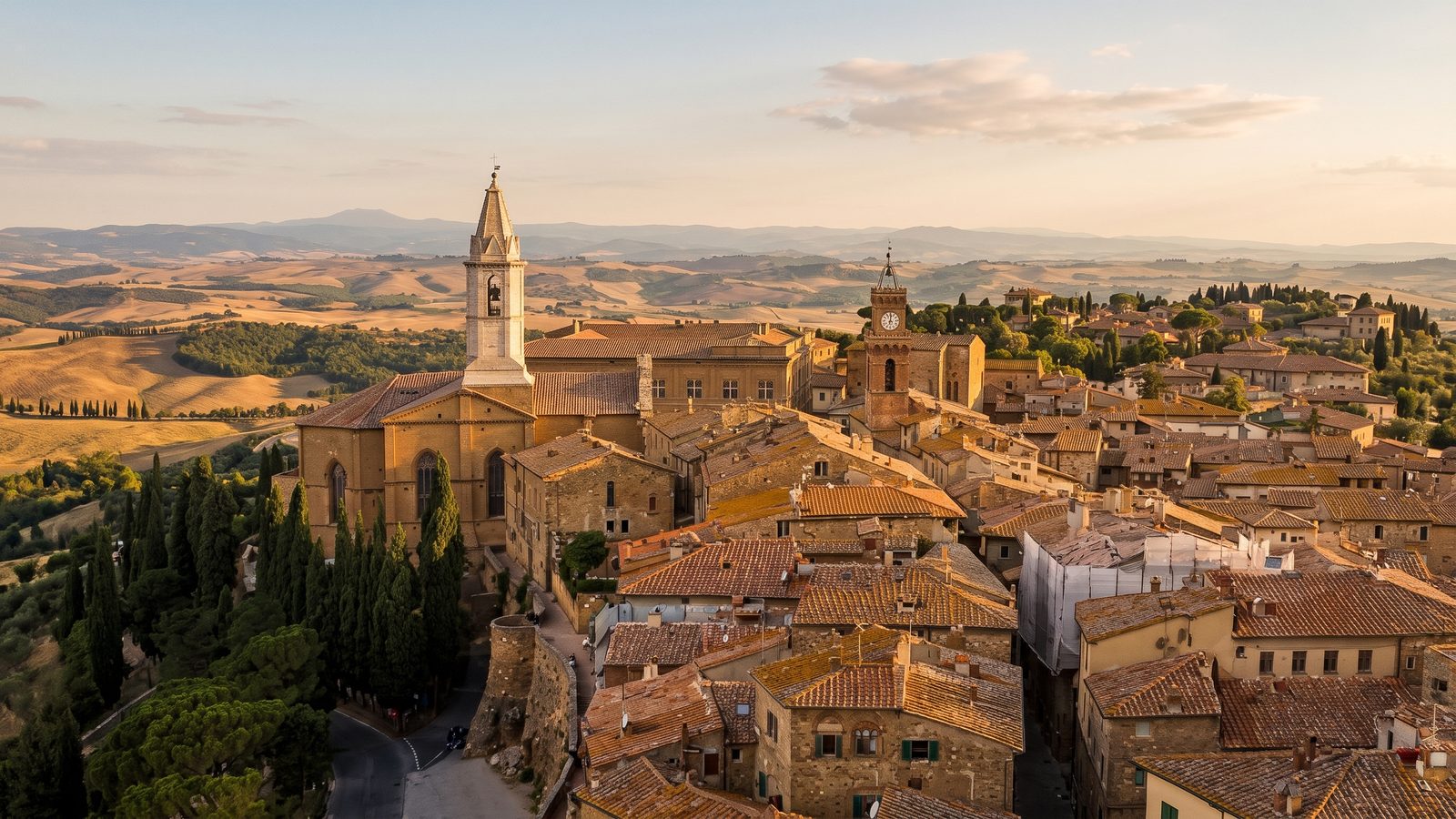
Welcome to Pienza, a stunning hilltop jewel in the heart of Tuscany renowned as the ideal Renaissance town. In the mid-15th century, Pope Pius II set out to transform his humble birthplace of Corsignano into a utopian masterpiece. Guided by the visionary architect Bernardo Rossellino, Pienza emerged as a living blueprint of Renaissance urban planning, seamlessly blending classical symmetry, humanistic philosophy, and breathtaking Tuscan landscapes.
As you walk through these preserved streets, you step into a carefully designed vision of civic harmony. From the grand architectural ensemble of Piazza Pio II to panoramic wall walks overlooking the Val d'Orcia, this tour reveals how a papal dream permanently redefined European urban design.
Listen to a sample
The opening of this tour, exactly as AllTours narrates it on site.
What you'll hear on this tour
Stop 1. The Papal Dream of Corsignano
You stand in a city born from a pope's grand ambition. Once the quiet medieval village of Corsignano, this humble Tuscan outpost sees its destiny irrevocably shift when native son Enea Silvio Piccolomini becomes Pope Pius II. Driven by humanistic ideals, he commissions architect Bernardo Rossellino to construct the first planned Renaissance town. Remarkably, between 1459 and 1462, workers erect the core cathedral, palace, and central piazza. A papal bull renames the town Pienza, or 'Pius's city.' When Pius dies in 1464, construction halts, unexpectedly preserving this pristine model of early Renaissance urbanism for you to explore today.
Stop 2. Harmonious Proportions of Piazza Pio II
Look around Piazza Pio II and observe the birth of a new architectural language. You see Bernardo Rossellino's masterwork unfold in subtle geometry. Notice the Duomo's balanced façade, where classical pilasters frame three majestic portals in perfect symmetry. Turn your gaze to Palazzo Piccolomini, inspired by Alberti’s Palazzo Rucellai in Florence, featuring three tiers of elegant loggias and ground-floor rustication. Even the piazza's unique trapezoidal layout is a deliberate trick of perspective, drawing your eye and unifying the surrounding structures. Across the square, the Palazzo Comunale echoes these grand proportions, creating an integrated stage of Renaissance design.
Stop 3. Sweeping Panoramas of Val d'Orcia
Step to the city walls and gaze out over the Val d'Orcia, a UNESCO World Heritage landscape sculpted by centuries of human harmony with nature. You watch rolling hills ripple across the horizon in shifting tones of emerald, gold, and ochre. Dark cypress trees stand like slender sentinels, marking ancient farmsteads and field boundaries against the wide Tuscan sky. In spring, bright red poppies blanket the slopes, while summer transforms the valley into a golden harvest. From this elevated vantage point, you witness how Pienza’s Renaissance planners intentionally framed these dramatic rural vistas to connect urban life directly with natural beauty.
Stop 4. Flavors of Pecorino and Tuscan Tradition
Inhale the rich aromas wafting from local shops as you explore Pienza’s celebrated culinary heritage. You are tasting the landscape itself through Pecorino di Pienza, a sheep's milk cheese infused with wild herbs from the surrounding pastures. Local cheesemakers age these wheels in diverse ways—wrapped in ash for earthy complexity, rubbed with tomato paste, or aged in rustic straw. Beyond cheese, sample the vibrant, peppery extra virgin olive oil pressed from ancient groves, or sit down to a plate of hand-rolled pici pasta served with rich ragù. Paired with savory Cinta Senese cured meats, every bite links you directly to regional traditions.
Stop 5. Humanism and the Pecorino Tradition
As you walk these historic streets, you feel a living culture where Renaissance humanism meets grounded agricultural roots. Pope Pius II envisioned more than stone buildings; he sought to cultivate an environment that elevated the human spirit and fostered civic harmony. Today, that philosophical vision thrives alongside deep-seated rural customs. You encounter this unique bond during events like the annual Sagra del Cacio, where locals gather to celebrate their prized Pecorino cheese. In every shop and public gathering, you witness a proud community keeping centuries of artisanal craftsmanship and shared heritage vibrantly alive.
Stop 6. Living in the Ideal City
Wander through the narrow stone lanes of the village, where every detail reflects a revolutionary urban vision. You notice how compact cobblestone paths suddenly open onto sweeping views of the valley, a deliberate design choice blending urban comfort with natural splendor. Warm travertine stone catches the light, giving the buildings a soft, inviting glow. Rossellino crafted every palace, house, and pathway to a comfortable human scale, promoting daily civic connection and peace of mind. Here, you do not simply visit a historical monument; you step directly into a living, breathing blueprint of an ideal Renaissance community.
Planning your visit
- Best time to go
- Spring or early autumn mornings for pleasant weather, bright landscapes, and clear lighting across the Val d'Orcia.
- Approximate duration
- About 1.5 to 2 hours
- Where to start
- Piazza Pio II, the central square of Pienza.
Access and conditions change seasonally — check the official site before you go.
Frequently asked questions
Is Pienza worth visiting?
Yes, Pienza is celebrated as a pristine example of early Renaissance urban planning, offering magnificent architecture, sweeping UNESCO-listed views over the Val d'Orcia, and world-renowned Pecorino cheese.
How long do you need at Pienza?
You typically need about 1.5 to 2 hours to tour the main sights, walk along the historic town walls, and taste local specialties.
Why was Pienza built and who designed it?
Pienza was transformed from the medieval village of Corsignano by Pope Pius II between 1459 and 1462. He hired Florentine architect Bernardo Rossellino to re-imagine his birthplace as an ideal Renaissance city.
Keep exploring
Header image is an AI-generated illustration of Pienza. AllTours.ai is an AI audio tour guide — point your camera at any landmark and hear its story.