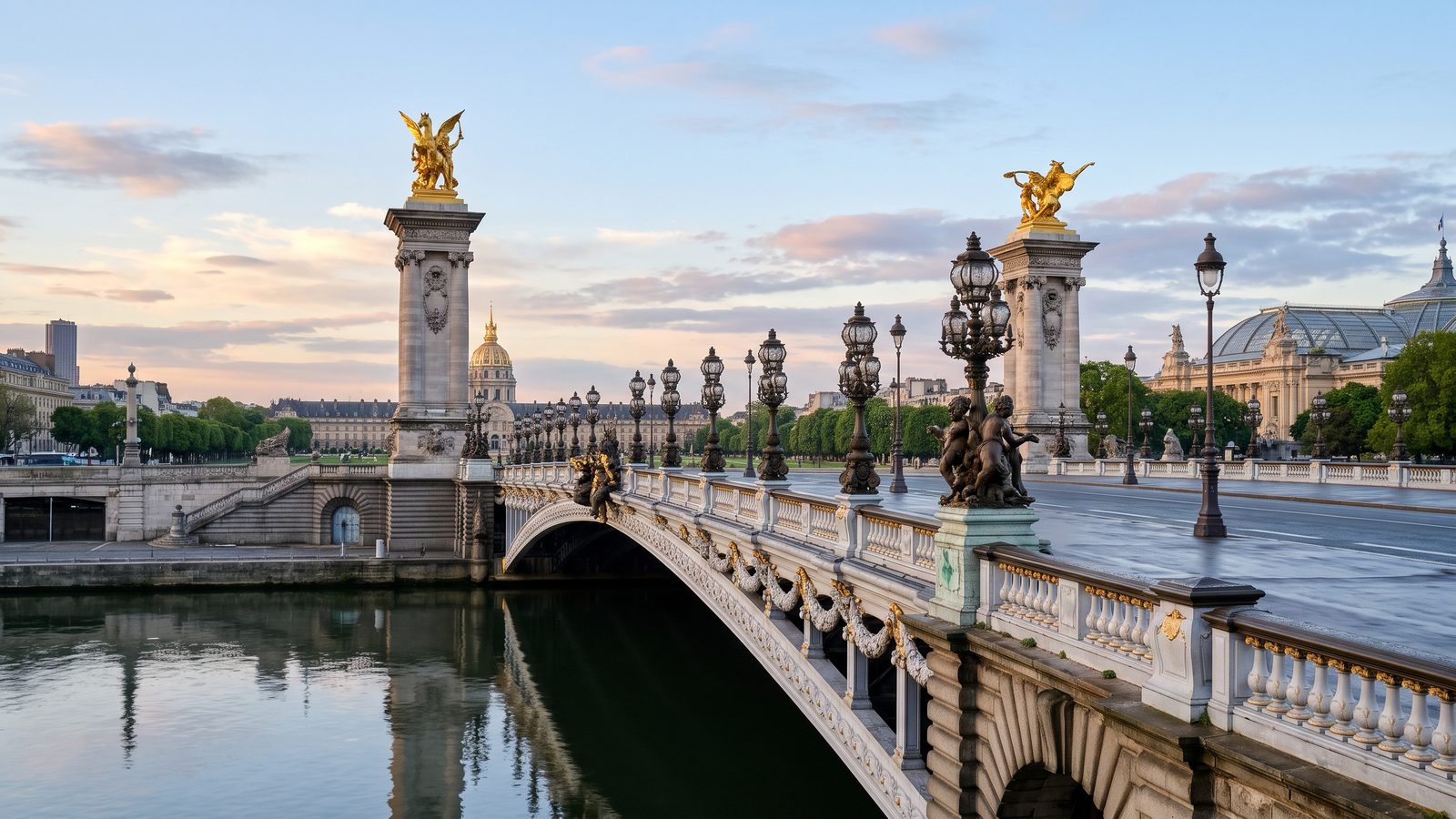
You are standing on Pont Alexandre III, widely celebrated as the most opulent bridge in Paris. Connecting the Champs-Élysées quarter with the Les Invalides complex, this Beaux-Arts triumph showcases breathtaking gilded sculptures, elaborate bronze streetlamps, and a sweeping single-span arch over the Seine. Built for the 1900 Universal Exposition, the bridge seamlessly combines innovative turn-of-the-century engineering with an artistic grandiosity that captures the vibrant spirit of Belle Époque Paris.
As you walk across its deck, you will discover allegorical statues, artistic details, and political symbols honoring diplomatic bonds. Prepare to explore the history, craft, and unforgettable photo perspectives of this open-air museum, taking in sweeping views across the historic riverfront of the French capital.
What you'll hear on this tour
Stop 1. Beaux-Arts Grandeur and Art Nouveau Touches
You stand amidst a quintessential masterpiece of Beaux-Arts architecture, lavishly adorned with nascent Art Nouveau flourishes. Notice how its single, remarkably shallow arch, a profound feat of nineteenth-century engineering, preserves the sweeping vistas of the Grand Palais and Les Invalides. Your gaze naturally ascends to the four monumental pylons, each standing thirty-two meters tall and crowned by magnificent gilded bronze Fames. These winged horses symbolize France's artistic, scientific, commercial, and industrial prowess. Along the balustrades, you discover a symphony of intricate details, including stone nymphs symbolizing the Franco-Russian alliance, complemented by elaborate candelabra twisting into delicate cherubs and marine motifs. Every detail reveals an era when architecture served as a canvas for national pride.
Stop 2. A Bridge Born of European Diplomacy
You stand upon a structure born from a pivotal moment in European diplomacy and Parisian ambition. This bridge serves as a tangible symbol of the Franco-Russian Alliance forged in the late nineteenth century between the French Third Republic and the Russian Empire. Named in honor of Tsar Alexander III, the bridge highlights a powerful political friendship. Imagine the grand scene in 1896 when Tsar Nicholas II personally laid the foundation stone right here along the Seine. Built for the 1900 Universal Exposition, engineers Jean Résal and Amédée Alby crafted this low-profile, single-span arch so it would not obstruct views of Les Invalides or the Grand Palais, creating a triumphant celebration of international cooperation and technology.
Stop 3. The Gilded Fames and Guardian Lions
You lift your eyes to the four monumental pylons anchoring the bridge at each corner, where you discover the magnificent gilded bronze Fames soaring over seventeen meters high. Crafted by master sculptors like Frémiet and Coutan, these allegorical figures represent France's flourishing Arts, Sciences, Commerce, and Industry, catching the Parisian light with breathtaking brilliance. At the base of these pylons, you encounter powerful stone lions sculpted by Gardet and Lenoir, serving as vigilant guardians of the Seine. As you look closely at the central arches, you discern bronze groups depicting the Genii of France and Russia holding their coats of arms, offering a profound reminder of the diplomatic bond underpinning this monumental structure.
Stop 4. An Open-Air Museum of Belle Époque Sculpture
Direct your gaze beyond the soaring Fames to the monumental allegorical groups adorning the base of each pylon, presenting a pantheon of French and Russian history in stone. On the right bank, you encounter France's rich past through the powerful figures of France in the Middle Ages and France in the Renaissance. Crossing to the left bank, you discover compelling representations of Russia, featuring Russia at Peace and Russia at War. Renowned sculptors of the Belle Époque crafted these distinct masterpieces, transforming the bridge into an outdoor museum. Even the bronze lampposts display exceptional artistry, with delicate putti holding garlands and mythical creatures intertwining, defining this bridge as a collaborative artistic triumph.
Stop 5. Capturing Light, Shadows, and Timeless Views
You find an unparalleled canvas for photography along Pont Alexandre III, requiring a keen eye for light and composition. During golden hour, the low sun bathes the structure in a warm glow, making the intricate bronze work pop against the sky. As twilight turns into blue hour, elegant illumination creates a striking contrast against deep indigo, perfect for long-exposure shots that transform the Seine into a silky reflective surface. You can frame the distant Eiffel Tower through one of the archways, leveraging the bridge's design to create a natural frame around Paris's iconic landmark. Whether capturing opulent backdrops or black-and-white architectural textures, endless dramatic compositions await your lens.
Stop 6. Engineering Genius Across the Seine
Let your gaze sweep across the bridge itself, a revolutionary feat of Belle Époque engineering. Designed with a single, graceful 107-meter steel arch, it ensures an unobstructed view between Les Invalides and the Champs-Élysées. Notice how the bridge stands barely six meters above the water; this deliberately low profile preserved grand Parisian perspectives while challenging its engineers. Every inch of its surface features Art Nouveau and Beaux-Arts ornamentation. You admire exquisite bronze candelabras sculpted with cherubs, sea monsters, and floral motifs. Upstream and downstream, sculpted relief nymphs represent the Seine and Neva rivers, while embedded coats of arms reinforce the deep diplomatic history woven into this functional gallery.
Planning your visit
- Best time to go
- Late afternoon through twilight (golden hour and blue hour) for optimal photography and light on the gilded statues.
- Approximate duration
- About 45 minutes
- Where to start
- Right Bank entrance of Pont Alexandre III, near the Grand Palais and Petit Palais.
Access and conditions change seasonally — check the official site before you go.
Frequently asked questions
Is Pont Alexandre III worth visiting?
Yes, Pont Alexandre III is widely considered the most ornate and picturesque bridge in Paris. It offers incredible views of the Eiffel Tower, Les Invalides, and the Seine, featuring magnificent Beaux-Arts architecture, gilded bronze statues, and historic decorative streetlamps.
How long do you need at Pont Alexandre III?
Most visitors spend 30 to 45 minutes walking across the bridge, taking photos, and admiring the detailed sculptures on the pylons and balustrades.
Why was Pont Alexandre III built?
The bridge was built to commemorate the Franco-Russian Alliance signed in the late 19th century and was inaugurated for the 1900 Universal Exposition. Tsar Nicholas II laid its foundation stone in 1896, and the bridge was named after his father, Tsar Alexander III.
Keep exploring
Header image is an AI-generated illustration of Pont Alexandre III. AllTours.ai is an AI audio tour guide — point your camera at any landmark and hear its story.