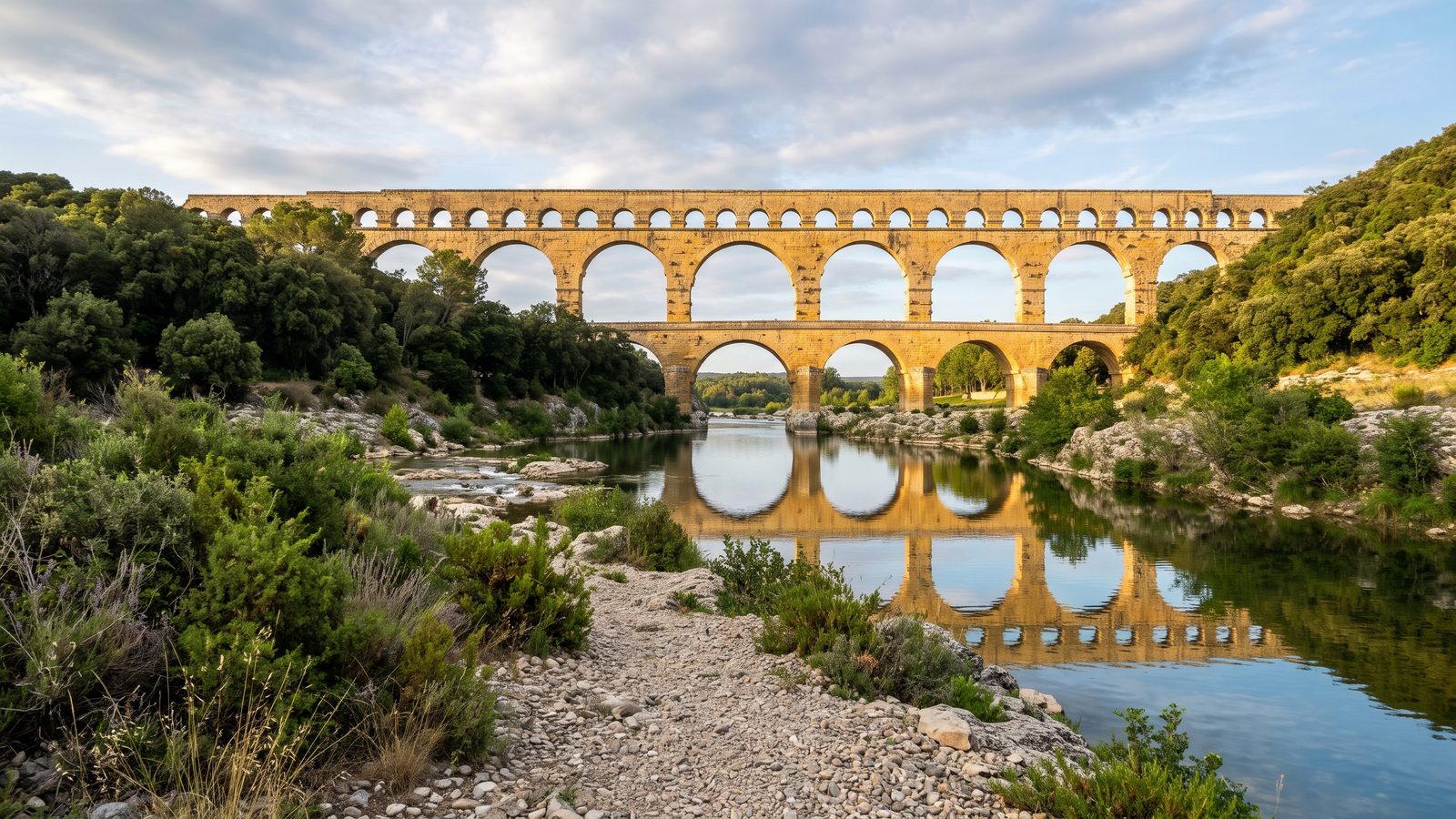
You stand before the Pont du Gard, an astounding masterpiece of ancient Roman engineering rising nearly forty-nine meters above the Gardon River. Built in the first century AD to carry fresh water to Nîmes, this monumental aqueduct spans two hundred seventy-five meters across the lush valley. As you gaze at its fifty-two massive arches, you feel an immediate connection to the sheer ambition and skill of a bygone empire.
This self-guided audio tour leads you along the riverbanks and limestone cliffs, revealing how Roman builders accomplished this mortarless feat. You will explore the history, artistic design, and surrounding natural beauty that make this ancient aqueduct one of the world's most enduring and impressive historical landmarks.
Listen to a sample
The opening of this tour, exactly as AllTours narrates it on site.
What you'll hear on this tour
Stop 1. Precision in Unmortared Stone
Look up at this towering three-tiered marvel and admire the pinnacle of Roman hydraulic engineering. You are observing a structure meticulously crafted to transport water over vast distances with incredible precision. Notice how the massive wedge-shaped stones, known as voussoirs, interlock perfectly without a single drop of mortar in the upper tier. Roman builders quarried, transported, and lifted these colossal multi-ton blocks using simple yet powerful machinery. The rhythmic repetition of the arches provides vital structural strength while creating a captivating visual cadence. You stand before a flowing stone sculpture that conquers nature with unmatched elegance and functional perfection.
Stop 2. Water for a Growing Empire
Step back over two thousand years into the reign of Emperor Augustus as you witness a defining moment of Roman ingenuity. Commencing around 40 AD, this monumental construction required roughly one thousand skilled workers who painstakingly quarried and moved massive stone blocks over vast distances. You are looking at the crown jewel of an ambitious fifty-kilometer aqueduct system built to supply fresh running water to the thriving city of Nîmes. As you examine these ancient stones, you see a testament to Rome's supreme mastery of hydraulic engineering and its steadfast commitment to public works that transformed ancient civilization across Gaul.
Stop 3. Rhythm and Form in Stone
As you gaze across the arcade, notice how Roman creators expertly blended pure function with refined artistic vision. You see a subtle curvature along the structure, a deliberate choice designed to enhance visual harmony and soften the immense scale of the stone tiers. Roman artists worked hand in hand with engineers to project an image of power, prosperity, and order across the Gallic landscape. Observe the precise spacing between each arch, which creates a rhythmic cadence akin to music or painting. You are experiencing a masterpiece where a sculptor’s sense of scale meets an artist’s eye for proportion and perfect balance.
Stop 4. Scents and Waters of the Gardon
Take a moment to look around the surrounding valley, where the Gardon River has carved steep limestone banks over millions of years. You feel a cool breeze drifting off the water as wild Mediterranean herbs like thyme and rosemary release their warm, fragrant oils into the air. Sunlight dances across the smooth, water-worn stones of the riverbed while a bright blue kingfisher flashes past clear currents. Notice how the ochre limestone of the ancient aqueduct blends naturally into the cliffs. You stand in the middle of a harmonious dialogue between human ingenuity and the vibrant Mediterranean wilderness.
Stop 5. The Flowing Heart of Roman Life
Imagine the daily lives of ancient inhabitants in Nîmes, whose town was transformed by the clean water flowing across this aqueduct. You are witnessing the infrastructure that brought public baths, surging fountains, and sophisticated sanitation to a Romanized society. Access to abundant fresh water fostered public health and urban sophistication on a scale previously unknown in the region. This monumental bridge served as a silent sentinel of imperial power, representing a commitment to communal well-being and refined living. As you walk near its shadow, you feel how this continuous current shaped a culture of hygiene, comfort, and order.
Stop 6. Unveiling the Forgotten Aqueduct
Consider how this ancient giant lay partially buried for centuries after the fall of Rome, its true purpose lost to time. You can imagine eighteenth-century scholars and archaeologists painstakingly clearing thick debris as local legends of ancient giants gave way to scientific exploration. As excavations gradually uncovered the elevated water channel, researchers realized this monument was a functional artery of water rather than merely a ceremonial bridge. Step by step, methodical investigations revealed the extraordinary engineering required to maintain a precise, gentle gradient across kilometers. You stand where generations of scholars solved an ancient mystery and restored a forgotten masterpiece to history.
Planning your visit
- Best time to go
- Early morning or late afternoon in spring and autumn offers warm light, pleasant walking temperatures, and fewer crowds along the river.
- Approximate duration
- About 2 hours
- Where to start
- Begin your tour near the visitor reception areas along either bank of the Gardon River.
Access and conditions change seasonally — check the official site before you go.
Frequently asked questions
Is Pont du Gard worth visiting?
Yes, Pont du Gard is widely considered a must-see landmark in France. As one of the best-preserved ancient Roman aqueduct bridges in the world, its towering three-tiered arches and river settings offer an unforgettable blend of history and scenery.
How long do you need at Pont du Gard?
Most visitors spend between 2 and 3 hours exploring the site. This provides enough time to walk along both riverbanks, admire the architecture from multiple angles, complete a self-guided audio tour, and visit the surrounding natural area.
Why was the Pont du Gard built?
The Pont du Gard was constructed in the 1st century AD under the Roman Empire to carry fresh water nearly 50 kilometers across the Gardon River valley to supply the Roman city of Nîmes.
Keep exploring
Header image is an AI-generated illustration of Pont du Gard. AllTours.ai is an AI audio tour guide — point your camera at any landmark and hear its story.