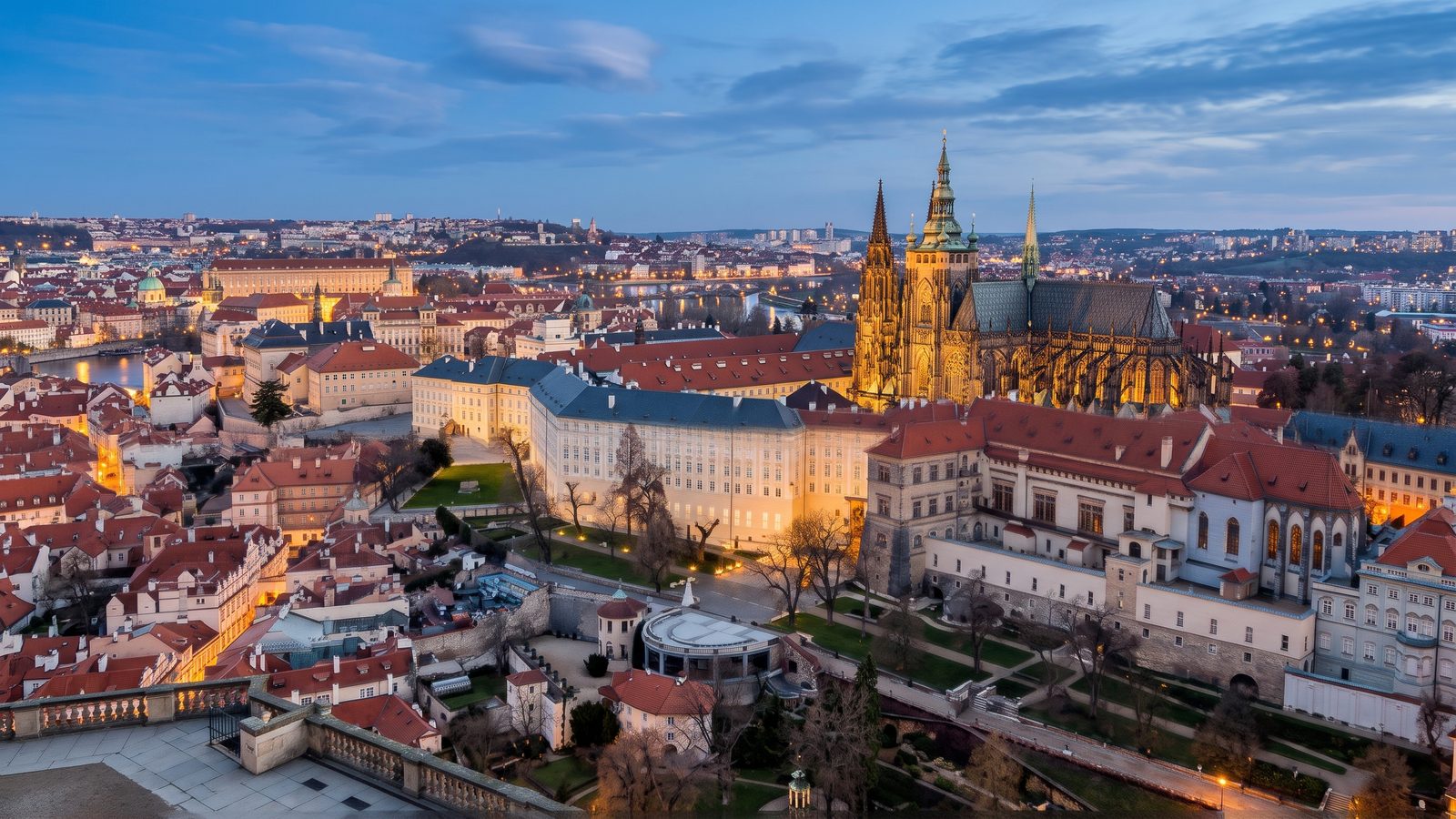
You stand before Prague Castle, a breathtaking fortress complex founded in the 9th century that has served as the beating heart of Czech history for over a millennium. As you walk through its sprawling grounds, you encounter a tapestry of architectural styles—from ancient Romanesque foundations to soaring Gothic spires and elegant Baroque facades. Once the seat of Bohemian kings and Holy Roman Emperors, it now hosts the Czech presidency.
This self-guided audio tour leads you through royal halls, sacred chapels, and panoramic viewpoints overlooking the Vltava River. Step past ancient castle gates to immerse yourself in centuries of faith, political power, alchemy, and artistic genius that have continuously shaped the vibrant cultural identity of Prague across the ages.
Listen to a sample
The opening of this tour, exactly as AllTours narrates it on site.
What you'll hear on this tour
Stop 1. The Soaring Gothic Spires of St. Vitus
You stand beneath the soaring spires of St. Vitus Cathedral, the spiritual heart of the Czech nation. Begun under King Charles IV in 1344, this Gothic masterpiece took nearly six centuries to complete, finally finishing in 1929. As you gaze up, observe the medieval flying buttresses that support its grand stone structure. Inside, you discover the hallowed St. Wenceslas Chapel, decorated with precious stones and frescoes honoring the patron saint. You admire the vibrant Art Nouveau stained-glass window designed by Alfons Mucha, contrasting with the medieval stone. Deep within a secret chamber rest the sacred Bohemian Crown Jewels, guarding the memory of royal coronations past.
Stop 2. Sweeping Vistas Over the City of Spires
You step out to the castle's elevated promenade to take in a breathtaking panorama of Prague. Below you, the silver ribbon of the Vltava River winds through the city, spanned by the statue-lined Charles Bridge. You gaze across a sea of terracotta rooftops toward the legendary 'thousand spires' rising from Lesser Town and Old Town Square. From this high vantage point, you easily imagine how medieval defenders once monitored approaching armies long before they reached the gates. Kings and emperors surveyed their domain from this exact vantage point, and today you share their unobstructed view across Bohemia's historical and cultural capital.
Stop 3. A Living Textbook of European Architecture
As you walk through the complex, you explore a living textbook of European architectural styles spanning a thousand years. You marvel at the late Gothic Vladislav Hall in the Old Royal Palace, where fluid, ribbed vaulting arches daringly overhead, foreshadowing Renaissance design. Nearby, you observe the stark, powerful Romanesque lines and twin white towers of St. George's Basilica, standing in bold contrast to the later Baroque flourishes of the Riding School. High above, delicate stone tracery decorates the cathedral's rose window, while flying buttresses allow kaleidoscopic light to flood through massive stained-glass panels. Every courtyard showcases how successive eras layered their aesthetic onto this ancient fortress.
Stop 4. Millennium of Kings, Emperors, and Alchemists
You trace a millennium of political power, beginning in the 9th century when Prince Bořivoj built a fortified wooden settlement here. You see how stone churches arose during the Romanesque period, followed by grand Gothic expansions under Charles IV when Prague became the seat of the Holy Roman Empire. You walk the grounds where Jagiellonian monarchs rebuilt after the Hussite Wars, and where Habsburg Emperor Rudolf II gathered alchemists, astronomers, and artists during a vibrant Renaissance court. Finally, you view the cohesive Baroque facade created under Empress Maria Theresa in the 18th century, unifying centuries of royal ambition into the stately palace complex you explore today.
Stop 5. The Crucible of Bohemian Renaissance and Faith
You feel the cultural pulse of Bohemia resonating through these historic courtyards. During the late 16th century, Emperor Rudolf II transforms the castle into a vibrant hub of science and art, attracting astronomers Tycho Brahe and Johannes Kepler alongside painter Giuseppe Arcimboldo. You realize this court was not merely a seat of government, but a thriving center for alchemy, philosophy, and creative expression. Today, that artistic legacy lives on through state ceremonies, art exhibitions, and musical performances held within the palace walls. As you explore, you see how Czech national identity and spiritual faith remain deeply intertwined with this enduring cultural beacon.
Planning your visit
- Best time to go
- Early morning at 8:00 AM before crowds arrive, or late afternoon for golden hour light over the city.
- Approximate duration
- about 2 to 3 hours
- Where to start
- The First Courtyard near the main western entrance at Hradčanské náměstí.
Access and conditions change seasonally — check the official site before you go.
Frequently asked questions
Is Prague Castle worth visiting?
Yes, Prague Castle is definitely worth visiting as the world's largest ancient castle complex and a UNESCO World Heritage site. It houses iconic landmarks like St. Vitus Cathedral, historic royal palaces, and offers unmatched panoramic views over Prague.
How long do you need at Prague Castle?
Most visitors spend between 2 to 4 hours exploring the castle complex, including St. Vitus Cathedral, the Old Royal Palace, St. George's Basilica, and the surrounding gardens.
When was Prague Castle built and who founded it?
Prague Castle was founded in the late 9th century (around 880 AD) by Prince Bořivoj of the Přemyslid dynasty, evolving over a thousand years from a wooden fortress into a grand palace complex.
Keep exploring
Header image is an AI-generated illustration of Prague Castle. AllTours.ai is an AI audio tour guide — point your camera at any landmark and hear its story.