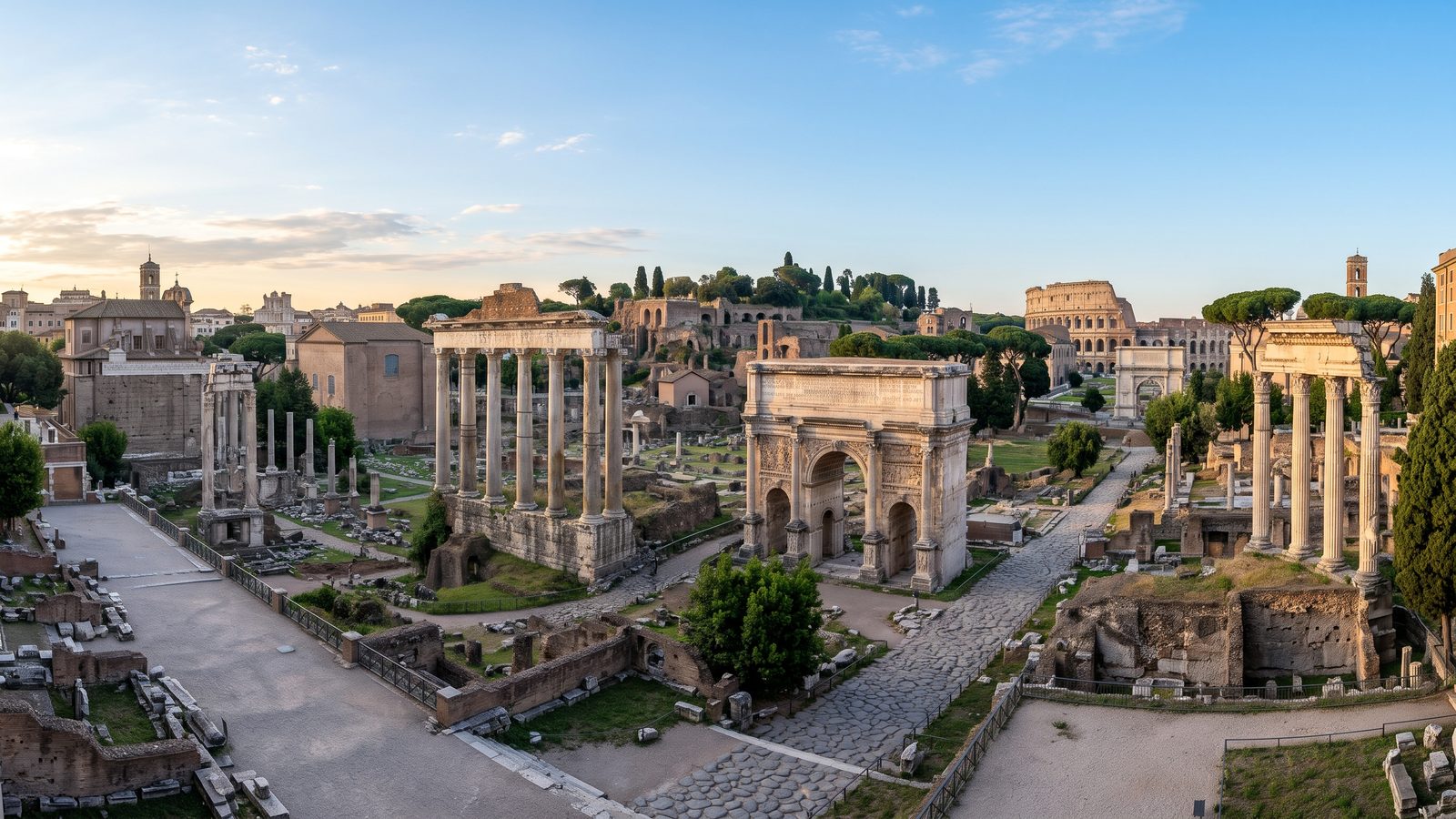
Step into the sprawling heart of ancient Rome, where a humble 500 BC marketplace evolved into the center of a mighty empire. As you walk among ancient stones, you tread the same paths where senators debated, citizens gambled, and emperors showcased their power. This self-guided audio tour leads you through towering temples, historic basilicas, and grand arches that once anchored public life in classical antiquity.
From the Republican era through the height of the Roman Empire, the Forum served as the city's political, judicial, and religious core. With this immersive guide, you will uncover legendary origins, architectural breakthroughs, and the vibrant daily rhythms that shaped Western civilization in the heart of Lazio, Italy.
Listen to a sample
The opening of this tour, exactly as AllTours narrates it on site.
What you'll hear on this tour
Stop 1. Echoes of Daily Roman Life
You stand in the vibrant heart of Rome, where ordinary citizens once mingle with senators and merchants. Look toward the Rostra, where you can picture crowds gathering to hear Cicero’s powerful orations or listen to new imperial decrees. Nearby, within the Basilica Julia, lawyers argue high-stakes cases while citizens roll dice on the outer steps. Across the square, the Basilica Aemilia hums with shopkeepers and money changers operating beneath market frescoes. Vendors hawking spices and bread share the pavement with Vestal Virgins maintaining sacred flames. Here, politics, justice, and trade play out daily beneath your feet from dawn until dusk.
Stop 2. Monuments to Imperial Power
You walk through a landscape transformed by emperors who turned civic grounds into monuments of total power. See the Temple of Divus Julius, dedicated in 29 BC by Augustus to honor his deified adoptive father, establishing the imperial cult. Nearby, you observe the Curia Julia Senate House and the Basilica Julia, both completed under Augustus to cement his authority. Continuing through the Forum, you encounter the Temple of Antoninus and Faustina, built from Proconnesian marble in 141 AD for an emperor and his divine wife. Finally, you marvel at the Arch of Septimius Severus, erected in 203 AD, whose carved panels proclaim Parthian victories across a vast empire.
Stop 3. Myths Etched in Marble
As you explore deeper, ancient myths intertwine with historic marble beneath your feet. Near the Comitium, you find the Lapis Niger, a sacred black marble pavement believed to cover Romulus’s tomb or his place of ascension. Nearby lies the Lacus Curtius, commemorating Marcus Curtius, who leaped into a mysterious chasm on horseback to save Rome through his pure valor. Overlooking the sacred Spring of Juturna, you behold the Temple of Castor and Pollux. Legend tells us the divine twin gods aided the Romans at the Battle of Lake Regillus in 496 BC, watering their steeds right here before announcing a miraculous military victory.
Stop 4. Masterpieces of Roman Engineering
Look closely at the colossal scale around you, made possible through Roman engineering and innovative materials. You admire the structural core of opus caementicium, or Roman concrete, which enabled builders to create massive, durable monuments faced with fine marble or brickwork. Consider the Basilica of Maxentius and Constantine, completed around 312 AD, whose vaulted ceilings once formed the largest covered space in Rome. Nearby, you gaze up at the surviving Corinthian columns of the Temple of Castor and Pollux, featuring intricate acanthus leaf capitals. From rugged travertine blocks to marble veneers, you observe a masterclass in structural ingenuity spanning centuries of evolving design.
Stop 5. Unearthing the Lost Forum
You gaze across ruins that owe their revival to centuries of meticulous archaeological excavation. Picture early 19th-century pioneers like Carlo Fea clearing thick debris around the Arch of Septimius Severus. Later, in 1898, Giacomo Boni revolutionizes the site using careful stratigraphy, stripping away meters of soil to reveal hidden historical layers. You see the fruits of his work in the uncovered Lapis Niger and the painstakingly reconstructed House of the Vestals. Archaeologists analyze volcanic tuff, imported marble, and brick stamps to date each stone accurately. Today, as you tread these ancient paths, ongoing conservation protects this urban heart for future generations.
Stop 6. Rise and Fall of the Civic Center
You trace thousands of years of transformation starting in the 7th century BCE, when the Cloaca Maxima drain converted a swamp into usable land. Walk past early Republican landmarks like the Temple of Saturn, built in 497 BCE to hold the treasury, and the historic Rostra speakers' platform where Cicero addresses citizens. You notice how Augustan renovations create Imperial splendor, capped by the Arch of Septimius Severus in 203 CE and the Column of Phocas in 608 CE. After centuries of decline and marble quarrying, the site turns into a field called Campo Vaccino before 19th-century digs restore its former glory.
Planning your visit
- Best time to go
- Early morning or late afternoon to avoid peak daytime heat and crowds.
- Approximate duration
- about 1.5 to 2 hours
- Where to start
- Enter at the main entrance along Via dei Fori Imperiali or near the Arch of Titus.
Access and conditions change seasonally — check the official site before you go.
Frequently asked questions
Is the Roman Forum worth visiting?
Yes, the Roman Forum is essential for anyone visiting Rome. It offers a direct connection to the political, religious, and daily life of ancient Rome, featuring landmark structures like the Temple of Saturn and the Arch of Septimius Severus.
How long do you need at the Roman Forum?
Most visitors spend between 1.5 and 2 hours exploring the ruins and listening to audio narration to fully appreciate its history and architecture.
What was the Roman Forum originally before it was built?
Before development began in the 6th and 7th centuries BCE, the Forum area was a marshy valley. It was transformed into usable land following the construction of the Cloaca Maxima drainage system.
Keep exploring
Header image is an AI-generated illustration of Roman Forum. AllTours.ai is an AI audio tour guide — point your camera at any landmark and hear its story.