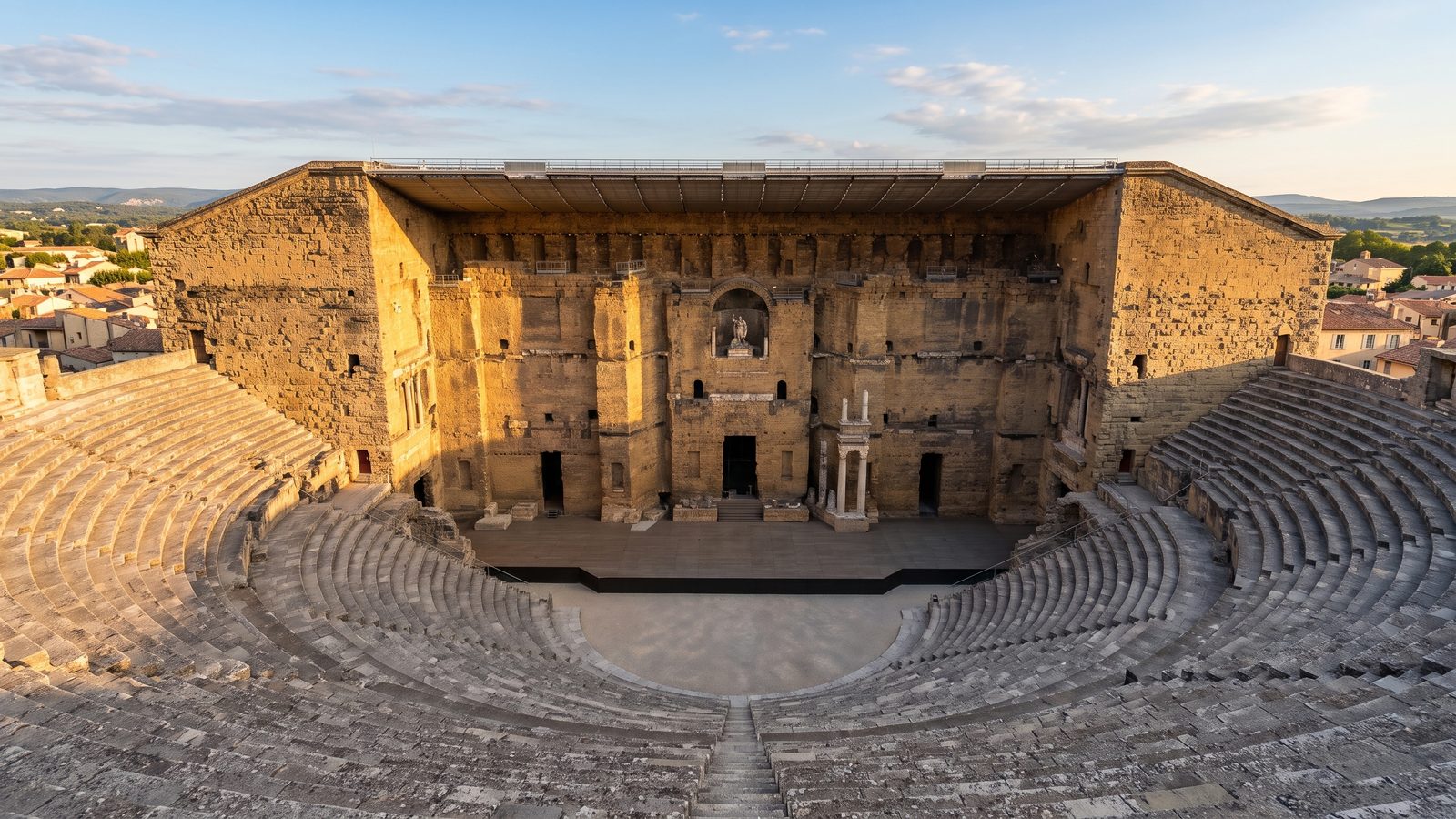
Welcome to the Roman Theatre of Orange, built in the first century CE under Emperor Augustus. Standing in Provence, this ancient site is world-renowned for its remarkably preserved 103-meter-wide exterior stage wall. As you step into this towering stone auditorium, you enter an ancient epicenter of entertainment where Roman dramatic traditions, imperial grandiosity, and local Gallic customs merged into an extraordinary cultural spectacle.
Walk along the steep stone tiers and gaze across the sweeping semi-circular auditorium toward the monumental stage wall. Discover how Roman master engineers engineered natural acoustics to carry an actor's voice effortlessly to thousands of eager spectators, creating a timeless architectural icon.
Listen to a sample
The opening of this tour, exactly as AllTours narrates it on site.
What you'll hear on this tour
Stop 1. Imperial Ambition in Roman Gaul
As you stand here, you gaze into the heart of Roman Gaul's grandest entertainment venue. Commissioned by Emperor Augustus in the first century AD, this theatre seated up to 9,000 spectators for dramatic performances and public spectacles. You witness a remarkable engineering feat, where stones were quarried, transported, and laid to project imperial power and Roman cultural values across newly conquered lands. It served as a vital tool of Romanization, embedding Roman identity into the region. Imagine the roars of the crowd and impassioned actors performing under the watchful gaze of an empire at its peak, creating a vibrant center of ancient civic life.
Stop 2. The Monumental Three-Story Stage Wall
Look closely at the monumental stage wall, the scaenae frons, a magnificent three-story structure rising high before you. You notice three deep niches that once held colossal statues, alongside precise masonry that originally featured glowing marble cladding and gilded bronze. Examine the central projecting pulpitum, designed to amplify actors' voices across the bowl. Flanking the stage are the parodoi, vaulted passageways providing dramatic entrances for performers. Every carefully fitted stone block reveals the mastery of Roman masonry, combining sweeping visual grandeur with practical theatrical design to create an astonishing venue for ancient storytelling.
Stop 3. Engineering the Pure Science of Sound
Shift your position slightly and listen to how sound travels across the auditorium. You notice how the precise curve of the stone seating tiers acts as a natural acoustic amplifier. Roman engineers mastered sound design by calculating auditorium curvature, stage slope, and using porous stone to absorb unwanted echoes. As you stand here, imagine a single unamplified actor speaking on stage while their voice reaches the very top row with crystal clarity. Without modern technology, this incredible structure relies purely on the physics of geometry and stonework, transforming the space into a self-contained acoustic instrument designed for perfect auditory immersion.
Stop 4. Spectacles of Gods and Mortals
Step into the shoes of an ancient spectator and feel the lingering energy of thousands of past performances. You stand where citizens from all walks of life gathered to watch tragic dramas, comedies, and grand public spectacles. Picture masked actors in vibrant costumes reciting lines that echoed across the vast stone seating. Scenery shifts, animal acts, and oil lamps enriched the atmosphere, drawing the crowd into dramatic tales of love, war, and mythology. As you explore the theatre, you feel how art and civic life intertwined here, leaving an enduring legacy of shared human emotion etched into the surrounding stones.
Stop 5. Where Gallic and Roman Worlds Met
Look out across the expansive seating area and reflect on how local and Roman traditions fused together. This theatre served as a cultural bridge where Greek tragedies and Roman literary classics reached diverse audiences across Gaul. You stand in a space that introduced myths and theatrical arts far beyond elite circles in Rome, fostering a shared sense of community. Imagine performances tailored with local accents or Druidic references to deeply resonate with native spectators. You are experiencing a vibrant, hybrid culture that transformed entertainment into a unifying force across the region, forging connections that lasted for generations.
Stop 6. Guarding Ancient Stones Against Time
Examine the careful stonework surrounding you to discover modern conservation in action. You see specialized mortar between ancient blocks, deliberately engineered to be softer than Roman stone so it yields during seismic activity without damaging the original fabric. Restorers work tirelessly to remove creeping mosses and lichens whose roots erode the sandstone. Look closely at the upper tiers, where subtle structural supports stabilize fragile sections without altering the ruin's historic appearance. You witness an ongoing scientific effort to protect this magnificent monument against environmental decay, ensuring its monumental walls remain standing for future generations.
Planning your visit
- Best time to go
- Morning or late afternoon to avoid peak sun and capture golden light on the stage wall.
- Approximate duration
- About 1 to 1.5 hours
- Where to start
- Inside the main entry gate facing the semi-circular stone seating.
Access and conditions change seasonally — check the official site before you go.
Frequently asked questions
Is the Roman Theatre of Orange worth visiting?
Yes, it is widely considered one of the best-preserved Roman theatres in Europe, famous for its towering 37-meter-high stage wall and remarkable ancient acoustics.
How long do you need at the Roman Theatre of Orange?
Most visitors need about 1 to 1.5 hours to tour the seating tiers, admire the monumental stage wall, and explore the acoustic design.
When was the Roman Theatre of Orange built?
The theatre was constructed in the 1st century CE under the reign of Emperor Augustus as an entertainment venue seating up to 9,000 spectators.
Keep exploring
Header image is an AI-generated illustration of Roman Theatre of Orange. AllTours.ai is an AI audio tour guide — point your camera at any landmark and hear its story.