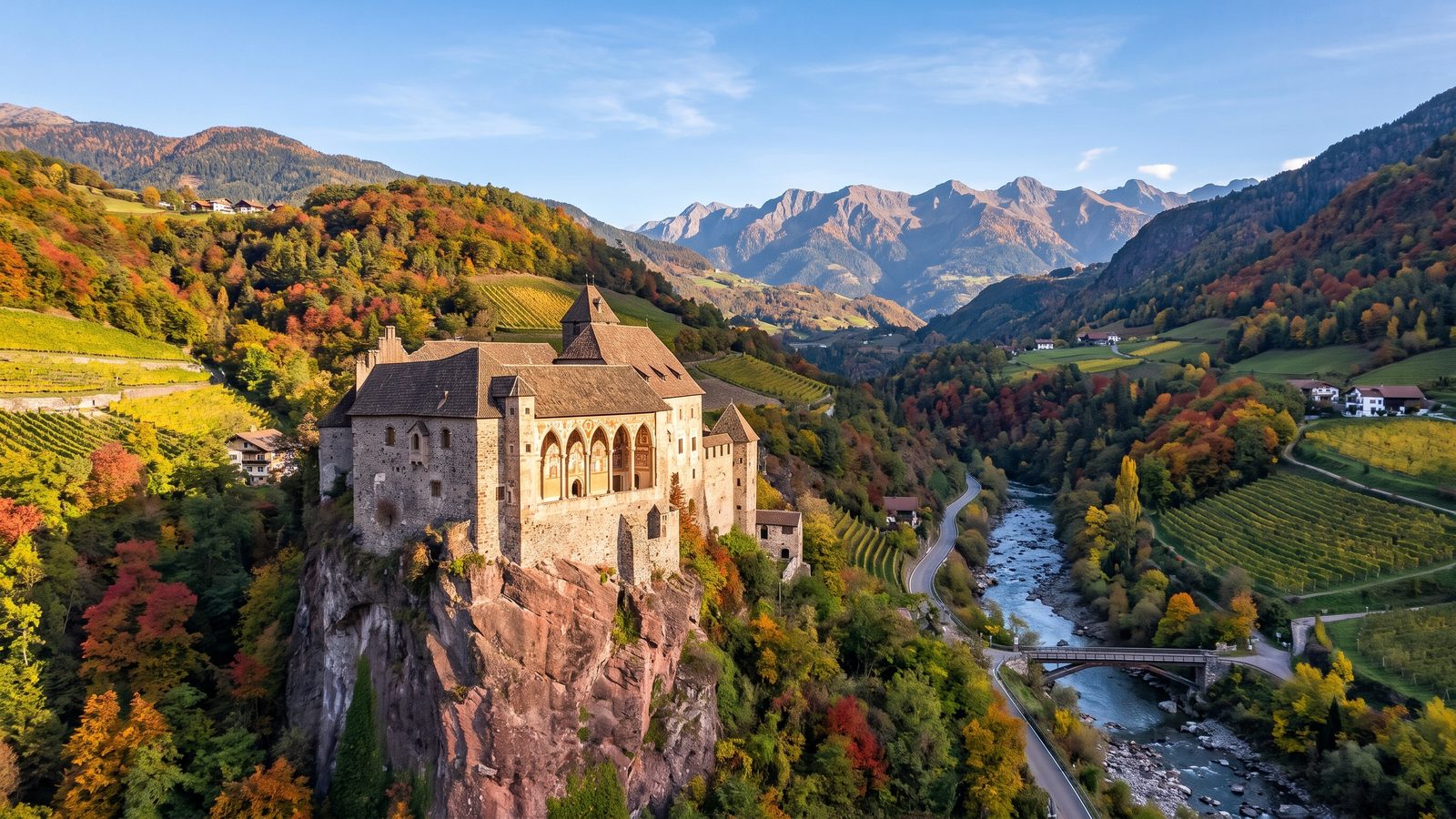
Welcome to Runkelstein Castle, South Tyrol's famed 'Picture Book Castle' perched dramatically on a porphyry rock high above Bolzano. Founded in the 13th century to guard the entrance to the Sarntal valley, this extraordinary fortress holds Europe's largest preserved cycle of medieval secular frescoes. As you walk through its ancient halls, you step directly into a vibrant world of courtly romance, knightly jousts, and timeless literary legends.
With this self-guided audio tour, you explore how wealthy medieval families transformed a rugged military stronghold into a refined residential retreat. From its architectural evolution and historical dramas to breathtaking alpine views, prepare to experience the vibrant romance and culture of the Middle Ages around every corner.
Listen to a sample
The opening of this tour, exactly as AllTours narrates it on site.
What you'll hear on this tour
Stop 1. The Extraordinary Secular Fresco Cycle
As you step inside, you immediately discover why Runkelstein is celebrated as the 'Picture Book Castle.' Before you stretches the world's most extensive collection of secular medieval frescoes. Painted in the 14th century, these vibrant murals adorn the walls with intimate scenes of courtly life, chivalric jousting tournaments, and legendary tales like Tristan and Isolde. Unlike typical religious art of the era, these murals capture the romance, fashion, and pastime of medieval nobility. As you admire these ancient brushstrokes, you gain a rare, personal window into aristocratic culture, where heroic literature and courtly elegance come alive directly upon the castle's stone walls.
Stop 2. Centuries of Destruction and Renaissance
You stand in a stronghold whose story begins in 1237, when the Lords of Wangen first constructed these fortified walls above the valley. Over the centuries, ownership passed to the wealthy Lords of Völs, who commissioned the breathtaking frescoes you admire today. History was not always kind to the fortress; a devastating 16th-century gunpowder explosion reduced large portions of the castle to ruins. Yet, its story did not end in ashes. In the 19th century, Archduke Johann of Austria spearheaded a meticulous restoration, rescuing the fortress from decay and ensuring that its medieval splendor endures for your visit today.
Stop 3. From Fortified Fortress to Refined Residence
Look closely at the castle's structural fabric to trace its fascinating architectural journey. You can clearly discern the original 13th-century Romanesque core in the thick, unadorned stone walls designed purely for medieval defense. However, as you look toward the Summer House, you notice dramatic 14th-century transformations added by the Vintler family. They introduced elegant Gothic windows and a distinctive open arcaded loggia, softening the fortress's harsh military appearance. This graceful blend of Romanesque strength and Gothic refinement reveals how medieval builders adapted a harsh fortress into a comfortable aristocratic home.
Stop 4. Panoramas Across the Sarntal Valley
Gaze out now at the breathtaking panorama unfolding all around you. Below your feet, the Talfer River carves its ancient path through the valley, acting as a vibrant lifeblood for the lush green vineyards clinging to the sun-drenched terraced slopes. Down in the basin, you can see the city of Bolzano nestled peacefully, framed by the towering, rugged peaks of the Sarntal Alps. This dramatic landscape provided not only magnificent scenery for castle residents, but also a formidable natural moat and barrier that reinforced the fortress's imposing man-made defenses against potential invaders.
Stop 5. Life Along the Porphyry Cliffs
Take a deep breath and feel the crisp mountain air, fragrant with the scent of pine and larch trees drifting down from surrounding slopes. Deep below you, the ceaseless murmur of the Talfer River provides a soothing, natural symphony that has echoed against these cliffs for centuries. Notice how the castle sits dramatically atop a precipitous outcrop of reddish porphyry rock. Looking closely at the sun-drenched ledges, you see resilient alpine plants like stonecrop clinging to the rugged stone, proving that vibrant life continually thrives even amidst this formidable, rocky terrain.
Stop 6. Sentinels of the Southern Alps
Lift your eyes now to the towering mountain peaks that surround Runkelstein Castle on all sides. These majestic sentinels belong to the Southern Limestone Alps and play a vital role in the castle's existence. Beyond framing a spectacular view, their steep, densely forested slopes provided crucial strategic protection against enemies and supplied essential timber and resources for castle inhabitants throughout the centuries. Standing here, you feel the ancient power of these mountains, acting as silent partners in every medieval drama that unfolded within these stone walls.
Planning your visit
- Best time to go
- Morning or early afternoon on a clear day for optimal light on the frescoes and alpine valley.
- Approximate duration
- about 1.5 hours
- Where to start
- At the castle entrance courtyard at the top of the porphyry rock access path.
Access and conditions change seasonally — check the official site before you go.
Frequently asked questions
Is Runkelstein Castle worth visiting?
Yes, Runkelstein Castle is world-famous for housing the largest and best-preserved collection of secular medieval frescoes, offering an unprecedented glimpse into courtly life, tournaments, and romance.
How long do you need at Runkelstein Castle?
Most visitors spend about 1 to 1.5 hours exploring the frescoed interior rooms, the Summer House loggia, and the scenic courtyard views.
Who built Runkelstein Castle and when?
The castle was originally built around 1237 by the Lords of Wangen and was later expanded by the Völs and Vintler families, who added its famous frescoes.
Keep exploring
Header image is an AI-generated illustration of Runkelstein Castle. AllTours.ai is an AI audio tour guide — point your camera at any landmark and hear its story.