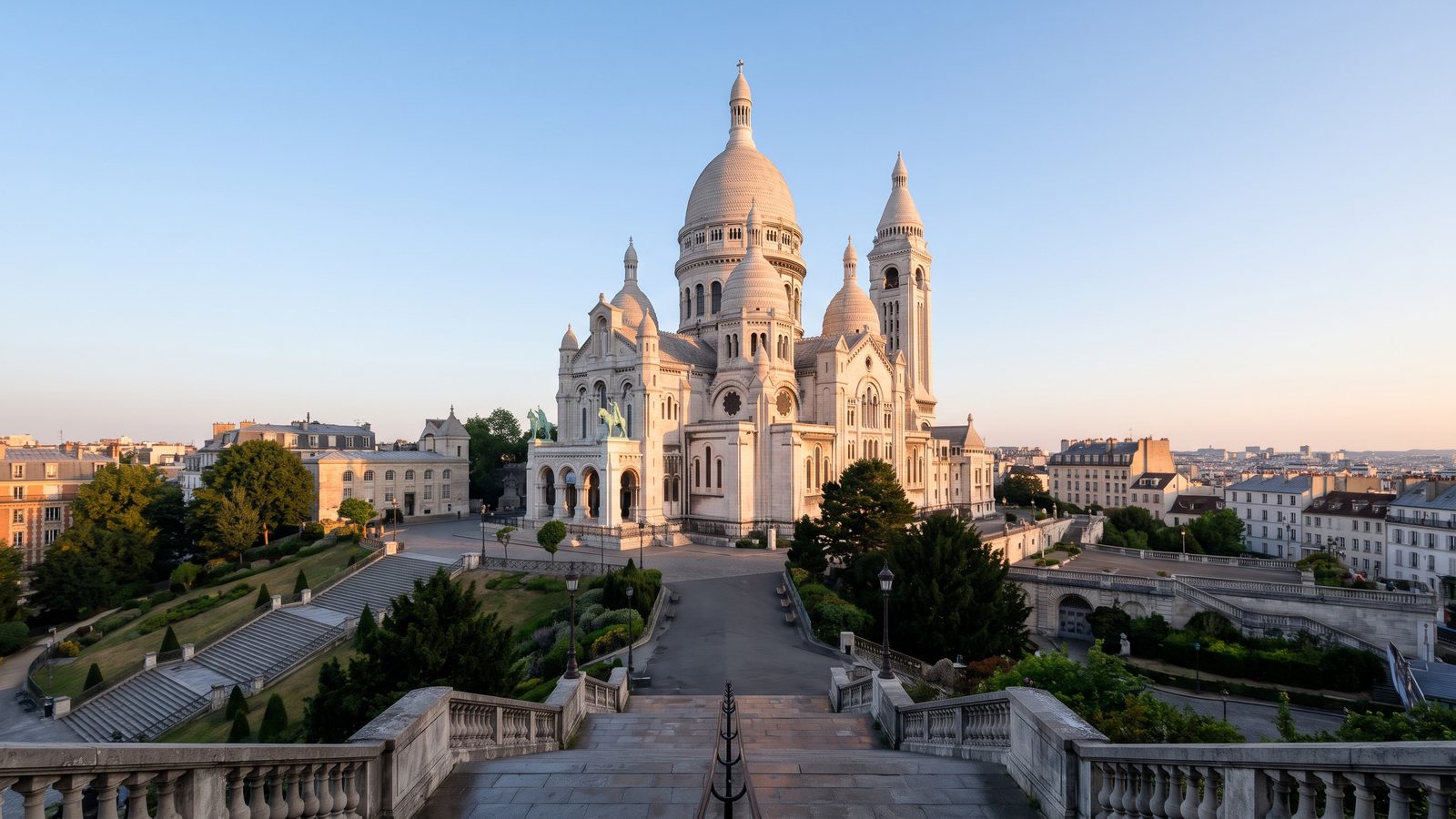
Perched high atop the historic hill of Montmartre, Sacré-Cœur Basilica stands as one of Paris's most distinctive and luminous landmarks. Conceived in the late nineteenth century following national hardship, its brilliant white domes crown the city's highest natural point. Beyond its striking Romanesque-Byzantine architectural design and grand mosaic interior, the basilica anchors a vibrant neighborhood steeped in bohemian artistic legacy and continuous spiritual devotion.
This self-guided audio tour leads you through the history, artistic details, and cultural life surrounding Sacré-Cœur. As you climb the slopes of Montmartre, you will uncover the stories behind its unique travertine stone, monumental apse mosaic, and breathtaking panoramic views overlooking the rooftops of Paris.
What you'll hear on this tour
Stop 1. Born from War and National Vow
You stand atop Montmartre, a hill steeped in memories of national trauma and spiritual resolve. The basilica's origins trace back to the devastating Franco-Prussian War and the turmoil of the Paris Commune. Seeking spiritual renewal, Alexandre Legentil and Hubert Rohault de Fleury make a national vow to build a church dedicated to the Sacred Heart of Jesus. Funded entirely by public subscription, construction begins in 1875 under architect Paul Abadie. Amid political controversy between conservative Catholics and secular republicans, the building process moves forward slowly across decades. Consecration finally takes place in 1919 after the conclusion of World War I, sealing a powerful monument of penance.
Stop 2. The Travertine Marvel of Montmartre
You gaze up at a striking Romanesque-Byzantine design, chosen by architect Paul Abadie to evoke early Christian basilicas rather than traditional Gothic spires. The edifice sparkles in white because it is crafted from Château-Landon travertine. This special stone leaches calcite whenever rain falls, naturally bleaching and preserving its brilliant façade against urban pollution. A massive central dome rises above you, framed by four smaller cupolas that highlight its eastern inspiration. The building layout forms a Greek cross, creating a sense of monumental balance and strength. Step inside, where grand arches and robust columns guide your eye toward the soaring apse, anchoring the structure's impressive spiritual presence.
Stop 3. A Masterpiece of Glass and Stone
Inside the basilica, you encounter an artistic feat of monumental scale. Above you spans the grand apse mosaic, covering 475 square meters as one of the largest in the world. Designed by Luc-Olivier Merson and crafted by skilled artisans, millions of glass tesserae capture the surrounding light, casting an ethereal glow across the sanctuary. You observe rich colors and intricate details depicting Christ in Majesty revealing His Sacred Heart. Beyond the ceiling, exquisite bronze doors present sculpted reliefs portraying pivotal scenes from the life of Christ. Every artistic choice combines aesthetic beauty with enduring craftsmanship, turning the interior into a glowing, light-filled showcase of early twentieth-century design.
Stop 4. An Unbroken Chain of Adoration
You enter a sacred space defined by deep devotion to the Sacred Heart of Jesus, rooted in seventeenth-century visions. Born from a national vow for spiritual healing, the basilica hosts a remarkable tradition that has continued uninterrupted since 1885. Day and night, pilgrims participate in Perpetual Adoration of the Blessed Sacrament, maintaining an unbroken chain of prayer spanning over a century. Looking toward the apse, you see the colossal mosaic of Christ radiating compassion, serving as a visual sermon on divine mercy. Millions of visitors and pilgrims travel here to seek peace, quiet reflection, and connection within this living sanctuary of continuous faith.
Stop 5. Paris Unfolded from the Highest Hill
You turn to take in a sweeping panorama across the rooftops of Paris from its highest natural point. Before you, the Eiffel Tower stands tall against the skyline, while the golden dome of Les Invalides catches the light nearby. You can trace the silver ribbon of the Seine River as it flows past historic neighborhoods toward Notre-Dame. The grand boulevards designed by Haussmann slice through the urban grid below, revealing centuries of architectural evolution. Above the bustling city, a feeling of serene tranquility envelops you, offering the exact inspiring vista that has drawn painters, poets, and travelers to Montmartre for generations.
Stop 6. The Creative Heart of Montmartre
You feel the lively bohemian spirit of Montmartre surrounding the basilica's grand steps. For decades, artists, writers, and dreamers have gathered here, drawn by the majestic views and inspiring atmosphere. Today, street musicians play melodies for passing crowds while portrait artists set up easels nearby, continuing a rich tradition of street performance. The glowing white silhouette of Sacré-Cœur serves as an iconic symbol of Paris, recognized across the globe and deeply loved by locals. As you wander the village-like streets around the church, you experience how this sacred monument anchors the artistic identity and enduring creative energy of the entire neighborhood.
Planning your visit
- Best time to go
- Early morning for quiet reflection and soft morning light, or late afternoon to watch sunset over Paris.
- Approximate duration
- about 1 to 1.5 hours
- Where to start
- At the base of the grand staircases in Square Louise Michel or near the upper funicular station.
Access and conditions change seasonally — check the official site before you go.
Frequently asked questions
Is Sacré-Cœur Basilica worth visiting?
Yes, Sacré-Cœur Basilica is one of Paris's most iconic landmarks. It offers stunning Romanesque-Byzantine architecture, one of the world's largest ceiling mosaics, and unmatched panoramic views of the Paris skyline from the top of Montmartre.
How long do you need at Sacré-Cœur Basilica?
Most visitors spend between 1 and 1.5 hours exploring the interior mosaic, admiring the travertine architecture, and taking in the panoramic views from the terrace outside.
Why was Sacré-Cœur Basilica built?
Sacré-Cœur was built following a national vow made by French Catholics after the Franco-Prussian War of 1870 and the turmoil of the Paris Commune, intended as an act of penance and spiritual renewal for France.
Keep exploring
Header image is an AI-generated illustration of Sacré-Cœur Basilica. AllTours.ai is an AI audio tour guide — point your camera at any landmark and hear its story.