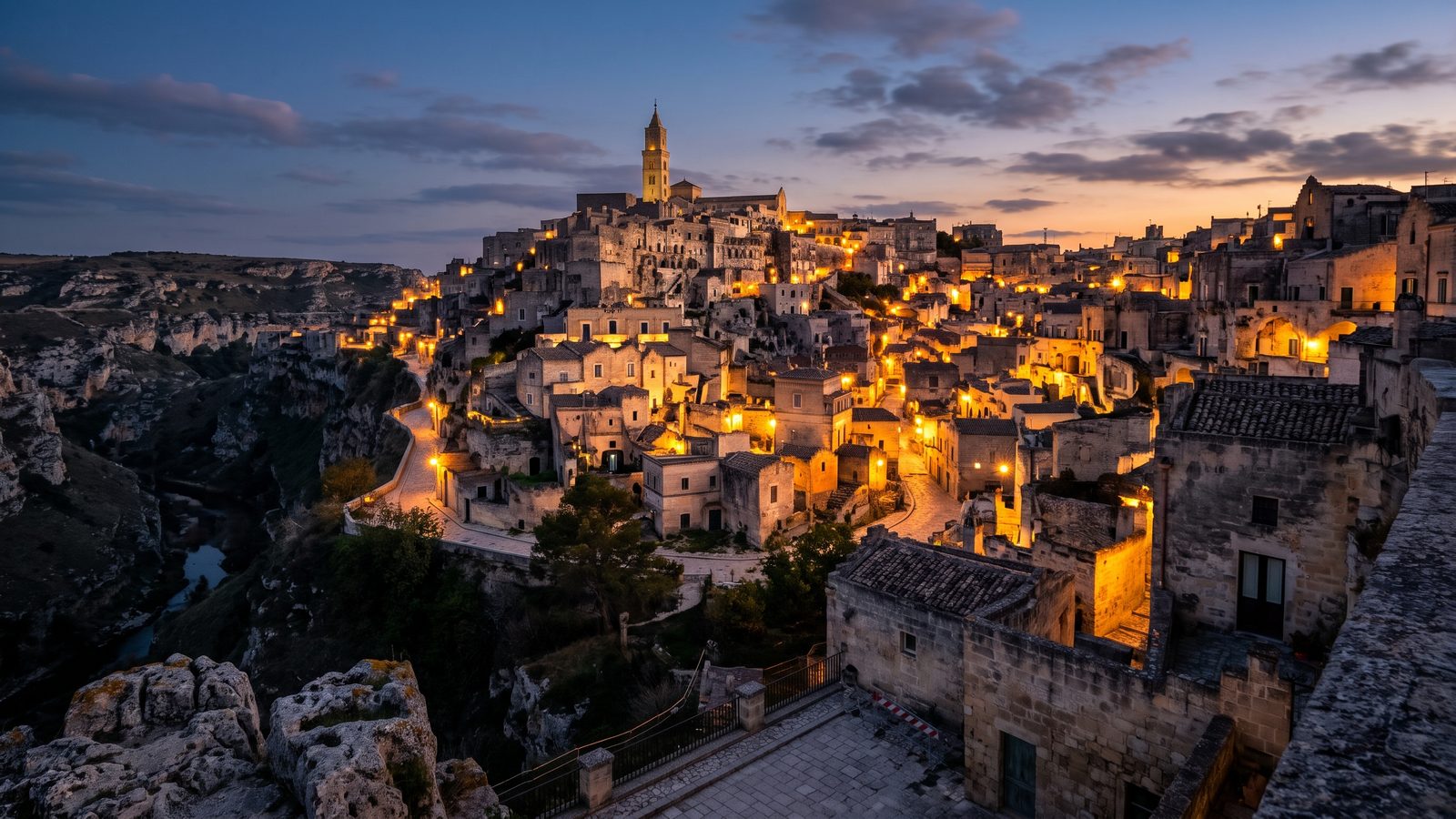
Welcome to Sassi di Matera in Basilicata, Italy, an extraordinary UNESCO World Heritage site where ancient dwellings carve directly into limestone cliffs. As you wander narrow alleys and steep staircases, you step into a living labyrinth shaped by over 10,000 years of continuous human persistence. From prehistoric shelter to mid-twentieth-century abandonment and dramatic rebirth, this self-guided audio experience reveals the profound spirit and architectural wonder of Matera.
Journey at your own pace through two distinct cave neighborhoods, Sasso Barisano and Sasso Caveoso. You will discover hand-carved rupestrian churches, ingenious water cisterns, and sweeping canyon vistas. Let each stone path guide you through thousands of years of history, culture, and resilience carved directly from the living earth.
Listen to a sample
The opening of this tour, exactly as AllTours narrates it on site.
What you'll hear on this tour
Stop 1. From Paleolithic Caves to Rebirth
You trace your steps back over 10,000 years to the Paleolithic era, when early hunter-gatherers carved their shelters into these limestone cliffs. As millennia pass, simple grottoes evolve into a thriving medieval community where monastic culture flowers with Byzantine-frescoed rupestrian churches. Century after century, inhabitants adapt this unique cave urbanism under various feudal lords. However, by the mid-twentieth century, dire poverty and high infant mortality transform the Sassi into the 'Shame of Italy,' forcing the government to evacuate over 15,000 residents by the 1950s. Today, you witness its incredible rebirth from haunting abandonment into a celebrated UNESCO World Heritage site, displaying an enduring human spirit.
Stop 2. Masterpieces Carved in Living Tuff
You observe an architectural marvel sculpted directly from soft calcareous tuff rather than merely built upon the earth. Inhabitants ingeniously repurposed natural ravines into a hydro-architectural system of channels and deep cisterns to collect rainwater beneath their homes. Look closely at the rupestrian churches like Santa Maria de Idris, where altars and columns are carved directly in situ from the living bedrock. Notice the social structure of the vicinato, where shared courtyards double as foundational roofs for lower cave homes, creating a vertical village where a neighbor's patio serves as your ceiling. This layered construction reflects thousands of years of innovative human adaptation to a challenging landscape.
Stop 3. Dazzling Canyons and Glowing Dusk
You gaze across the sweeping landscape from the Murgia Timone plateau, taking in a sprawling human anthill carved into the deep Gravina canyon. Descending into the Sassi, your perspective shifts to intimate shared courtyards that suddenly open onto staggering vertical cliffs. Neighborhoods cling precariously above you, creating a dizzying interplay of light, shadow, and stone. As dusk approaches, the ancient city illuminates into a living nativity scene. Every window across Sasso Barisano and Sasso Caveoso glows brightly, turning the entire cliffside into a sea of twinkling light. You witness a breathtaking visual spectacle that highlights Matera's unique harmony between nature and human ingenuity.
Stop 4. Terracotta Whistles and Living Traditions
You step inside a local artisan workshop nestled within the cave alleys, where centuries of crafting traditions thrive. Master potters shape local reddish-brown clay into essential water jugs and oil amphorae using methods passed down through generations. You discover the iconic cucu, a vibrant ceramic whistle shaped like a bird and decorated with traditional folk patterns. Far more than a simple toy, this whistle serves as a historic good luck charm believed to ward off evil spirits across these stone lanes. As you watch artisans paint intricate floral and geometric motifs, you realize these handcrafted objects represent living remnants of a deeply resilient, self-sufficient culture.
Stop 5. Sacred Frescoes and Courtyard Life
You feel the deep cultural heartbeat of Matera inside its carved rupestrian churches, where ancient frescoes merge Byzantine and Latin Christian traditions. These vibrant sacred paintings served as a living catechism for generations of worshipping cave dwellers. Outside the sanctuaries, everyday life unfolded across shared courtyards and water cisterns, bound together by communal daily rituals, folk music, and distinct local dialects. You sense the enduring connection between the people and their land, preserved through traditional agricultural practices and regional culinary heritage. This shared identity sustained the community through centuries of hardship, leaving behind an intangible tapestry of faith, music, and storytelling that resonates throughout the stone streets.
Stop 6. Dramatic Chasm of the Gravina
You stand overlooking the dramatic Gravina di Matera, where an ancient river carved a deep canyon through the limestone plateau. Across the chasm lies the wild Murgia Materana, a sun-baked expanse of natural caves and Mediterranean scrub contrasting sharply with the dense urban network around you. The pale tuff stone of the Sassi glows under the changing sky, casting long, striking shadows into the ravine below. Terraces, staircases, and carved cave mouths mimic the organic lines of the natural cliff face, blending city and landscape into one continuous creation. You behold a starkly beautiful panorama showcasing the powerful dialogue between nature and human persistence.
Planning your visit
- Best time to go
- Late afternoon leading into dusk, when temperatures cool and the warm glow of sunset lights up the tuff stone before twilight illumination.
- Approximate duration
- about 2 hours
- Where to start
- Piazza Vittorio Veneto, central Matera.
Access and conditions change seasonally — check the official site before you go.
Frequently asked questions
Is Sassi di Matera worth visiting?
Yes, as one of the world's oldest continuously inhabited settlements and a UNESCO World Heritage site, Sassi di Matera offers an unmatched blend of prehistoric cave architecture, rich cultural history, and breathtaking canyon views.
How long do you need at Sassi di Matera?
A minimum of half a day to a full day is recommended to explore both the Sasso Barisano and Sasso Caveoso districts, visit rock-hewn churches, and take in the panoramic views across the Gravina canyon.
Why was Matera called the 'Shame of Italy'?
In the mid-20th century, Matera earned this title due to severe poverty, disease, and high infant mortality in the overcrowded cave dwellings, leading the Italian government to forcibly evacuate over 15,000 residents in the 1950s.
Keep exploring
Header image is an AI-generated illustration of Sassi di Matera. AllTours.ai is an AI audio tour guide — point your camera at any landmark and hear its story.