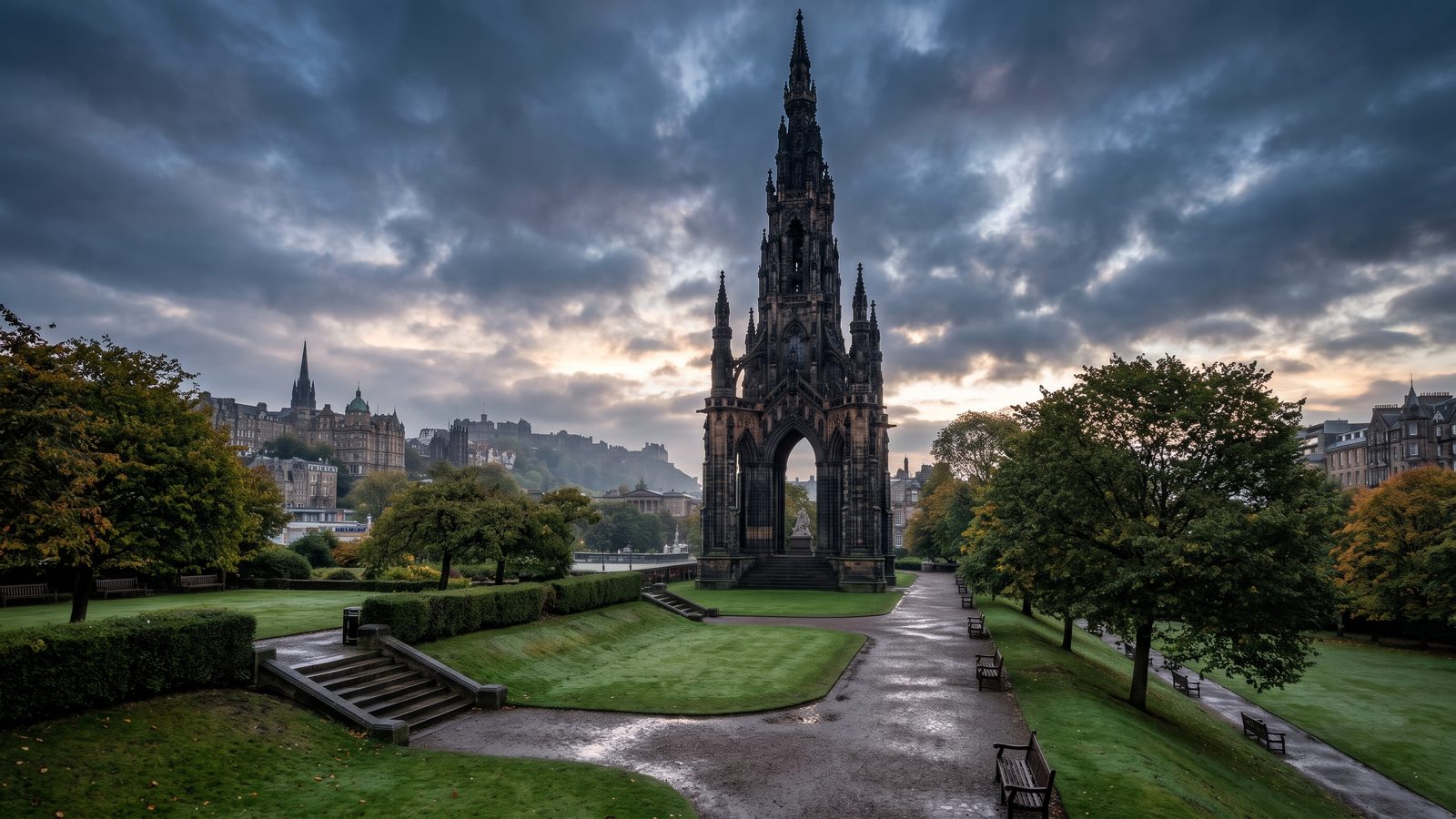
Welcome to the Scott Monument, a soaring 200-foot Victorian Gothic spire standing in Princes Street Gardens. Dedicated to Sir Walter Scott, Scotland's legendary author, this impressive tribute in dark Binny sandstone is often called a cathedral of storytelling. As you walk around it, you see delicate arches, intricate pinnacles, and a white marble statue of Scott with his loyal hound, Maida, surrounded by carved fictional characters.
This self-guided audio tour guides you through the history, architecture, and dramatic urban setting of one of the world's largest memorials to a writer. Learn how a public competition shaped this masterpiece and discover how it anchors Edinburgh's magnificent landscape today.
Listen to a sample
The opening of this tour, exactly as AllTours narrates it on site.
What you'll hear on this tour
Stop 1. A Soaring Story in Stone
As you gaze up, the audacity of this Gothic Revival masterpiece becomes instantly clear. Reaching over 200 feet into the Edinburgh sky, the monument is carved from warm Binny sandstone whose dark, weathered surface tells tales of centuries past. You notice intricate stone lacework, pointed arches, and delicate pinnacles framing the central archway. There sits Sir Walter Scott in white marble, accompanied by his loyal deerhound, Maida. Surrounding him within numerous niches, you discover a veritable gallery of 64 sculpted characters from Scott's novels, alongside 32 Scottish poets. Together, they transform this grand Victorian tribute into one of the largest literary monuments on Earth.
Stop 2. Grief, Genius, and Tragic Design
You stand before a monument born from national grief after Sir Walter Scott's death in 1832. To honor Scotland's beloved bard, a public competition launches in 1836. The winning design belongs to George Meikle Kemp, a self-taught architect submitting under a pseudonym. Funded entirely by public subscriptions across all social classes, construction begins in 1840. Tragically, Kemp never witnesses his finished masterpiece, drowning in the Union Canal in 1844, the year of its inauguration. Today, you feel both Scott's enduring legacy and the tragic story of his ill-fated designer.
Stop 3. A Gothic Cathedral of Craftsmanship
Looking upward, you marvel at the audacity of Victorian craftsmanship embodied in this Gothic Revival structure. Meticulously built from Binny sandstone, its golden-brown hue deepens with age and Edinburgh's weather. You observe a towering network of pointed arches, delicate crockets, and soaring pinnacles that mirror medieval cathedrals while expressing 19th-century romanticism. Designed by George Meikle Kemp, the central spire reaches over 200 feet high, flanked by four smaller turrets that create a dramatic vertical posture. Inside, narrow spiraling staircases lead up through a stone labyrinth. Outside, 64 miniature statues of Scott's novel characters inhabit their niches, turning the entire spire into a living architectural gallery.
Stop 4. Panorama Over Edinburgh's Divided City
As you ascend the narrow, spiraling staircases, four distinct viewing platforms reveal a living map of Edinburgh unfolding below. At the lowest level, you gain an intimate view of the intricate stone carvings and Princes Street Gardens. Higher up, the city opens dramatically. To the north, you see the elegant Georgian symmetry of New Town stretching toward the Firth of Forth and Fife. Looking east, Arthur's Seat commands the horizon near the Royal Mile and Holyrood Palace. To the south, the medieval Old Town spills down toward the Pentland Hills. Facing west, Edinburgh Castle stands sentinel on its volcanic crag above the gardens.
Stop 5. From Medieval Loch to Verdant Refuge
You look out from the monument into the peaceful green expanse of Princes Street Gardens. It is hard to imagine that this tranquil refuge was once the Nor Loch, a murky medieval defensive barrier known for foul conditions and witch trials. Drained in the early 19th century, the area became vital space for the railway and these public gardens. As you walk along gently curving pathways, you see how Victorian urban planners framed breathtaking visual corridors toward Edinburgh Castle. Vibrant floral displays add brilliant color against the dark stone of the monument, allowing this massive spire room to breathe within the cityscape.
Stop 6. The Spirit of a Burgeoning Empire
You stand before a quintessential symbol of the Victorian age. This monument embodies a 19th-century passion for grand public works and literary heroes. You notice how the Gothic Revival style reflects Victorian nostalgia for medieval grandeur, brought to life through modern industrial precision. Built from dark Binny sandstone, the structure carries a solemn gravity characteristic of Edinburgh's Victorian heritage. From its open design competition won by an unknown self-taught architect to the meticulous sculpting of 64 literary figures, every detail reveals a culture dedicated to public pride, narrative art, and intellectual reverence. It remains a striking declaration of national identity.
Planning your visit
- Best time to go
- Morning or late afternoon for clear light across Edinburgh's skyline and quieter walks in Princes Street Gardens.
- Approximate duration
- about 45 minutes
- Where to start
- Princes Street Gardens, at the base of the Scott Monument near Princes Street.
Access and conditions change seasonally — check the official site before you go.
Frequently asked questions
Is Scott Monument worth visiting?
Yes, the Scott Monument is one of Edinburgh's most iconic landmarks, offering intricate Victorian Gothic architecture, rich literary history, and stunning panoramas over the Old and New Towns.
How long do you need at Scott Monument?
Most visitors spend around 30 to 45 minutes exploring the exterior carvings, enjoying Princes Street Gardens, and taking in the architectural details.
Who designed the Scott Monument and when was it built?
The monument was designed by self-taught architect George Meikle Kemp, who won a public competition in 1836. Construction began in 1840 and the structure was inaugurated in 1844.
Keep exploring
Header image is an AI-generated illustration of Scott Monument. AllTours.ai is an AI audio tour guide — point your camera at any landmark and hear its story.