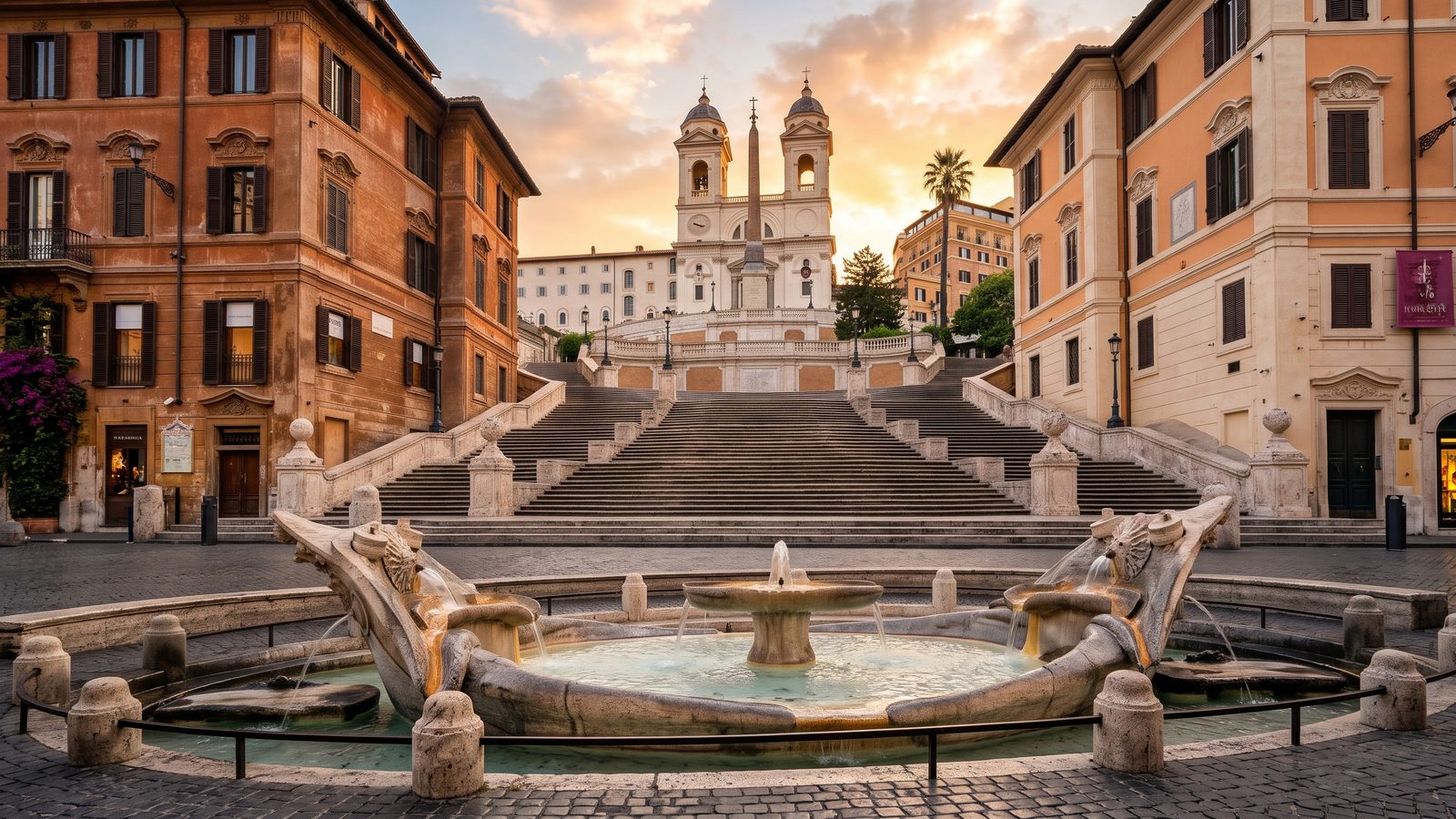
Stand at the base of the Spanish Steps, where Rome’s rich artistic heritage unfolds around you. Connecting Piazza di Spagna with the Trinità dei Monti church, this 135-step Baroque masterpiece designed by Francesco de Sanctis and Alessandro Specchi has captivated visitors for centuries. As you ascend, you follow in the footsteps of Romantic poets, high-fashion models, and travelers who have gathered here to experience Rome's vibrant energy.
This audio tour guides you through the complex political rivalry, architectural genius, and artistic triumphs that brought this monumental urban staircase to life. Learn how French diplomacy, papal ambitions, and Bernini’s theatrical fountain converged to create one of the most iconic gathering spots in the Eternal City.
Listen to a sample
The opening of this tour, exactly as AllTours narrates it on site.
What you'll hear on this tour
Stop 1. Bernini's Sunken Boat at the Base
You stand at the foot of the steps before the Fontana della Barcaccia, a Baroque treasure completed around 1629. Designed by Gian Lorenzo Bernini alongside his father Pietro, this travertine fountain takes the shape of a half-sunken boat. You can spot the bee and sun crests of Pope Urban VIII from the Barberini family, who commissioned the work. Legend says a Tiber River flood in 1598 stranded a fishing boat in this very spot. Notice how Bernini creatively solves low aqueduct water pressure by lowering the vessel into a shallow basin. This playful, narrative design predates the monumental steps behind it, setting a dramatic stage for the entire square.
Stop 2. A Diplomatic Standoff Settled in Stone
Look up the steep hill linking Piazza di Spagna to Trinità dei Monti church. For decades, this slope posed a fierce urban planning challenge driven by French diplomats like Cardinal Mazarin, who envisioned a statue of King Louis XIV at the summit. Popes Innocent X and Alexander VII repeatedly blocked the plan to protect papal authority. The standoff finally broke when French diplomat Étienne Gueffier left 20,000 scudi in his 1721 will. Under Pope Innocent XIII, architects Francesco de Sanctis and Alessandro Specchi received approval for their design. Built between 1723 and 1725, these 135 travertine steps forever united French ambition and papal tradition in stone.
Stop 3. The Butterfly Geometry of Travertine
As you climb the 135 steps, notice how the staircase shuns a simple straight line. Architect Francesco de Sanctis designed a dynamic, irregular geometry often compared to the spread wings of a butterfly. Constructed between 1723 and 1725, the broad travertine terraces, sweeping curves, and alternating flights narrow and widen as you move. This clever spatial design creates an illusion of greater distance and constantly shifts your perspective. Instead of an exhausting, monotonous ascent, your walk becomes an engaging sensory journey. You are moving through a monumental sculpture of landscape architecture, designed to blend urban utility with dramatic theatrical grace.
Stop 4. High Fashion on a Historic Stage
Step into a long legacy of style and elegance on these steps. Since the 18th century, Roman elites gathered here to promenade in fine silks and tailored suits. By the mid-20th century, the steps became the beating heart of Italian Alta Moda. Nearby Via dei Condotti houses flagships for fashion giants like Valentino, Fendi, and Bulgari, who drew creative inspiration from this setting. Famous events like the "Donna Sotto le Stelle" fashion shows turned these steps into a world-famous runway, where models showcased breathtaking haute couture gowns under the night sky. Today, you are walking across a living canvas of history and modern sartorial glamour.
Stop 5. Sweeping Panoramas Over Terracotta Rooftops
Pause near the summit to look out over the Eternal City. Below you, the lively Piazza di Spagna centers around the Barcaccia Fountain, while Via Condotti slices straight through the city, drawing your eyes toward the distant dome of St. Peter's Basilica. Terracotta rooftops stretch out beneath the Mediterranean sky. As you turn back, the towering façade of Trinità dei Monti and the ancient Obelisco Salustiano dominate the skyline behind you. De Sanctis’s 135 steps offer an ever-changing visual narrative, rewarding your ascent with spectacular framing of Roman architecture from every landing.
Stop 6. Pure Drama in Undulating Travertine
Observe how the steps embody the peak of late Baroque urban theatricality. Built between 1723 and 1726 by De Sanctis and Specchi, the Scalinata di Trinità dei Monti turns function into art. The convex and concave sections undulate upwards, carving out dynamic plays of light and deep shadows across the travertine stone. Paired with Bernini’s earlier Barcaccia Fountain at the base, the entire architectural ensemble acts as a grand stage set. This dramatic arrangement bridges the earthly bustle of the piazza below with the sacred church above, offering an emotionally charged journey designed to awe and inspire every passerby.
Planning your visit
- Best time to go
- Early morning at sunrise to avoid heavy crowds, or late afternoon for golden light over the rooftops.
- Approximate duration
- about 45 minutes
- Where to start
- Piazza di Spagna, in front of the Fontana della Barcaccia at the base of the steps.
Access and conditions change seasonally — check the official site before you go.
Frequently asked questions
Is Spanish Steps worth visiting?
Yes, the Spanish Steps are one of Rome's most famous Baroque landmarks, offering rich history, beautiful architecture, and an iconic atmosphere connecting Piazza di Spagna to Trinità dei Monti.
How long do you need at Spanish Steps?
Most visitors spend between 30 and 45 minutes exploring the base near Bernini's fountain, walking up the 135 steps, and admiring the city views from the top terrace.
Why are they called the Spanish Steps?
They get their name from the Spanish Embassy to the Holy See, which has been located in Piazza di Spagna at the base of the steps since the 17th century.
Keep exploring
Header image is an AI-generated illustration of Spanish Steps. AllTours.ai is an AI audio tour guide — point your camera at any landmark and hear its story.