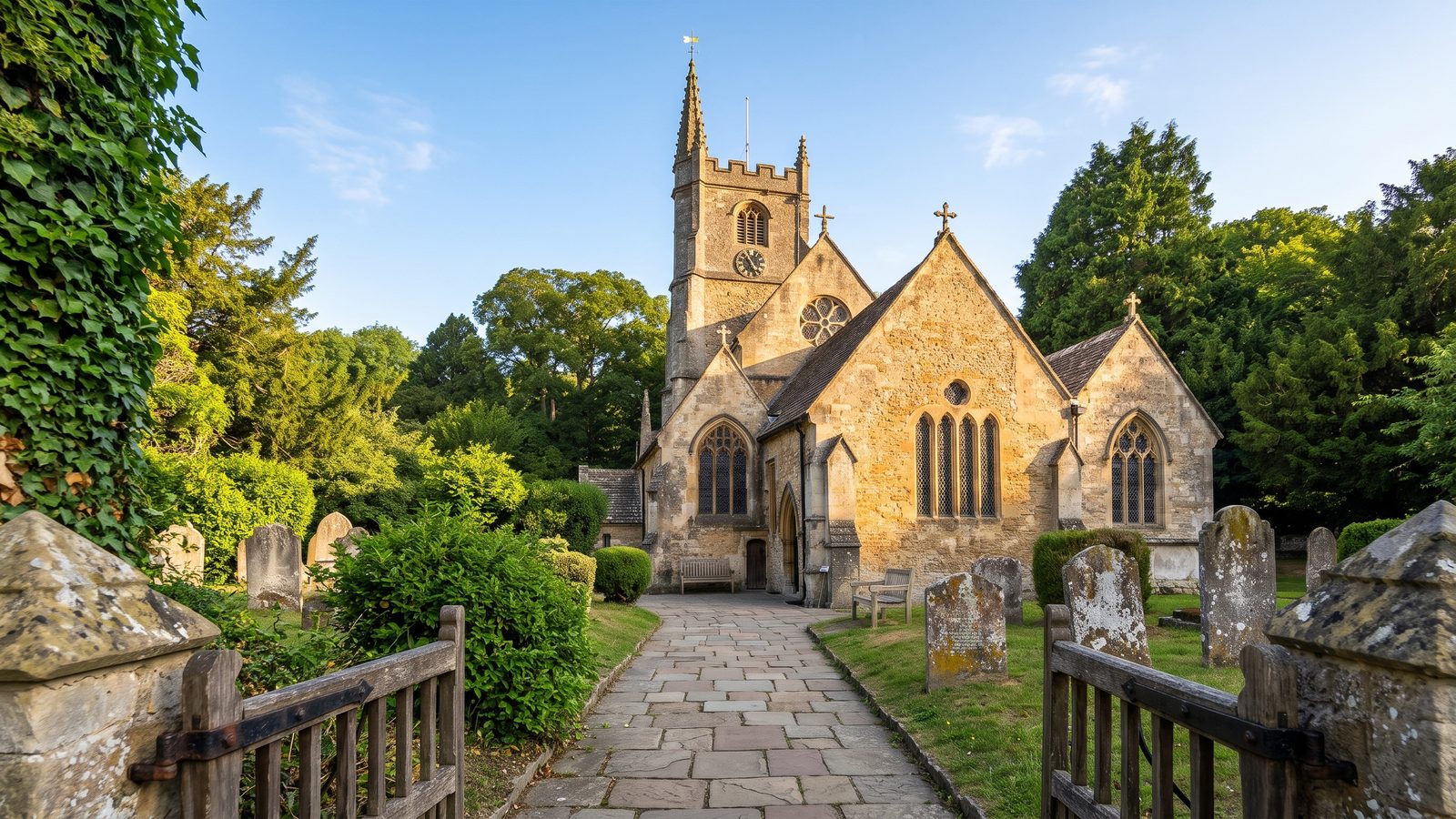
Step into St Andrew's Church, the historic spiritual heart of Castle Combe nestled in the Cotswolds. Dating back to Norman and Saxon times, this iconic parish church combines centuries of faith with striking architectural evolution. As you wander through its ancient nave, quiet churchyard, and light-filled interior, you discover a sacred haven where medieval craftsmen, noble lords, film crews, and quiet village life seamlessly intersect across nine centuries of living history.
On this self-guided audio tour, you will unearth fascinating local stories etched into honey-coloured stone. From a rare faceless medieval clock to centuries-old tombs and screen appearances in major Hollywood films, each corner reveals how faith and community prosperity shaped this quintessential English village sanctuary.
Listen to a sample
The opening of this tour, exactly as AllTours narrates it on site.
What you'll hear on this tour
Stop 1. The Faceless Clock and Silver Screen
You step into the serene quiet of St Andrew's Church, a sanctuary whose foundations reach back to Norman origins. As you look toward the north wall, you spot its most famous mechanical treasure: a rare, faceless 15th-century clock that marks time without a dial, reminding visitors of a bygone era when human minutes yield to divine eternity. Look around the medieval tower and sturdy nave, and you might recognize these very stones from famous film scenes in 'War Horse' and 'Stardust'. You stand at a remarkable crossroads where ancient devotion, medieval engineering, and silver-screen movie magic harmoniously converge in the heart of Castle Combe.
Stop 2. Centuries Written in Sacred Stone
You trace the ancient stone walls, following a chronicle that begins with 12th-century Norman foundations. As you walk through the nave, you see how generations expanded this original footprint during the 13th and 14th centuries. By the 15th century, local wool wealth brought soaring Perpendicular Gothic windows and intricate masonry, transforming the dark stone structure into a soaring house of light. You imagine medieval villagers, local masons, and the wealthy Scrope family, lords of the manor, pouring their coin and labor into these walls. Each era leaves its mark, preserving memories of feudal power, plague, and unwavering faith across centuries.
Stop 3. Honey Stone and Gothic Detail
You stand before the striking tower, observing its robust lower levels that echo early Norman fortress architecture. As your eyes climb upward, you notice the transformation into elegant 15th-century Perpendicular Gothic design, complete with delicate battlements and finely carved gargoyles guarding against rainwater. Notice the warm, honey-coloured Cotswold stone, quarried nearby and meticulously dressed by medieval masons. Large windows with delicate stone tracery flood the interior with soft daylight, creating a profound theological impression of divine presence. From its sturdy foundations to its timber roof structure, you appreciate the incredible craftsmanship designed for both physical durability and spiritual aspiration.
Stop 4. Silent Echoes in the Churchyard
You step into the tranquil churchyard, where weathered limestone and slate gravestones lean gently among the grass. Here, you discover the final resting places of generations of Castle Combe villagers, including prominent families like the Scropes and Dunstans whose names fill local records. You walk past markers smoothed by centuries of English weather, reflecting on the community's personal stories and changing burial customs. Nearby, an ancient yew tree stands sentinel, its gnarled trunk predating much of the current church building. As you linger in this peaceful sanctuary, you experience a living archive connecting past village lives to the enduring landscape around you.
Stop 5. Saxon Foundations and Medieval Marvels
You explore a living heritage stretching back to Saxon origins in the 10th century. As you examine the magnificent 12th-century font, you touch a tangible piece of history where generations of local villagers have been baptized across nine centuries. You see how 15th-century wool prosperity expanded these sacred halls, installing soaring windows that brighten the nave. Nearby, the mechanical medieval clock works without a face, proving how practical timekeeping evolved in rural England before modern dials existed. From Norman towers to medieval stonework, you witness layers of architectural and spiritual inheritance preserved intact for modern travellers to share.
Stop 6. The Living Museum of Castle Combe
You walk from the sacred grounds into Castle Combe itself, an authentic living museum preserved without modern intrusions like TV aerials or yellow road lines. You watch the Bybrook stream meander through the valley, where medieval wool mills once powered the village's historic prosperity. Standing before the iconic 14th-century Market Cross, you visualize medieval merchants trading famous Castle Combe cloth at the bustling market. Honey-coloured 17th-century Cotswold cottages line the gentle slopes, their steep roofs built to weather seasonal storms. You absorb the peaceful atmosphere, imagining the clip-clop of horses on stone bridges and the quiet rhythms of traditional village life.
Planning your visit
- Best time to go
- Morning or late afternoon on a clear day for soft sunlight on the Cotswold stone.
- Approximate duration
- about 45 minutes
- Where to start
- The main entrance gate of St Andrew's Church in the village center of Castle Combe.
Access and conditions change seasonally — check the official site before you go.
Frequently asked questions
Is St Andrew's Church worth visiting?
Yes, St Andrew's Church is a highlight of Castle Combe, featuring a rare 15th-century faceless clock, historical ties to Norman origins, fine Cotswold stone architecture, and famous film locations.
How long do you need at St Andrew's Church?
A typical visit takes around 30 to 45 minutes to explore the interior, inspect the ancient clock and font, and walk through the historic churchyard.
What is the history of St Andrew's Church in Castle Combe?
Founded in Norman and Saxon times, the church was expanded in the 15th century using wealth from the local wool trade, adding Perpendicular Gothic features and housing centuries of village heritage.
Keep exploring
Header image is an AI-generated illustration of St Andrew's Church. AllTours.ai is an AI audio tour guide — point your camera at any landmark and hear its story.