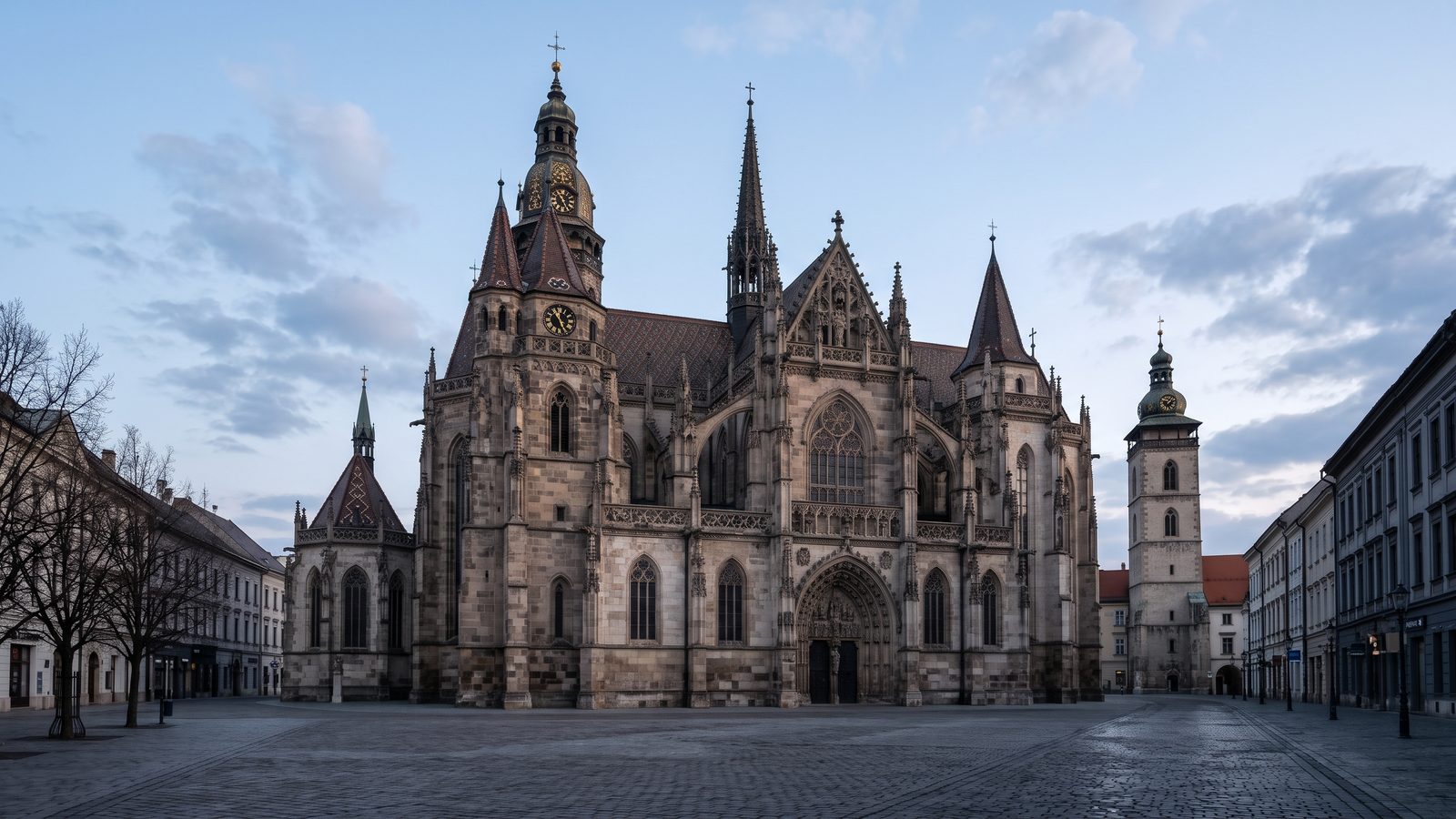
Welcome to Košice, home to Europe's easternmost High Gothic masterpiece. As you stand before St. Elisabeth Cathedral, you gaze upon an architectural triumph begun in the late fourteenth century that took over a hundred years to complete. Its soaring spires, intricate stone carvings, and unique double-nave design tell the story of medieval ambition, royal patronage, and unwavering faith amidst centuries of Central European upheaval.
With this self-guided audio tour, step into a sacred sanctuary where history, art, and spirituality converge. You will discover sacred relics, magnificent panel paintings, structural marvels of Gothic engineering, and the quiet crypt holding one of Slovakia's greatest national heroes.
Listen to a sample
The opening of this tour, exactly as AllTours narrates it on site.
What you'll hear on this tour
Stop 1. Inside the Sacred Double Nave
As you step inside, the sheer audacity of this Gothic sanctuary envelops you. Notice the rare double-nave layout, an innovative design for its time that creates an expansive, boundless space drawing your gaze upward. Sunlight filters through vibrant stained-glass windows, projecting luminous color across ancient stone columns. You are looking at a monument begun around 1378, reflecting the evolution from High to Late Gothic style over a century of painstaking labor. As you explore the hall, seek out the magnificent Golden Altar of St. Elisabeth with its detailed panel carvings. Deep beneath your feet in the cathedral crypt lies the revered tomb of Francis II Rákóczi, linking this holy place directly to Slovakia's fight for freedom.
Stop 2. Chapel of the Holy Relic
Make your way to the north transept to discover the hushed reverence of the Chapel of the Holy Relic. Consecrated in 1482 by Bishop Jan V, this intimate sanctuary was built specifically to house a precious fragment of St. Elisabeth's veil brought back from the Crusades. You stand before an exquisite late Gothic silver reliquary detailing scenes from the saint's life. Legend whispers that a cardinal blessed the foundation stone to guard this sacred enclosure against all evil. As you look up, admire the subtle blue and gold celestial frescoes adorning the ceiling, restored in the seventeenth century yet retaining their original divine glow, recalling centuries of pilgrims who sought miraculous healing here.
Stop 3. Symphony of Stone and Glass
Step back to trace the outer skeleton of this High Gothic masterpiece, built with remarkable medieval engineering. You observe how slender flying buttresses arc gracefully outward, transferring the massive weight of the nave walls and ribbed vaults away from the interior. This ingenious structural innovation frees the stone walls, allowing for expansive stained-glass windows that flood the sanctuary with celestial light. Examine the delicate pinnacles, functional gargoyles, and the breathtaking geometric tracery of the great west rose window. Notice the twin towers as well; though completed in different style phases, they whisper a silent story of centuries of painstaking craftsmanship, transforming heavy stone into mathematical harmony.
Stop 4. Art, Sermons, and Civic Identity
As you examine the cathedral's artistic treasures, you witness centuries of rich cultural expression. The vibrant stained-glass windows serve as visual sermons, historically teaching moral stories to illiterate worshippers and shaping community values across generations. Look toward the High Altar of St. Elisabeth, a fifteenth-century panel painting masterpiece that reflects the artistic currents flowing through medieval Košice. This sanctuary has long served as a crucible of shared heritage, where Slovak and Hungarian cultural influences intertwine inside civic celebrations and traditional festivals. Listen closely to the acoustics around you, which continue to host organ concerts that fill this sacred space with enduring musical beauty.
Stop 5. Centuries of Faith and Upheaval
You are walking upon sacred ground where construction began in 1378, built over the foundations of a 1230s Romanesque parish church. Imagine the monumental ambition required to embark on a project spanning centuries through Central Europe's turbulent history. Construction progressed slowly through the main nave and side aisles, only to face dramatic interruption during the fifteenth-century Hussite Wars, leaving unfinished sections exposed to the elements. Through unwavering perseverance and the generous patronage of powerful rulers like King Sigismund of Luxembourg, the grand vision gradually materialized. By the early sixteenth century, master masons placed the final intricate details, concluding the era of High Gothic architecture.
Stop 6. Mastery of the Gothic Vault
Look upward to immerse yourself in the structural soul of Gothic architecture. You see how pointed arches do far more than frame the space; they act as engineering marvels that channel the immense weight of the stone ceiling downward with incredible efficiency. Above you, intricate ribbed vaults crisscross the roof like a sophisticated skeletal system, pinpointing heavy forces and allowing medieval builders to construct impossibly thin, soaring walls. Outside, flying buttresses counteract the outward thrust of these ceiling vaults. This masterwork of physics liberates the interior stone from load-bearing duties, transforming solid rock into shimmering tapestries of divine light that direct your eyes toward heaven.
Planning your visit
- Best time to go
- Morning on weekdays for quiet contemplation and optimal interior sunlight through the stained glass.
- Approximate duration
- about 45 to 60 minutes
- Where to start
- In front of the cathedral's main western facade on Hlavná Street.
Access and conditions change seasonally — check the official site before you go.
Frequently asked questions
Is St. Elisabeth Cathedral worth visiting?
Yes, St. Elisabeth Cathedral is Košice's defining landmark and Europe's easternmost High Gothic cathedral. It features a unique double-nave design, exquisite stained glass, the Chapel of the Holy Relic, and the historical crypt of Francis II Rákóczi.
How long do you need at St. Elisabeth Cathedral?
Most visitors spend between 45 minutes to an hour exploring the cathedral's interior, viewing the high altar, visiting the crypt, and admiring the Gothic exterior architecture.
What is the history of St. Elisabeth Cathedral?
Construction of the cathedral began in 1378 on the site of a 13th-century Romanesque parish church. Despite interruptions during the 15th-century Hussite Wars, royal patronage from figures like King Sigismund of Luxembourg helped complete this High Gothic monument by the early 16th century.
Keep exploring
Header image is an AI-generated illustration of St. Elisabeth Cathedral. AllTours.ai is an AI audio tour guide — point your camera at any landmark and hear its story.