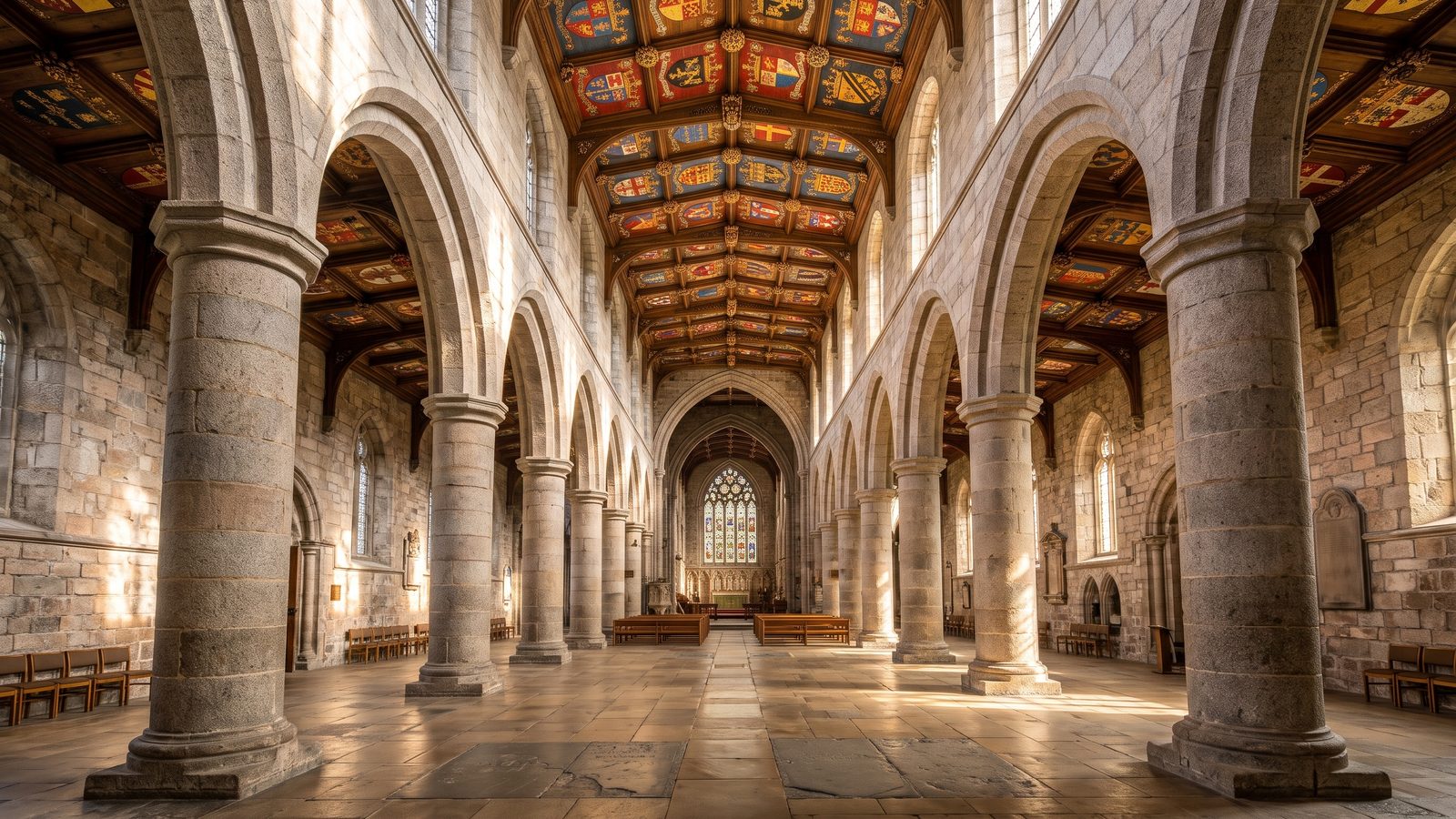
Welcome to St Machar's Cathedral, a granite masterpiece situated in Old Aberdeen. As one of Scotland's most historically significant sites, this medieval sanctuary offers you an unforgettable journey through 1,400 years of heritage. From its sixth-century Celtic beginnings to its enduring granite architecture and famed heraldic ceiling, you will discover how this resilient cathedral survived regional conflict, severe storms, and the Scottish Reformation.
Use this self-guided audio tour to explore at your own pace. Wander beneath sturdy stone arches, marvel at vibrant coats of arms overhead, and uncover the dramatic stories etched into every grey granite block of this living piece of Scottish history.
Listen to a sample
The opening of this tour, exactly as AllTours narrates it on site.
What you'll hear on this tour
Stop 1. The Painted Heraldic Ceiling
As you stand in the nave and look up, you behold the cathedral's true crowning glory: a magnificent heraldic ceiling completed around 1520 under Bishop Gavin Dunbar. You are gazing at forty-eight intricately painted and gilded wooden shields spanning the oak canopy. Far from simple decoration, this ceiling serves as a frozen political map of Europe and Scotland. Each coat of arms heralds the authority of European monarchs, Scottish noble families, or church leaders of the early sixteenth century. Remarkably, this wooden masterpiece survived the fierce destruction of the Scottish Reformation, offering you a rare, vibrant window into pre-Reformation wealth, power, and art.
Stop 2. Centuries of Faith and Storms
You are standing on ground hallowed since the sixth century, when St. Machar, a companion of St. Columba, established a church where the river bent like a bishop's crozier. While the early wooden structure vanished long ago, the stone cathedral around you took shape in the fourteenth and fifteenth centuries under ambitious leaders like Bishop Henry Lichtoun. You can imagine the dramatic upheavals this site endured, from the iconoclasm of the 1560 Scottish Reformation, which stripped its lead roof, to a catastrophic storm in 1688 that collapsed the central tower and transepts. What you see today is the painstakingly restored nave, preserved across centuries of change.
Stop 3. Fortress of Grey Granite
Take a moment to examine the formidable fabric of the cathedral, built from heavy local grey granite. You immediately notice a stark, defensive aesthetic compared to delicate European Gothic churches. Aberdeen's identity as the Granite City echoes through these thick, solid walls and sturdy arches, built without flying buttresses to withstand both harsh climate and regional conflict. As you admire the twin western towers, you see their unadorned, fortress-like massing, designed to protect the sacred interior during turbulent eras. Stepping through the doors, you experience a compact yet grand nave that reflects both structural resilience and practical, enduring medieval engineering.
Stop 4. From Celtic Roots to Reformation
As you move through this peaceful space, you tread within a sanctuary that has echoed with continuous prayer for well over eight centuries. You are tracing a spiritual thread that began with early Celtic Christianity and evolved into the heart of the medieval Catholic Diocese of Aberdeen. Feel the silent weight of history as you reflect on the sixteenth-century Scottish Reformation, when traditional rites were cast aside and the cathedral was transformed into a Presbyterian place of worship. Today, despite centuries of shifting theology, physical destruction, and profound religious turmoil, you stand in an active parish church of the Church of Scotland, where community worship still thrives.
Stop 5. A Living Medieval Legacy
Look around you at one of Scotland's rare surviving pre-Reformation cathedral spaces that still functions as an active house of worship. You are witnessing a continuous 1,400-year thread of spiritual and community heritage rooted in Aberdeenshire soil. The enduring granite walls whisper stories of medieval bishops who shaped early Scottish culture, politics, and intellectual life. Although the original choir and central transepts were lost over time, the surviving nave preserves an unbroken connection to Scotland’s ecclesiastical past. As you explore, you participate in a living tradition, connecting directly with generations of worshippers who maintained this sacred haven against all odds.
Planning your visit
- Best time to go
- Morning or early afternoon for optimal natural light illuminating the painted heraldic ceiling.
- Approximate duration
- About 45 to 60 minutes
- Where to start
- Inside the main entrance of the cathedral nave.
Access and conditions change seasonally — check the official site before you go.
Frequently asked questions
Is St Machar's Cathedral worth visiting?
Yes, St Machar's Cathedral is well worth visiting. It features a unique 16th-century heraldic ceiling with 48 painted coats of arms, fortified granite twin towers, and over 1,400 years of history tracing back to 6th-century Celtic roots.
How long do you need at St Machar's Cathedral?
Most visitors spend between 45 and 60 minutes exploring the nave, admiring the heraldic ceiling, and viewing the historic exterior architecture.
What is the historical significance of St Machar's Cathedral?
Founded according to tradition in the 6th century by St Machar, the site grew into the medieval Catholic Diocese of Aberdeen. Despite suffering roof damage during the 1560 Reformation and losing its central tower in a 1688 storm, the surviving nave remains an active Church of Scotland parish church.
Keep exploring
Header image is an AI-generated illustration of St Machar's Cathedral. AllTours.ai is an AI audio tour guide — point your camera at any landmark and hear its story.