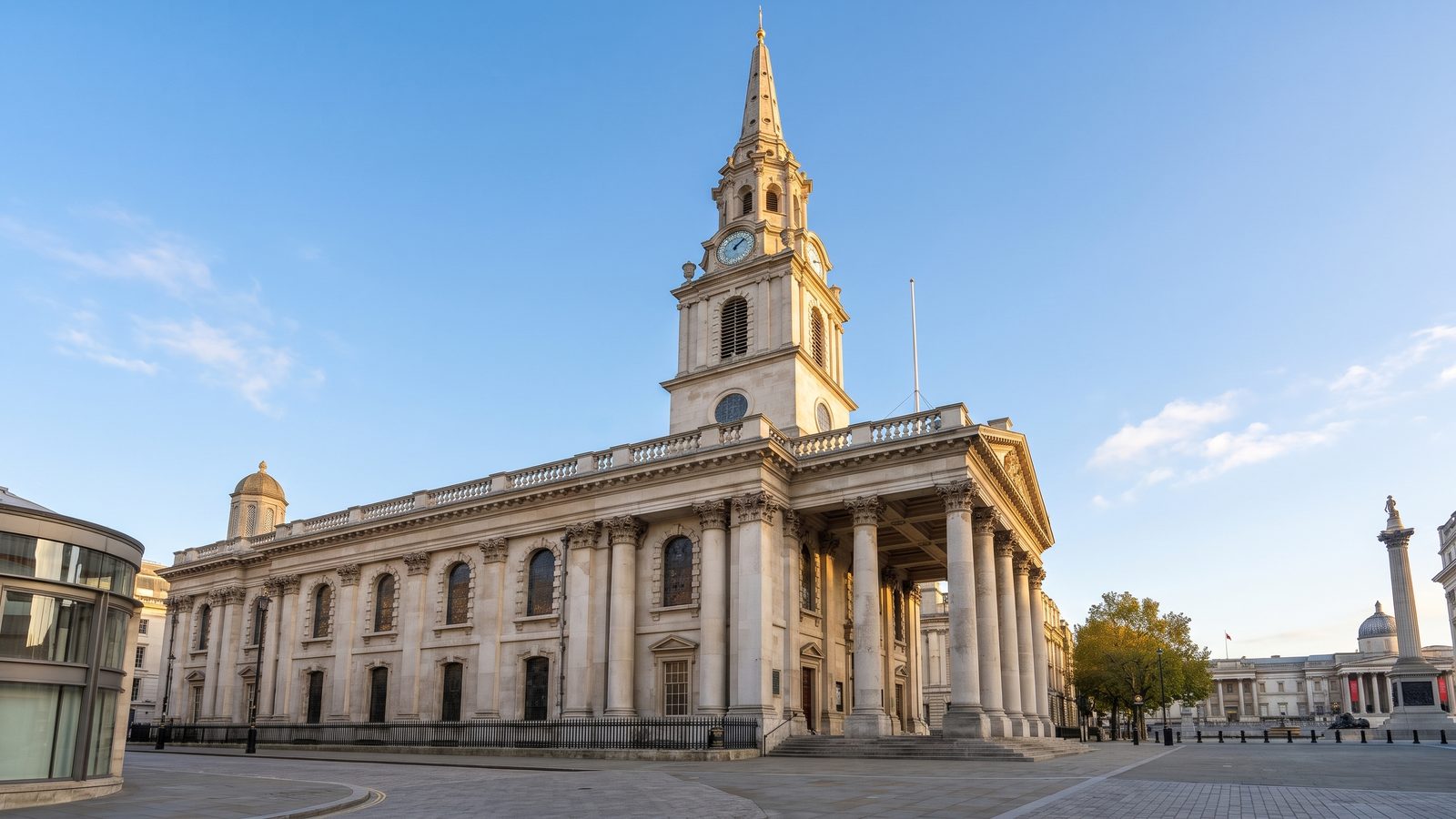
Step into St Martin-in-the-Fields, a historic landmark standing at Trafalgar Square that has served Londoners for over eight centuries. From its medieval roots and Tudor royal decrees to James Gibbs’s architectural revolution in 1726, this grand church bridges deep spiritual traditions with vibrant modern city life. Discover how its majestic portico and spire redefined sacred architecture across the globe.
Beyond its historic Portland stone façade, St Martin’s thrives as a world-renowned cultural hub and beacon of charity. As you explore the radiant nave and atmospheric crypt, you will encounter legendary musical legacies, pioneering homelessness outreach, and nearly three centuries of continuous worship in the heart of London.
What you'll hear on this tour
Stop 1. A Revolutionary Vision in Portland Stone
You stand before an architectural masterpiece that redefined church design worldwide. James Gibbs crafted this groundbreaking Neoclassical temple, fronted by six colossal Corinthian columns that evoke ancient Rome. Notice how the soaring steeple does not merely sit upon the roof, but ascends directly through the building's core. This innovative solution perfectly harmonizes a classical temple entrance with a traditional English spire, establishing a landmark blueprint copied across colonial America. As you admire the crisp lines of pristine Portland stone, consider the interior's elegant nave. Large arched windows bathe the space in natural light, while flanking galleries create an atmosphere of expansive, understated grandeur and precise mathematical order.
Stop 2. Eight Centuries of Royal and Civic History
You are walking on ground where Londoners have gathered for over eight hundred years. Early records trace a medieval church here to the thirteenth century, but King Henry VIII dramatically altered its fate in 1542. Ordering a complete rebuild, he sought to redirect plague funeral processions away from his new palace at Whitehall, creating an independent parish. That Tudor structure miraculously survived both the English Civil War and the Great Fire of London. However, by the early eighteenth century, failing medieval foundations paved the way for James Gibbs's masterpiece, completed in 1726. Solidifying its status as a royal parish, the church has served nearby palaces and London's civic heart ever since.
Stop 3. A Vital Sanctuary of Practical Compassion
You discover a sacred space defined by a deep commitment to serving London's most vulnerable. Long before modern welfare states existed, this parish opened its doors to the impoverished, a tradition that thrives today through 'The Connection at St Martin's.' Operating directly from the historic crypt, this pioneering charity provides hot meals, warm showers, mental health support, and essential job training to rebuild lives. As you look around, you feel the tangible impact of an annual Christmas Appeal broadcast around the world, raising crucial funds for individuals facing hardship across the United Kingdom. Here, practical love and holistic care form an enduring beacon of hope in the city center.
Stop 4. The Sonic Masterpieces of Trafalgar Square
You step into one of London's foundational pillars of classical music, famous worldwide for its remarkable acoustic clarity. In this nave, baroque orchestras and soaring vocalists perform daily, filling the grand hall with astonishing warmth. The church acts as a dynamic stage, hosting peaceful daytime recitals alongside magnificent evening performances by world-class ensembles. This very building gave birth to the world-renowned Academy of St Martin in the Fields, whose recording legacy transformed classical music history. Down below, the historic crypt regularly vibrates with intimate jazz and folk sessions, ensuring your journey through this sacred space is enriched by a rich and ever-changing auditory tapestry.
Stop 5. Democratizing Music and Community in the Crypt
You experience a living cultural institution dedicated to making fine art accessible to everyone. The church's long-standing tradition of free lunchtime concerts transforms the majestic nave into an open-door concert hall, presenting emerging talents alongside established artists. Every architectural line and curve, originally engineered for Anglican liturgy, now elevates violin concertos and chamber music with effortless acoustic brilliance. Descending into the crypt, you enter the bustling Crypt Café. This vibrant social hub combines historic brick vaulting with a warm, inclusive welcome. Serving delicious food while fostering deep social connection, the crypt embodies St Martin’s enduring commitment to community outreach and civic hospitality for all visitors.
Stop 6. Centuries of Continuous Prayer and Harmony
You stand in the nave and feel the quiet rhythm of nearly three centuries of unbroken prayer. From morning contemplation to the uplifting strains of Choral Evensong, Gibbs designed every sightline and acoustic detail to draw worshipers together toward the altar. Smooth wooden pews, worn soft by generations of churchgoers, welcome you into a shared tradition of reflection. As the majestic organ rolls and the renowned choir's harmonies fill the air, monarchs and local citizens alike gather under one roof in equal devotion. Here, sacred music and sacred text merge into a timeless, living faith that offers peace from the bustling metropolis outside.
Planning your visit
- Best time to go
- Morning for quiet contemplation and optimal interior light, or early afternoon to attend a free lunchtime concert.
- Approximate duration
- about 45 to 60 minutes
- Where to start
- Outside the main Corinthian portico facing Trafalgar Square.
Access and conditions change seasonally — check the official site before you go.
Frequently asked questions
Is St Martin-in-the-Fields worth visiting?
Yes, St Martin-in-the-Fields is well worth visiting. Situated beside Trafalgar Square, it features groundbreaking Neoclassical architecture by James Gibbs, world-class music performances, a historic vaulted Crypt Café, and 800 years of royal and social history.
How long do you need at St Martin-in-the-Fields?
Most visitors spend between 45 minutes and an hour exploring the nave and crypt. If you attend a lunchtime recital or stay for lunch in the Crypt Café, plan for about 1.5 hours.
Why did Henry VIII rebuild St Martin-in-the-Fields?
In 1542, King Henry VIII ordered a complete rebuild of the church to divert funeral processions of plague victims away from his new palace at Whitehall, establishing St Martin's as an independent parish.
Keep exploring
Header image is an AI-generated illustration of St Martin-in-the-Fields. AllTours.ai is an AI audio tour guide — point your camera at any landmark and hear its story.