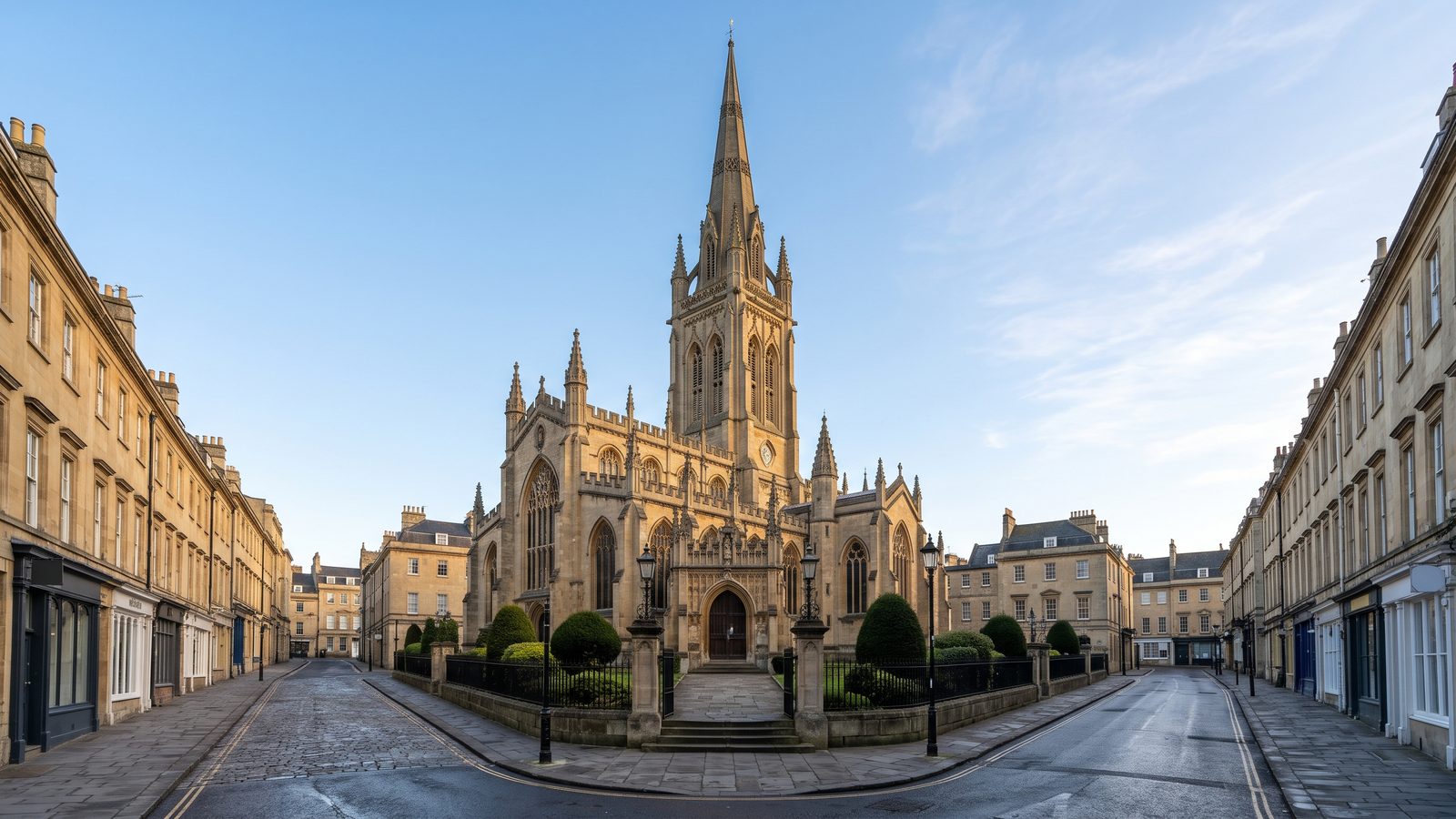
Standing just beyond Bath's historic city walls, St Michael's Church—traditionally known as 'St Michael's Without'—presents a captivating journey through British architectural history. While the honey-coloured Victorian Gothic façade you see today dates from the 19th century, this hallowed site has witnessed over a thousand years of continuous worship. From Saxon roots to Georgian expansion and Victorian reinvention, St Michael's remains an irreplaceable cornerstone of local identity.
On this self-guided audio tour, you will discover the building's dramatic architectural transformations. Explore its soaring 180-foot spire, luminous stained glass windows by Clayton and Bell, and the hidden layers of ancient foundations resting beneath the nave's worn flagstones, all while experiencing the quiet serenity of this active place of worship.
Listen to a sample
The opening of this tour, exactly as AllTours narrates it on site.
What you'll hear on this tour
Stop 1. The Soaring 180-Foot Spire
You cast your eyes upward to admire the soaring Victorian spire, an impressive 180-foot beacon crafted from warm, honey-coloured Bath stone. Added in the 1860s to replace a much humbler medieval tower, this towering structure dominates the city skyline. As you look closer, notice how delicate stone crockets resemble climbing foliage along its sharp angles. Legend whispers that renowned architect Sir George Gilbert Scott personally supervised the placement of the uppermost finial, ensuring its perfect alignment with the celestial north star. Designed to inspire awe and spiritual connection, this lofty spire stands as an enduring symbol of 19th-century artistic ambition reaching skyward above Bath.
Stop 2. Clayton and Bell's East Window
You step towards the chancel to take in the breathtaking East Window, a magnificent Victorian masterpiece installed in the 1860s. Crafted by the famous London studio Clayton and Bell, this vibrant stained-glass window floods the sanctuary with brilliant ruby reds, sapphire blues, and rich amber tones. At the base of the window, you can trace the dramatic scene of the Archangel Michael defeating the dragon, while celestial hosts rise toward divine glory above. When morning sunbeams filter through these delicate panes, they cast colorful, kaleidoscopic patterns across the ancient stone floor, turning this quiet architectural corner into a luminous visual sermon of faith and renewal.
Stop 3. Masterpiece of Victorian Gothic Revival
You stand before the grand exterior of St Michael's Church, taking in a textbook example of Victorian Gothic Revival architecture designed by George Phillips Manners in 1835. As you examine the façade, observe the soaring pointed arches, steeply pitched rooflines, and delicate stone tracery surrounding the lancet windows. Built from signature Bath stone, the design deliberately rejected the plainer Georgian classical styles of the previous century in favor of medieval grandeur. Strong buttresses and tall pinnacles anchor the impressive tower, creating a sense of dramatic verticality. Every carved detail reflects a passionate mid-19th-century movement aimed at evoking ancient spiritual reverence through bold architectural form.
Stop 4. A Thousand Years of Worship
You are standing on ground that has sustained continuous worship for more than a millennium. A humble Saxon church likely occupied this spot long before the Norman Conquest, making way over centuries for evolving medieval structures. As Bath expanded dramatically in the Georgian era, workers demolished the medieval building to erect a classical church in 1742. However, when the Gothic Revival swept Victorian England less than a century later, classicism fell out of favor. In 1835, architect George Phillips Manners began constructing the present Gothic Revival building, artfully evoking ancient traditions upon foundations that have anchored Bath's spiritual community through every era.
Stop 5. Echoes Beneath the Flagstones
As you step inside the nave, high vaulted arches immediately guide your gaze upward. Beneath your feet, the floor covers the remains of at least two earlier churches built on this sacred site since Saxon times. You can admire the rich narrative details throughout the sanctuary, from stained-glass panels commemorating generous local benefactors to the intricate woodcarvings embellishing the oak pulpit. For generations, this interior has served as a living community archive, hosting countless baptisms, weddings, and memorial services. Every stone, window, and timber pew holds silent memories of the daily lives and spiritual devotions that have shaped Bath for centuries.
Stop 6. The Living Sanctuary
You pause in the quiet stillness of the nave, where centuries of spiritual devotion continue to resonate today. Sunlight streams through Victorian glass windows, casting colorful light upon the central stone altar. Deep organ notes resonate through the vaulted ceiling during services, elevating prayers high above the pews. From the historic baptismal font to the intricately carved wooden pulpit, every sacred element reflects an unbroken tradition of faith spanning generations. Whether hosting morning Eucharist, joyous weddings, or quiet individual reflection, St Michael's offers visitors and local worshippers a peaceful sanctuary from the busy streets outside.
Planning your visit
- Best time to go
- Morning is best to catch the sunlight streaming through the stained-glass East Window.
- Approximate duration
- about 30 to 45 minutes
- Where to start
- Begin your visit outside the entrance on Broad Street to admire the exterior architectural details and soaring spire.
Access and conditions change seasonally — check the official site before you go.
Frequently asked questions
Is St Michael's Church, Bath worth visiting?
Yes, St Michael's Church is well worth visiting for its striking 180-foot Victorian spire, rich 1,000-year history, and magnificent Clayton and Bell stained glass.
How long do you need at St Michael's Church, Bath?
Most visitors spend around 30 to 45 minutes exploring the interior architecture, historic details, and stained-glass artwork.
What is the history of St Michael's Church in Bath?
The site has hosted continuous worship for over a thousand years. Originally a Saxon church outside the city walls, it was rebuilt in medieval times, replaced by a Georgian structure in 1742, and transformed into the present Gothic Revival church by George Phillips Manners in 1835.
Keep exploring
Header image is an AI-generated illustration of St Michael's Church, Bath. AllTours.ai is an AI audio tour guide — point your camera at any landmark and hear its story.