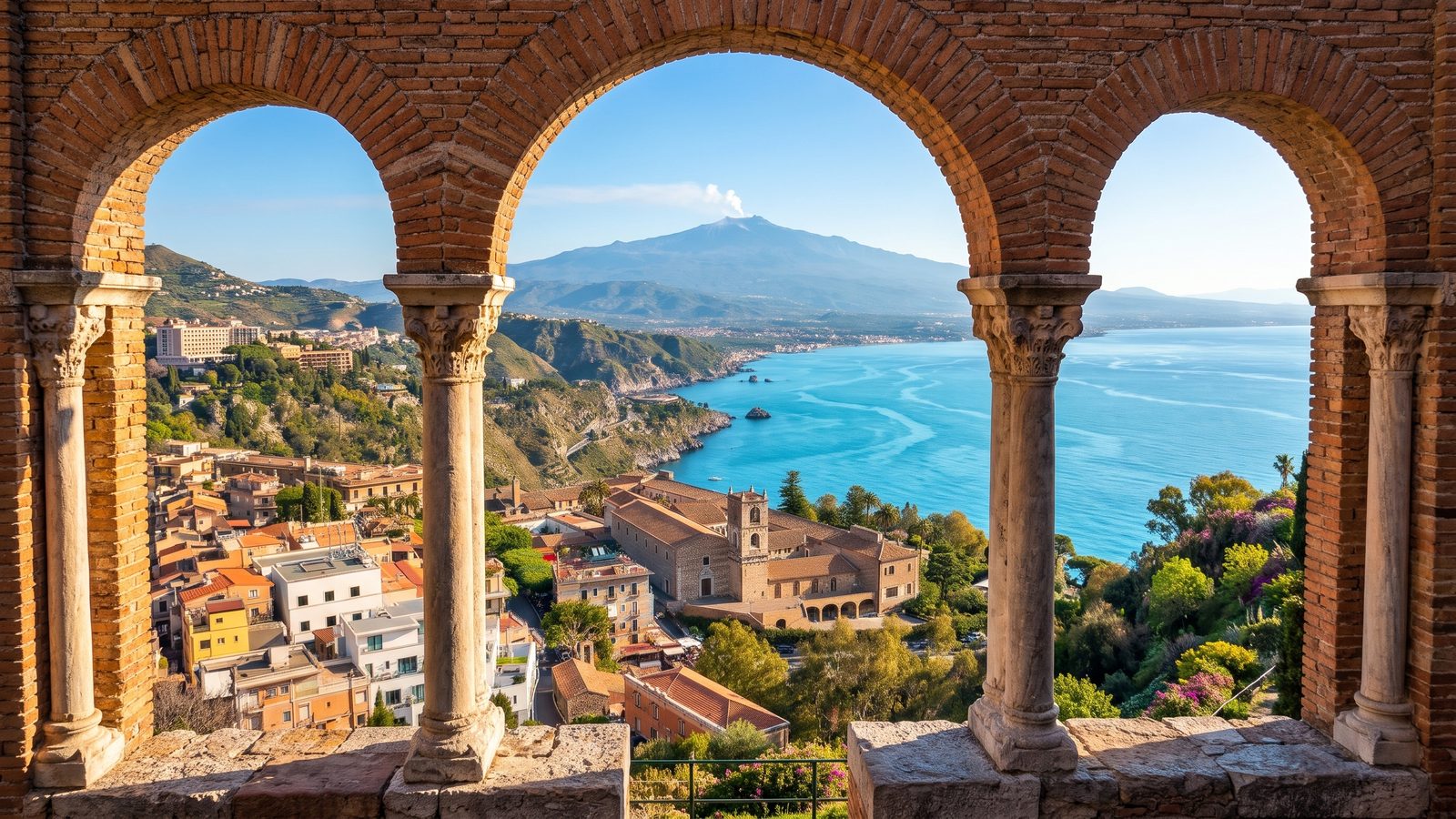
Perched high on the slopes of Mount Tauro, Taormina offers a breathtaking doorway into centuries of Sicilian history and Mediterranean beauty. Founded in the fourth century BC, this ancient hilltop town overlooks the shimmering turquoise waters of the Ionian Sea and the majestic, smoking peak of Mount Etna. As you stroll along historic lanes, discover how Greek ambition, Roman engineering, and vibrant culture shaped this timeless coastal haven.
This self-guided audio tour leads you through Taormina’s iconic sights, from sweeping panoramic terraces to historic ruins. Marvel at world-famous architecture, explore rich literary heritage, and immerse yourself in authentic Sicilian daily life as you experience one of Italy’s most captivating destinations.
Listen to a sample
The opening of this tour, exactly as AllTours narrates it on site.
What you'll hear on this tour
Stop 1. Panoramic Windows to Mount Etna
From this high vantage point, your gaze sweeps across a breathtaking panorama framed by ancient history and living geology. Immediately, the majestic silhouette of Mount Etna commands your attention, its active peak often crowned with smoke above Sicily's vibrant landscape. Down below, your eyes follow the coastline as it curves elegantly towards Naxos Bay, marking where the island's first Greek settlers landed. You look directly onto the turquoise waters of the Ionian Sea, where the lush jewel of Isola Bella sits cradled in the bay. Inside the ancient Greek Theatre, this legendary view frames every performance, blending monumental ancient stonework seamlessly with the dramatic light, endless sea, and towering volcano.
Stop 2. Hellenistic Ingenuity and Roman Transformation
You stand before the ancient Greek Theatre, marveling at the brilliant engineering of its builders. Hellenistic craftspeople carved the seating directly into the natural slopes of Monte Tauro, creating exceptional acoustics and a colossal auditorium holding thousands. As you look closer, you observe how later Roman architects transformed the space, converting the orchestra into a gladiatorial arena bounded by robust brickwork and protective walls. Up on stage, the soaring backdrop of the scaenae frons once held decorative statues within intricate niches. You notice alternating bands of brick and local limestone, revealing sophisticated Roman structural techniques built directly atop the precisely cut stone seats of the original Greek artisans.
Stop 3. Literary Legends and Vibrant Sicilian Life
As you wander through Taormina, you enter a haven steeped in legendary creative energy. You trace the footsteps of famous authors like D.H. Lawrence, who penned Lady Chatterley's Lover in a nearby villa, alongside Truman Capote and Oscar Wilde, who drew deep inspiration from these dramatic heights. Today, this rich artistic history thrives during the summer Taormina Arte festival, when the ancient theatre hosts film screenings, plays, and concerts. Along Corso Umberto, you join locals in the evening passeggiata, observing elegant fashion and warm Sicilian hospitality. Pausing at a bustling outdoor café, you savor a refreshing granita, embracing the deliberate pace of daily life.
Stop 4. From Greek Refuge to Byzantine Stronghold
You step back into 358 BC, when Andromachus gathered survivors from the destroyed colony of Naxos to establish Tauromenion on these defensive slopes. Built as a bold stand against Syracusan control, the settlement later flourished under Roman rule into a glamorous resort for wealthy patricians. Its strategic location made it a fierce prize throughout antiquity. You trace the dramatic turning point in 902 AD, when Taormina fell after a grueling siege, surrendering as the final Byzantine bastion in eastern Sicily to Arab invaders. This crucial conquest transformed the town's cultural identity, setting the stage for its eventual Norman revival and creating the rich historical layers beneath your feet.
Stop 5. Secret Grottos and Shifting Tides
Looking down toward the crystalline Ionian Sea, you discover a spectacular coast carved by ancient volcanic forces. Below lies Isola Bella, connected to the mainland by a thin sandbar that continuously appears and disappears with the tide. Once the private garden retreat of 19th-century Scottish noblewoman Florence Trevelyan, this lush island now thrives as a protected nature reserve for flora and seabirds. Further along the cliffside, sunlight streams into the submerged opening of the Grotta Azzurra, filling the sea cave with an otherworldly blue radiance. Along the shore, smooth volcanic pebbles polished by centuries of crashing waves highlight Sicily's raw coastal beauty.
Stop 6. Volcanic Soil and Blooming Terraces
You feel the dynamic power of Mount Etna shaping Taormina’s surrounding ecosystem. Rich volcanic ash carried down over centuries nourishes fertile terraces where citrus groves and ancient olive trees cling to the steep hillsides. Looking toward the coast, brilliant cascades of magenta and orange bougainvillea spill over historic stone walls against the deep blue Mediterranean sky. The sea breeze carries the intoxicating perfume of wild jasmine and sweet prickly pear blossoms growing across the resilient scrubland. Above it all, the famous light of Taormina strikes the dark volcanic rock and shimmering sea, creating a luminous glow that defines this stunning coastal environment.
Planning your visit
- Best time to go
- Spring or early autumn in the morning or late afternoon for gentle sunlight, milder temperatures, and clear views of Mount Etna.
- Approximate duration
- About 2 hours
- Where to start
- Piazza IX Aprile or the entrance area near the Greek Theatre on Mount Tauro.
Access and conditions change seasonally — check the official site before you go.
Frequently asked questions
Is Taormina worth visiting?
Yes, Taormina is widely considered one of Sicily's top destinations due to its remarkable Greek Theatre, dramatic views of Mount Etna, beautiful coastline at Isola Bella, and rich cultural history.
How long do you need at Taormina?
A visit of 2 to 3 hours is ideal for walking through the main historic center, exploring the ancient theatre, and taking in the coastal views.
When was Taormina founded and by whom?
Taormina was founded in 358 BC by Andromachus, who gathered survivors from Naxos, Sicily's first Greek colony, to establish Tauromenion on the slopes of Mount Tauro.
Keep exploring
Header image is an AI-generated illustration of Taormina. AllTours.ai is an AI audio tour guide — point your camera at any landmark and hear its story.