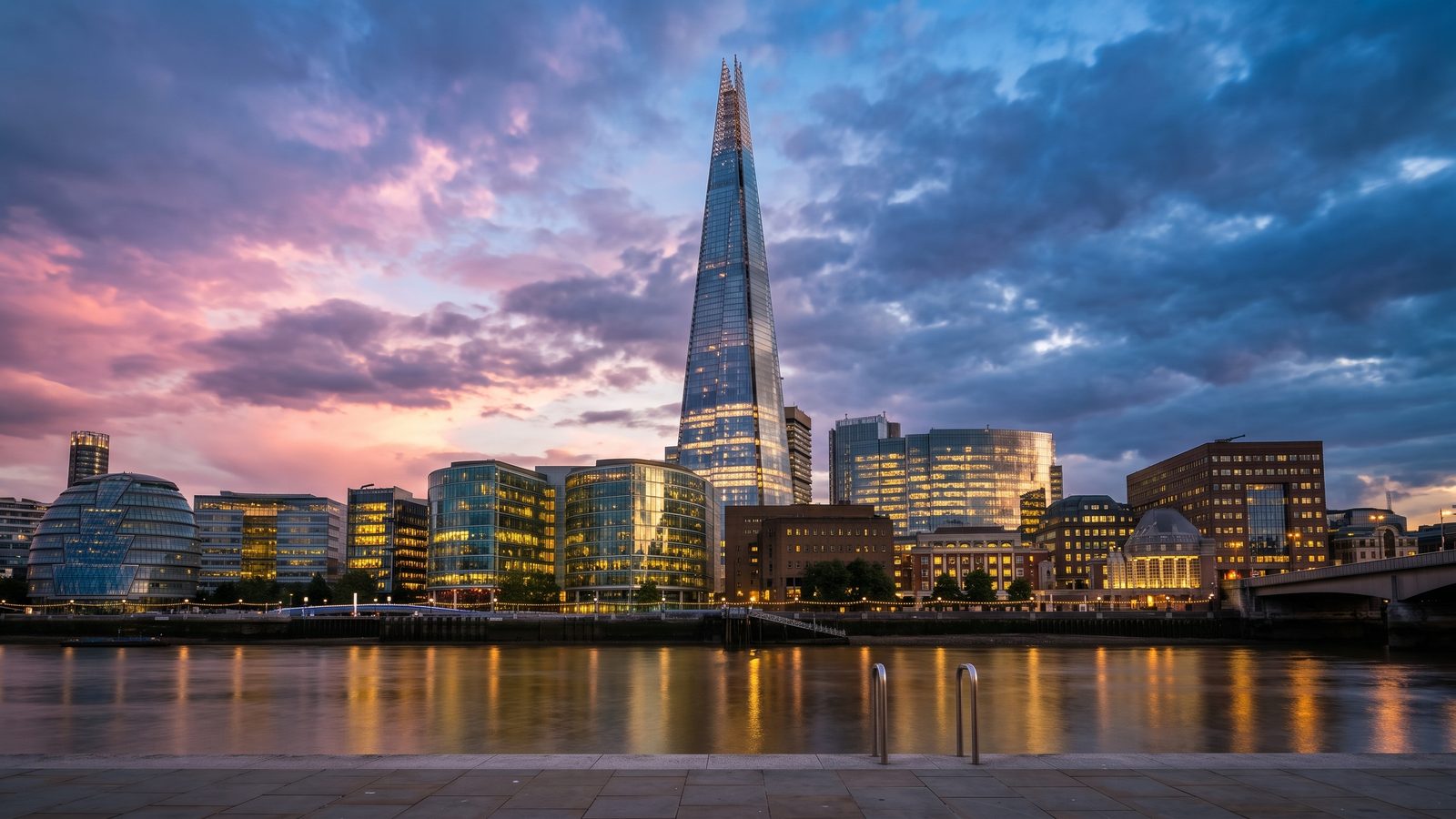
Soaring high above the River Thames, The Shard stands as a spectacular symbol of modern London. Designed by renowned architect Renzo Piano, this 87-story glass pyramid redefines the city's historic skyline while serving as a vibrant vertical city. As you explore its observation decks, you will discover the engineering marvels, rich history, and panoramic views that make this landmark an essential stop on any London journey.
This self-guided audio tour leads you through the building's creation and its extraordinary vantage points. From Roman history along the Thames to modern architectural feats, you will gain a deeper appreciation for London's past, present, and future as you gaze out over the sprawling metropolis below.
What you'll hear on this tour
Stop 1. Renzo Piano's Vertical City
You stand before Renzo Piano's vision of a vertical city, a soaring structure designed to blend into London's sky. Notice how its eight slanting glass facades, known as the shards, reflect the light around you. The architect specifically selected extra-white, low-iron glass to maximize transparency and prevent the building from appearing as a dark, monolithic mass. As your eyes follow the tapering silhouette upward, you see the unfinished spire where the open glass panels allow natural ventilation and heat dissipation. This deliberate design choice blurs the boundary between interior and exterior space, letting you feel connected to the elements high above the city streets.
Stop 2. From Office Block to Landmark
You are looking at a location that once held Southwark Towers, an uninspired 1970s office block demolished for this ambitious project. Developer Irvine Sellar envisioned a new skyline icon here in 2000, though the plan faced intense opposition over historic views of St. Paul's Cathedral. Following a major public inquiry, Deputy Prime Minister John Prescott approved construction in 2003. Groundbreaking began in 2009, bringing architect Renzo Piano's initial concept of a shard of glass into reality. The spire topped out in 2012 for the London Olympics, and the building officially opened to the public in 2013 as Western Europe's tallest skyscraper at the time.
Stop 3. The Sprawling Urban Tapestry
From high above London, you watch the urban tapestry unfold across every horizon. Your eyes follow the serpentine curve of the River Thames, linking historic sites like the medieval Tower of London with the modern glass towers of Canary Wharf. Below you, notice the contrast between the dense, irregular Roman and medieval street patterns of the City and the grand, ordered avenues of Westminster. Green lungs like Hyde Park break up the urban density, while uniform red-tiled Georgian terraces meet Victorian housing. Modern skyscrapers like the Walkie-Talkie and Gherkin rise around the central financial district, framed by the enduring dome of St. Paul's Cathedral.
Stop 4. The Lifeblood of London
You gaze down at the majestic serpentine curve of the River Thames, the historical lifeblood of London. This vital waterway nurtured Roman Londinium two millennia ago and served as the city's primary highway for centuries, carrying medieval barges, royal processions, and winter frost fairs across its frozen surface. Today, you see sleek commuter ferries, historic Thames Clippers, and working tugboats navigating the powerful tidal currents. Each bridge spanning the water marks a historical connection between the north and south banks, reminding you how this ancient river continually shapes the growth, character, and daily rhythm of the metropolis sprawling beneath your feet.
Stop 5. A Dialogue Across Centuries
As you look out across the horizon, you observe centuries of architectural history engaged in a silent conversation. The timeless dome of St. Paul's Cathedral stands alongside the audacious, modern profiles of the Walkie-Talkie and the Cheesegrater. From this elevated perspective, you discern how ancient Roman street grids still guide the city below medieval spires, Victorian edifices, and contemporary glass towers. As dusk approaches, thousands of illuminated windows bring the panorama to life, illustrating London's resilience and continuous reinvention. The Shard's soaring height offers you the ultimate vantage point to watch this dynamic silhouette evolve against the ever-changing English sky.
Stop 6. Crossroads of the World
From this towering vantage point, you observe London's role as a bustling global travel hub. Directly beneath you, watch the constant movement at London Bridge Station, a vital transport nexus where regional and international commuters stream through daily. Looking toward the horizon, you might spot aircraft descending toward Heathrow and Gatwick, connecting this historic capital to every corner of the globe. Taking in this view becomes a travel experience in itself, offering you a high-altitude perspective on how millions of journeys intersect across the city's vast transit network each day, keeping London permanently tuned to a global pulse.
Planning your visit
- Best time to go
- Late afternoon before sunset to watch the city transition from daylight to twilight.
- Approximate duration
- About 1 to 1.5 hours
- Where to start
- The View from The Shard entrance at London Bridge Station, Joiners Street.
Access and conditions change seasonally — check the official site before you go.
Frequently asked questions
Is The Shard worth visiting?
Yes, visiting The Shard offers unparalleled 360-degree views of London from Western Europe's highest viewing platforms, alongside fascinating insights into the city's history and modern architecture.
How long do you need at The Shard?
Most visitors spend between 60 to 90 minutes exploring the observation decks, enjoying the views, and listening to the audio guide stories.
Who designed The Shard and when did it open?
The Shard was designed by Italian architect Renzo Piano. Construction began in 2009, topped out in 2012, and the building officially opened to the public in 2013.
Keep exploring
Header image is an AI-generated illustration of The Shard. AllTours.ai is an AI audio tour guide — point your camera at any landmark and hear its story.