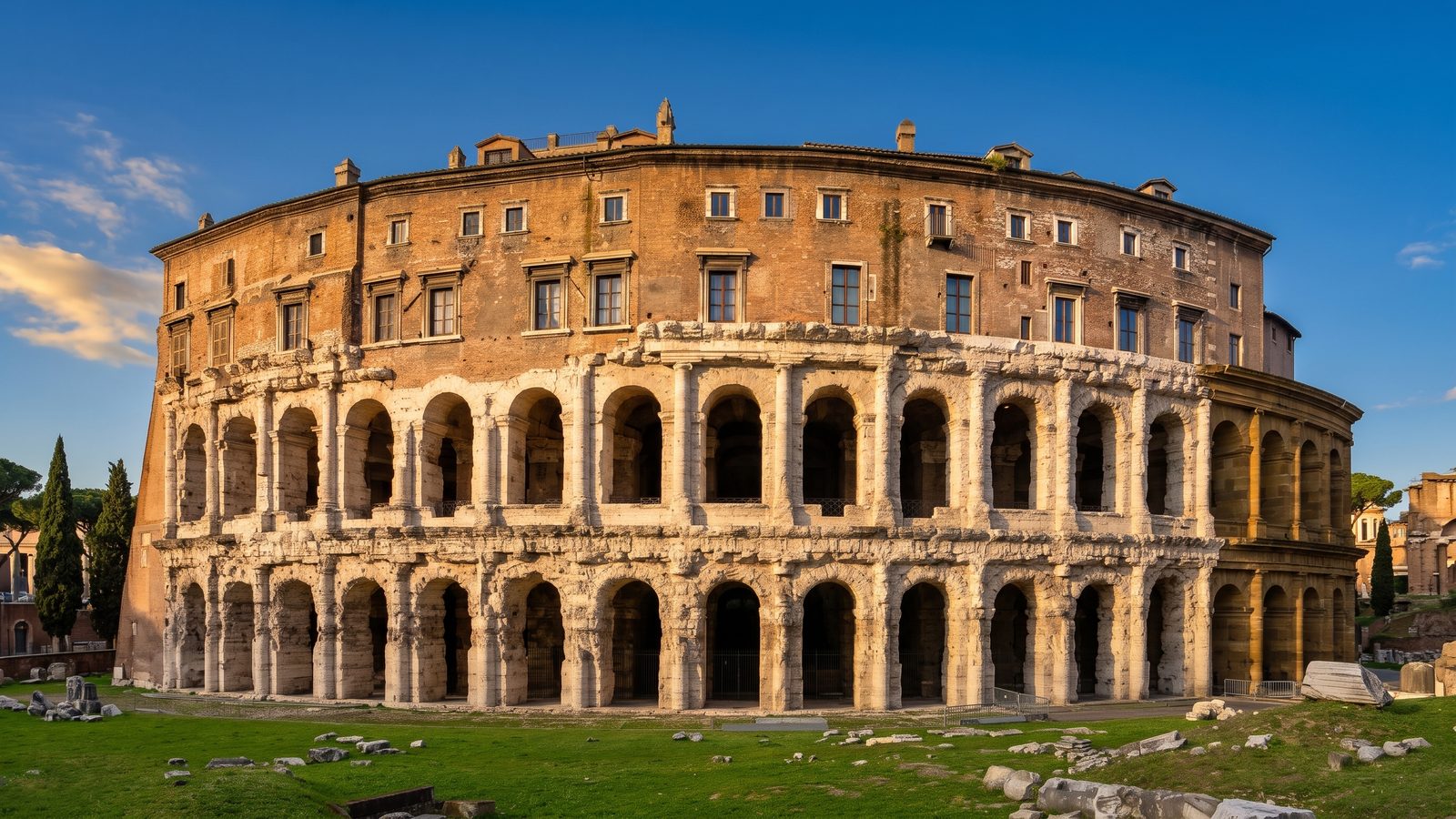
Welcome to the Theatre of Marcellus, an astonishing monument where two millennia of Roman history are physically layered atop one another. Initiated by Julius Caesar and completed under Emperor Augustus in 13 BC, this vast open-air venue once held up to 20,000 spectators. Standing before its grand travertine arcades today, you witness a remarkable survival story from classical theater to medieval fortress and Renaissance palace.
This self-guided audio tour walks you around the ancient exterior. As you explore the towering arches, you will discover how Augustus used entertainment to cement imperial power, how Renaissance architects drew inspiration from its design, and how modern Romans still live inside its top-floor apartments today.
Listen to a sample
The opening of this tour, exactly as AllTours narrates it on site.
What you'll hear on this tour
Stop 1. The Blueprint for Imperial Grandeur
As you stand before the towering facade, observe the magnificent progression of classical styles. Completed around 13 to 11 BC, this massive freestanding structure didn't rely on a natural hillside, thanks to innovative Roman concrete and radial vaulting. Look closely at the ground-level arches framed by sturdy Doric columns, topped by the more graceful Ionic order on the second story. Originally, a third tier of ornate Corinthian columns crowned the structure. This brilliant architectural formula directly inspired later monuments, including the iconic Colosseum. Feel the gleaming travertine facade under your gaze, a masterclass in Roman engineering and civic ambition that set the standard for imperial monuments.
Stop 2. From Ancient Stage to Renaissance Residence
Look up at the upper floors to witness two thousand years of continuous transformation. Dedicated in 13 BC as a grand venue for public plays, the theater's purpose shifted dramatically as the Roman Empire crumbled. By the 11th century, the powerful Savelli family converted these massive Roman arcades into a fortified medieval stronghold guarded by towers. Centuries later, in the 16th century, architect Baldassarre Peruzzi ingeniously integrated the ancient remains into a grand palazzo for the Orsini family. Today, you see modern private apartments occupying the Renaissance palace built directly atop ancient Roman arches, demonstrating an extraordinary adaptability across centuries.
Stop 3. Augustus and the Power of Spectacle
Pause here to consider the political power woven into these stones. Augustus, Rome’s first emperor, completed this massive venue around 13 BC and named it after his beloved nephew and original heir, Marcus Claudius Marcellus. By embedding his family’s name into the city's skyline, Augustus created a dynastic monument that proclaimed imperial legacy. The sheer volume of travertine transported from nearby Tivoli showcased the empire's vast resources. Hosting extravagant theatrical performances served a dual purpose: entertaining the masses while consolidating political loyalty through the famous strategy of 'bread and circuses.' You are standing before a masterwork of ancient political propaganda.
Stop 4. Echoes of Ancient Drama
Imagine the thunderous applause of up to 20,000 Roman citizens filling this immense auditorium. Inaugurated in 13 BC, the theater hosted day-long festivals featuring tragedies, comedies by Plautus, and lively pantomimes. Picture male actors wearing expressive linen masks that amplified their voices across the tiered seating. Behind them stood the scaenae frons, an elaborate architectural backdrop adorned with marble and statues. On hot summer days, a massive canvas awning called the vela stretched overhead to protect spectators from the fierce Roman sun. Here, citizens from every social class gathered under Augustus's reign, united in the shared excitement of live theater.
Stop 5. The Architectural Legacy of Palladio
Look closely at the curved footprint that still dictates the shape of the surrounding street. This ancient structure served as a textbook for Renaissance masters who sought to revive classical antiquity. Renowned architect Andrea Palladio carefully measured and sketched these very arcades, studying the precise proportions, column arrangements, and radial vaults. He incorporated these classical principles into groundbreaking architectural designs that spread across Europe. Because the theater continuously served as a fortress and residence rather than a stone quarry, its essential structure survived intact. Today, as you watch modern Romans stroll past these millennia-old arches, you see a living bridge connecting classical antiquity directly to present day.
Stop 6. Julius Caesar's Grand Vision
Consider the ancient origins of this legendary site. Julius Caesar originally commissioned the theater, clearing land in the Campus Martius. Though Caesar died before seeing it realized, Emperor Augustus completed the massive project using local tufa and travertine. Tragedy struck early when Marcellus, Augustus’s young nephew and designated successor, died before the dedication in 13 BC, turning the building into a poignant tribute. Active theatrical life continued here for centuries until waning by the 4th century AD. The robust Roman foundations you see before you ensured its survival through dark centuries of decay, warfare, and constant urban evolution.
Planning your visit
- Best time to go
- Early morning or late afternoon for soft golden light on the travertine facade and fewer crowds.
- Approximate duration
- about 30 minutes
- Where to start
- Outside the exterior arcades along Via del Teatro di Marcello.
Access and conditions change seasonally — check the official site before you go.
Frequently asked questions
Is Theatre of Marcellus worth visiting?
Yes, it is one of Rome's most visually unique ancient sites, showcasing ancient Roman arches seamlessly topped by medieval fortifications and a Renaissance palazzo.
How long do you need at Theatre of Marcellus?
You need about 20 to 30 minutes to walk around the exterior perimeter, admire the stacked architectural layers, and listen to the audio tour.
Why does Theatre of Marcellus look like the Colosseum?
The Theatre of Marcellus was completed earlier in 13 BC and served as the architectural prototype for the Colosseum, pioneering the multi-tiered arcaded facade with Doric and Ionic orders.
Keep exploring
Header image is an AI-generated illustration of Theatre of Marcellus. AllTours.ai is an AI audio tour guide — point your camera at any landmark and hear its story.