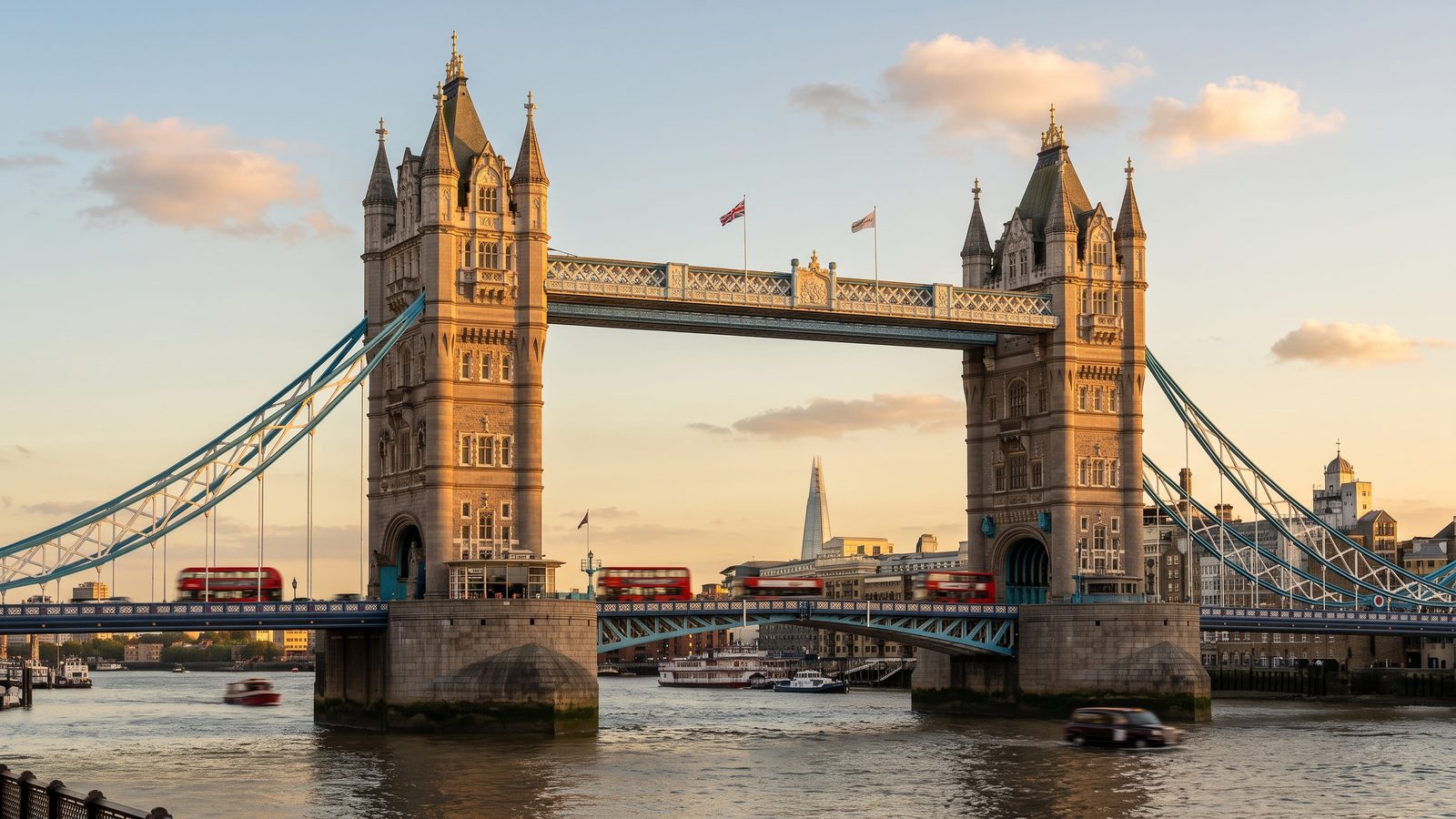
Tower Bridge stands as a magnificent masterpiece of Victorian design, spanning the historic River Thames in central London. Constructed to resolve severe traffic congestion while preserving vital shipping access to the Pool of London, its iconic twin towers and lifting bascules represent an extraordinary feat of 19th-century engineering. This self-guided audio tour walks you through the bridge's remarkable origins, architectural secrets, elevated walkway views, and historic engine rooms.
Whether you are looking through the thrilling glass floor at traffic below or admiring ornate Gothic Revival stonework up close, this immersive audio journey reveals the human stories and structural genius behind London's most famous landmark. Step back into industrial history and explore the city from a unique perspective.
What you'll hear on this tour
Stop 1. The Secret Mechanics Behind the Bascules
As you examine this structural marvel, you appreciate the brilliant engineering of its lifting bascules. Each massive leaf weighs over one thousand tons, pivoting upward effortlessly through an ingenious counterweight system. You learn that steam-driven pumping engines once generated hydraulic pressure to lift the spans, while modern electric motors pump oil today using those same fundamental hydraulic principles. Notice how ornate Cornish granite and Portland stone clad the inner steel framework, protecting vital metalwork from the harsh elements while maintaining structural integrity. Far below the water line, massive caissons rest deep in the Thames riverbed, anchoring the entire structure to support immense weight and dynamic forces.
Stop 2. Walkways in the Sky and Glass Floors
You step out onto the high-level walkways and watch London unfold around you in a panoramic spectacle. Looking west, you see the ancient stone battlements of the Tower of London standing beside sleek financial skyscrapers like the Gherkin and the Walkie-Talkie. Directly beneath your feet, the thrilling glass floor reveals a dizzying perspective of the Thames, transforming rushing currents, floating boats, and iconic red buses into a dynamic visual story. As you gaze across the skyline, you witness the city's continuous evolution, seeing how historic architecture and modern ambition meet above the water. This elevated vantage point places you right inside London's vibrant heart.
Stop 3. Solving Late Victorian London's River Crossing
You travel back to late nineteenth-century London, where expanding East End traffic urgently requires a new river crossing without blocking vital shipping in the Pool of London. After evaluating over fifty proposals, the Corporation of London selects a groundbreaking hybrid design by City Architect Horace Jones and civil engineer John Wolfe Barry in 1884. Construction begins in 1886, requiring eight years of intense labor from 432 workers who sink massive concrete piers into the riverbed. When the bridge officially opens on June 30, 1894, steam-driven hydraulic engines power its bascules, establishing a historic milestone that showcases Victorian industrial prowess to the world.
Stop 4. Victorian Gothic Elegance on the Thames
You observe a masterclass in Victorian Gothic Revival architecture as you admire the ornate twin towers. Architects Horace Jones and George D. Stevenson deliberately cloak cutting-edge steel skeletons in Cornish granite and Portland stone, ensuring the structure harmonizes with the nearby Tower of London. Take a moment to examine the delicate turrets, pointed arch windows, and mock battlements crowning each pinnacle. These decorative elements lend medieval grandeur to a building housing heavy industrial machinery. Even high-level walkways seamlessly integrate intricate ironwork, connecting the towers like a cathedral nave while framing the rising bascule leaves into a dynamic architectural display.
Stop 5. Victorian Engine Rooms and Interactive Displays
You step inside the magnificent Victorian Engine Rooms, surrounded by massive, meticulously preserved steam engines that once powered the bridge's heavy bascules. Polished steel and complex iron mechanisms bring the energy of Victorian industrial artistry to life. As you explore the enclosed high-level walkways, interactive exhibits tell the stories of construction workers, operators, and daily life in the recreated Bridge Master's Office. Standing above the glass floor, you look down onto Thames traffic while surrounded by historical artifacts. From early architectural concepts to its modern status as a global icon, the exhibition reveals the human ingenuity behind London's most famous landmark.
Stop 6. The Lifeline of the Pool of London
You look down at the River Thames flowing steadily beneath the bridge, feeling the pulse of London's historical trade artery. This stretch of water, known as the Pool of London, once operated as the world's busiest port, welcoming ships from across the globe. You observe how powerful tidal currents rise and fall by several meters twice daily, dictating maritime navigation for centuries. The bridge's lifting bascules were specially designed to respect this vital river, allowing tall-masted vessels to sail upstream uninterrupted. Standing here today, you connect with two thousand years of history carved into the moving waters below.
Planning your visit
- Best time to go
- Early morning or late afternoon to avoid peak crowds on the walkways.
- Approximate duration
- About 1 to 1.5 hours
- Where to start
- North Tower entrance near the Tower of London.
Access and conditions change seasonally — check the official site before you go.
Frequently asked questions
Is Tower Bridge worth visiting?
Yes, visiting Tower Bridge offers a unique mix of Victorian engineering history, panoramic London views, high-level glass floor walkways, and access to the original steam engine rooms.
How long do you need at Tower Bridge?
Most visitors spend about 1 to 1.5 hours exploring the high-level walkways, checking out the glass floors, and exploring the Victorian Engine Rooms.
When was Tower Bridge built and why?
Construction began in 1886 and the bridge officially opened on June 30, 1894. It was built to ease East End traffic congestion without blocking river access to the Pool of London.
Keep exploring
Header image is an AI-generated illustration of Tower Bridge. AllTours.ai is an AI audio tour guide — point your camera at any landmark and hear its story.