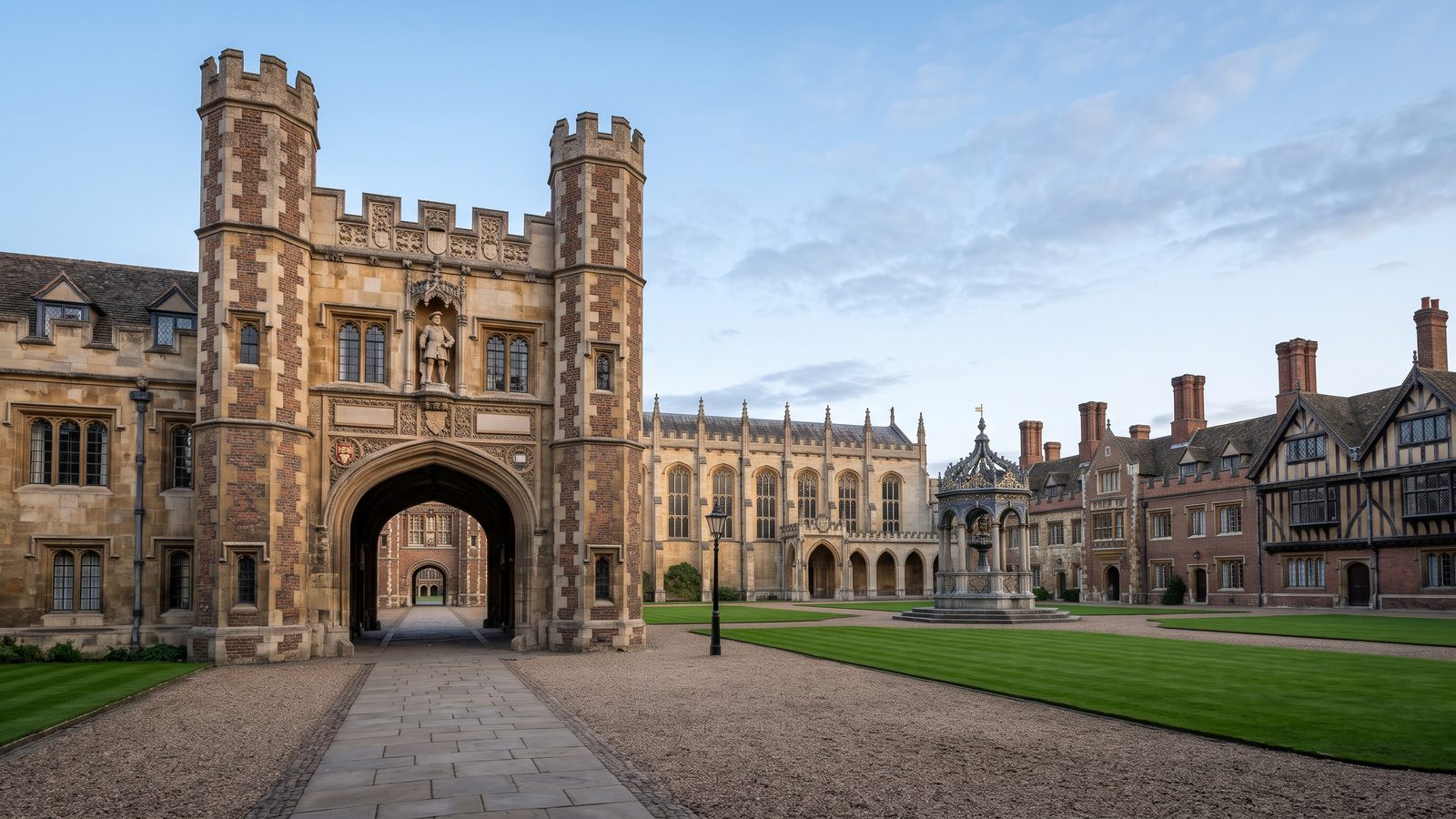
Welcome to Trinity College, Cambridge, a titan of intellect, history, and royal ambition founded by King Henry VIII in 1546. As you step into this historic realm, you follow in the footsteps of groundbreaking minds like Sir Isaac Newton, Lord Byron, and Lord Tennyson. Explore grand Tudor gateways, peaceful gardens along the River Cam, and a college that has nurtured more Nobel laureates than many whole nations.
This self-guided audio tour leads you through Trinity's majestic courts and riverside landscapes. You will discover how a Tudor monarch merged medieval halls into Cambridge's largest college, while uncovering centuries of academic tradition, world-changing scientific discoveries, and iconic river culture along the Backs.
Listen to a sample
The opening of this tour, exactly as AllTours narrates it on site.
What you'll hear on this tour
Stop 1. The Legacy of Great Court
You step into Great Court, one of Europe's largest enclosed quadrangles and a true stage for centuries of intellectual genius. Founded by King Henry VIII in 1546 to be the grandest of all foundations, this court surrounds you with inspiring academic history. Look around to imagine Sir Isaac Newton formulating his groundbreaking theories right where you stand. Nearby, you can observe a living descendant of the famous apple tree that sparked his law of gravity. As you walk across these stones, you gaze upon the exquisite Wren Library housing priceless manuscripts. You are experiencing a place that has produced more Nobel laureates than entire countries.
Stop 2. From Tudor Gate to Baroque Masterpiece
Stand in Great Court and admire the magnificent Great Gate, built from brick and faced with Ketton stone. You observe intricate carvings around Henry VIII's statue, displaying early Tudor Renaissance power. Master Thomas Nevile brought classical symmetry to these surrounding ranges. Next, you transition into Nevile's Court, where the architectural style shifts dramatically toward Sir Christopher Wren's masterpiece, the Wren Library. You gaze at its Portland stone façade, adorned with colossal pilasters, large arched windows, and allegorical figures on the pediment. Designed to flood its interior with natural light, this building represents a revolutionary leap from Tudor Gothic tradition to the refined classical ideals of the Enlightenment.
Stop 3. Sacred Glass and Scientific Genius
You enter the quiet majesty of Trinity Chapel, constructed between the reigns of Mary I and Elizabeth I before its consecration in 1567. Looking upward, you marvel at the delicate Tudor fan vaulting that seems to defy gravity. As light streams inside, you discover a striking stained-glass panel depicting Sir Isaac Newton holding a prism, honoring his revolutionary study of light. You run your eyes along the dark oak choir stalls, marked by generations of students and fellows engaged in daily devotion. Here, surrounded by sacred music from the majestic organ, you experience a living monument where faith and rigorous scientific inquiry exist side by side.
Stop 4. Tranquil Backs and Newton's Tree
Leaving the stone quadrangles, you enter Trinity’s peaceful grounds. You discover the secluded Fellows' Garden, a sanctuary where scholars have contemplated big ideas for centuries. Pathways lead you out toward the Backs, where expansive green lawns sweep gently down toward the River Cam. You walk along the same paths where literary giants like Lord Byron and Lord Tennyson once sought poetic inspiration under ancient trees. Nearby, you encounter a direct descendant of Sir Isaac Newton's famous apple tree, standing as a living symbol of scientific discovery. These beautiful gardens offer you a refreshing break from heavy academic study while connecting you deeply with nature.
Stop 5. Gliding Along the River Cam
You look out over the gentle waters of the River Cam as flat-bottomed wooden punts glide past. Originally used by workers to transport cargo along shallow riverbanks, these craft were adapted by late 19th-century students into a cherished Cambridge pastime. You imagine standing on the rear deck, guiding the vessel forward by pushing a long pole against the muddy riverbed. Adopting the distinct forward-facing Cambridge stance, you navigate past the iconic backs of the colleges and historic stone bridges. Punting remains a quintessential rite of passage, offering you an intimate, floating perspective of Trinity's riverside architecture, lush gardens, and living student tradition.
Stop 6. Henry VIII and Royal Ambition
You stand on historic ground shaped by the intense political and religious changes of 1546. Seeking to consolidate power and leave a grand legacy, King Henry VIII dissolved two older medieval institutions—Michaelhouse, founded in 1324, and King's Hall, dating to 1317. By combining their wealth and land, Henry created Trinity to be the largest and richest college across Oxford and Cambridge. His vision established an intellectual bulwark to support his newly reformed church and train future leaders of state. As you wander through these courts, you walk inside a bold monarch's grand experiment that forever transformed the English academic landscape.
Planning your visit
- Best time to go
- Morning or late afternoon on a dry spring or summer day for clear light and pleasant walks along the Backs.
- Approximate duration
- About 1 to 1.5 hours
- Where to start
- The Great Gate on Trinity Street, main entrance to Great Court.
Access and conditions change seasonally — check the official site before you go.
Frequently asked questions
Is Trinity College, Cambridge worth visiting?
Yes, Trinity College is one of Cambridge's largest and most famous colleges. Visitors can admire Great Court, see Sir Christopher Wren's library, view Newton's apple tree descendant, and explore the beautiful gardens along the River Cam.
How long do you need at Trinity College, Cambridge?
Most visitors spend 1 to 2 hours exploring Trinity College. This allows enough time to visit Great Court, the Chapel, the Wren Library area, and stroll along the river at the Backs.
Who founded Trinity College, Cambridge and when?
Trinity College was founded in 1546 by King Henry VIII, who merged two older existing colleges, Michaelhouse (1324) and King's Hall (1317), to create the largest college in Cambridge.
Keep exploring
Header image is an AI-generated illustration of Trinity College, Cambridge. AllTours.ai is an AI audio tour guide — point your camera at any landmark and hear its story.