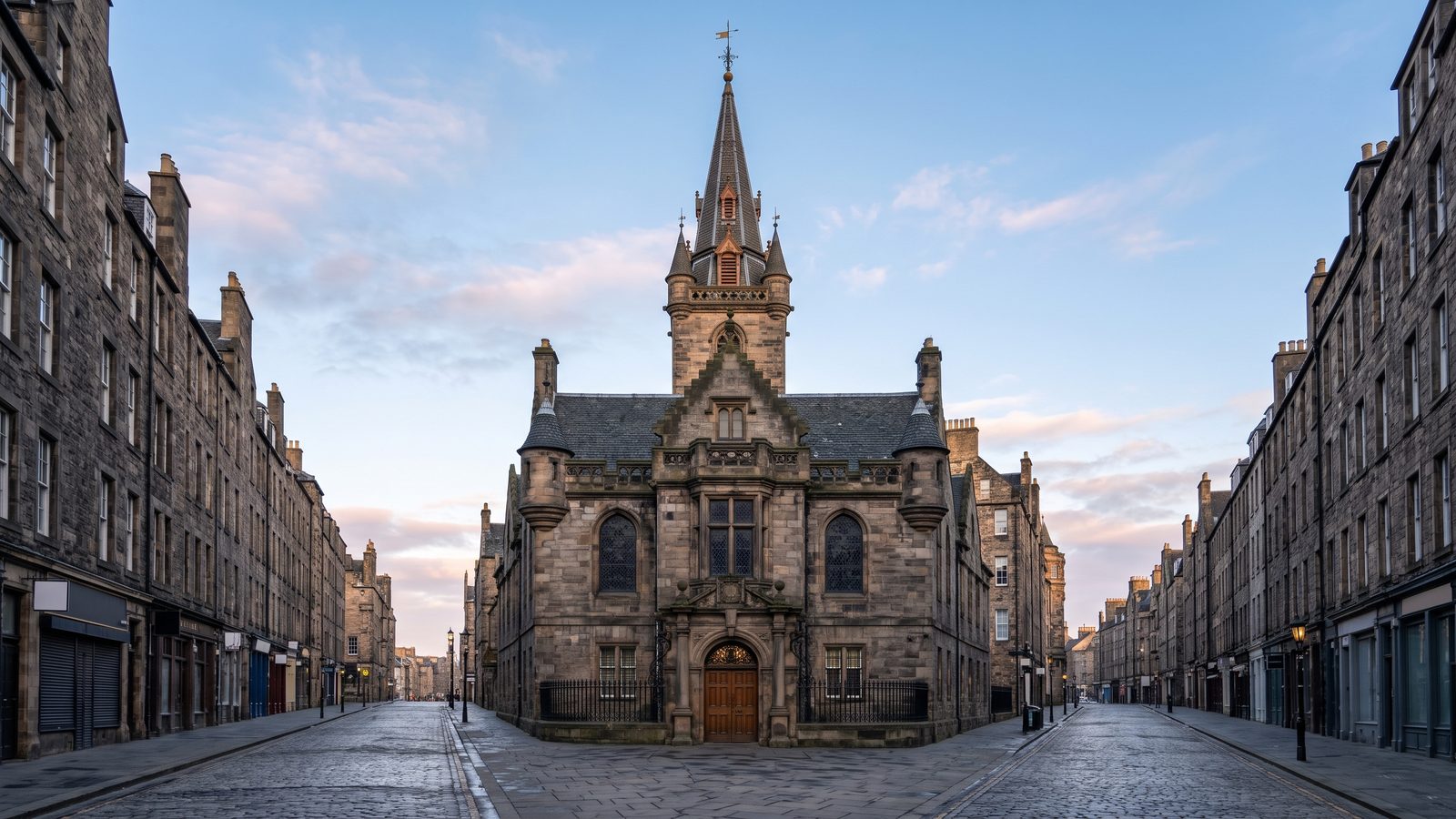
You stand before the Tron Kirk, a resilient centerpiece of Edinburgh's historic Royal Mile. Named after the public weighing beam that once stood nearby, this 17th-century structure has served as a parish church, a bustling market hub, and the traditional meeting site for Hogmanay celebrations. Step closer to appreciate its unique blend of architectural styles and the centuries of commercial and cultural history woven into its sandstone walls.
As you explore, this self-guided tour guides you through the church's origins during Scotland's turbulent Covenanter era, its devastating fire in 1824, and its dramatic rebuilding. Immerse yourself in the story of a building that continually adapts while remaining the beating heart of Old Town Edinburgh.
Listen to a sample
The opening of this tour, exactly as AllTours narrates it on site.
What you'll hear on this tour
Stop 1. The Bustling Heart of Royal Mile Trade
You stand where the city's commercial pulse beat loudest for centuries. Look around and imagine the bustling square surrounding the Tron Kirk, named after the public weigh-beam, or 'tron,' that once stood directly outside. All goods entering Old Town were officially measured and taxed here. Picture the sensory overload of daily life: the aroma of fresh fish and warm bread, the loud shouts of hawkers selling woolens and spices, and the ceaseless chatter of merchants haggling over prices. This square served as Edinburgh's primary stage for civic announcements, news exchange, and trade, shaping the rhythm of life for every local resident along the surrounding closes.
Stop 2. A Gathering Place for Celebrations and Community
You step toward a building that has served as Edinburgh's cultural barometer for generations. Beyond its religious role, the Tron Kirk became a central community hub where citizens gathered for news and civic life. For centuries, thousands of people congregated beneath its clock tower every New Year's Eve to celebrate Hogmanay, eagerly waiting for the midnight bells to chime across the Royal Mile. You can almost feel the joy and camaraderie echoing off these historic walls. Today, the church continues its social tradition by adapting into a dynamic venue hosting local art exhibitions, artisan craft markets, and Edinburgh Fringe festival performances.
Stop 3. Sandstone Base and Lead-Covered Spire
You examine the striking contrast etched into the church's exterior stonework. Notice the robust, fortress-like lower tower constructed from local sandstone in the 1630s, displaying subtle Scottish vernacular Baroque details. As your eyes ascend, look up at the elegant octagonal, lead-covered spire. This spire is a 19th-century replacement built after a devastating fire destroyed the original wooden structure in 1824. Observe the large, arched windows lining the nave, designed to flood the interior with natural light—a major architectural departure from older, darker church designs. Together, these architectural elements form an enduring silhouette anchored high above the historic Royal Mile intersection.
Stop 4. Seventeenth-Century Upheaval and Transformation
You trace the turbulent timeline of a church born during a century of intense religious reform. Masons began building the Tron Kirk in 1637 to serve Edinburgh's expanding population, finishing a decade later at the peak of the Covenanting period. The structure replaced the earlier church of St. Mary in the Fields. Fast forward to 1824, when the Great Fire of Edinburgh swept through the Old Town; while the blaze gutted the church interior, the original steeple miraculously survived before being redesigned. After closing as an active parish church in 1952, the building continually reinvented itself as a visitor center, market, and cultural center.
Stop 5. Resilience, Reform, and Lasting Identity
You look upon a site representing deep layers of Scottish civic and ecclesiastical heritage. Built over foundations connected to pre-Reformation Scotland, the Tron Kirk stands as a guardian of Edinburgh's memory. Its Dutch-influenced spire symbolizes the city's remarkable recovery following catastrophic fires. In 1843, this congregation stood at the center of the Disruption, a pivotal moment in Scottish church history that led to the formation of the Free Church of Scotland. From its origins as a public weighing site to its modern incarnation as a cultural venue, the building showcases Scotland's enduring commitment to preserving history through continuous adaptation.
Stop 6. The Iconic Crossroads of Edinburgh's Old Town
You stand before a landmark that has anchored the intersection of the Royal Mile and South Bridge for centuries. Constructed between 1637 and 1647, the church features rare Dutch-influenced Baroque styling. During its early years, intense Covenanter sermons echoed within its nave during a period of fierce religious debate. Though the Great Fire of 1824 claimed its original timber spire, the resilient stone replacement you see today highlights Edinburgh's determination to rebuild. Its prominent clock tower remains an irreplaceable emblem of Old Town, serving as the city's historic meeting point where generations have gathered to welcome the New Year.
Planning your visit
- Best time to go
- Morning or late afternoon to comfortably appreciate the exterior details along the Royal Mile with lighter street crowds.
- Approximate duration
- about 30 minutes
- Where to start
- Outside the main entrance of Tron Kirk at the intersection of the Royal Mile and South Bridge.
Access and conditions change seasonally — check the official site before you go.
Frequently asked questions
Is Tron Kirk worth visiting?
Yes, Tron Kirk is worth visiting as one of the Royal Mile's most iconic historic landmarks, boasting unique 17th-century architecture, a famous spire, and a rich history connected to Edinburgh's market and Hogmanay traditions.
How long do you need at Tron Kirk?
A visit to view the architecture and appreciate the history of Tron Kirk typically takes about 20 to 30 minutes.
Why is it called the Tron Kirk?
It is named 'Tron Kirk' because it was constructed near the city's 'tron,' or public weighing beam, where merchants' goods were officially weighed and taxed in historic Edinburgh.
Keep exploring
Header image is an AI-generated illustration of Tron Kirk. AllTours.ai is an AI audio tour guide — point your camera at any landmark and hear its story.