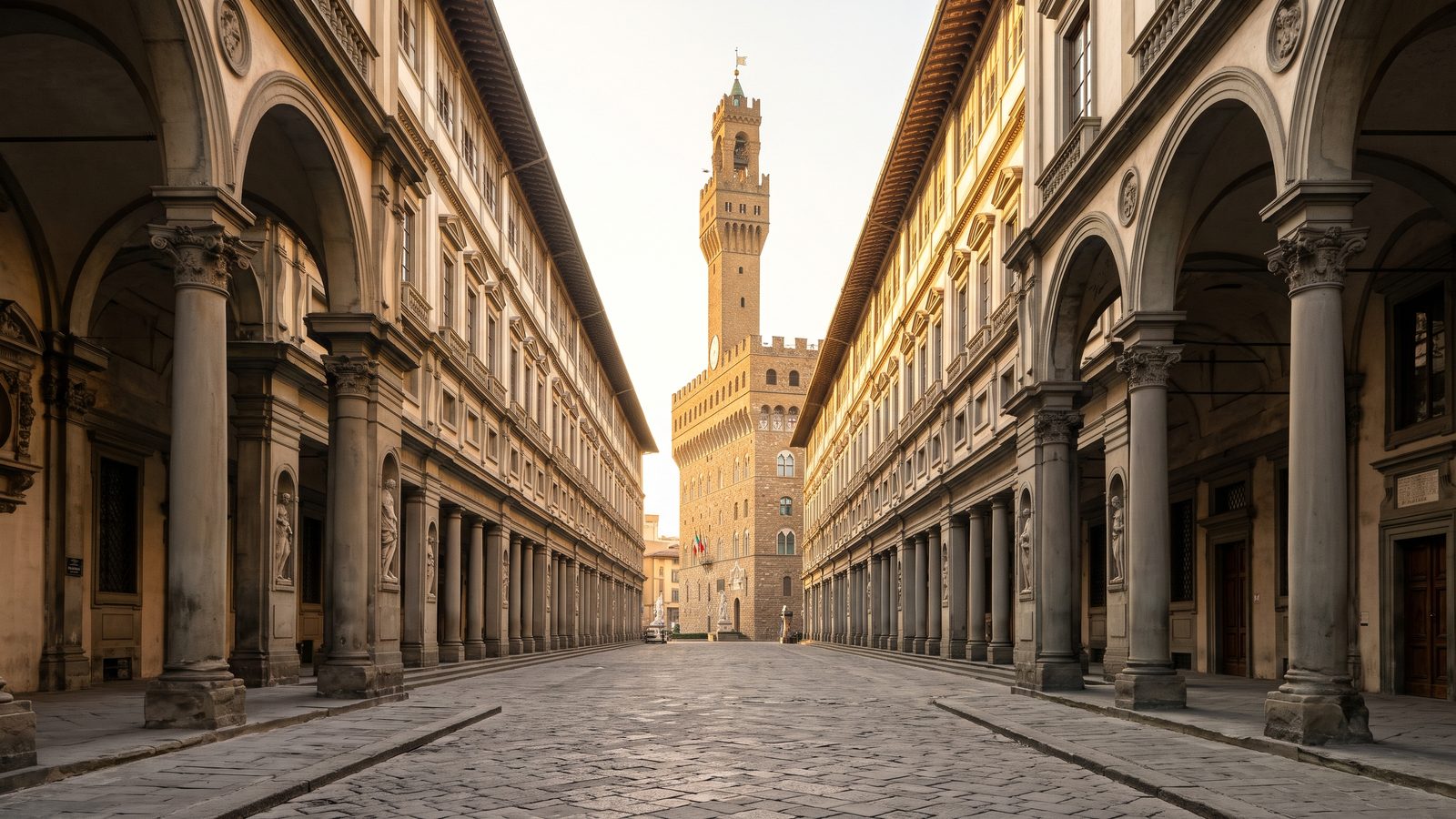
Step inside Florence's premier art museum, designed in 1560 by Giorgio Vasari as grand administrative offices for Cosimo I de' Medici. Today, the Uffizi Gallery houses an extraordinary collection of Renaissance masterpieces. As you walk its grand corridors overlooking the Arno River, this self-guided audio tour reveals the history, architectural brilliance, and artistic revolution that defined Florentine culture and reshaped the Western world forever.
Marvel at world-famous masterpieces, including Sandro Botticelli's Birth of Venus and Leonardo da Vinci's Annunciation. Learn how Medici power, humanist philosophy, and revolutionary artistic techniques transformed a civic administrative hub into a global sanctuary of timeless human genius and aesthetic elegance.
Listen to a sample
The opening of this tour, exactly as AllTours narrates it on site.
What you'll hear on this tour
Stop 1. Masterpieces of Botticelli and Da Vinci
You stand before Botticelli’s Primavera, a mysterious masterpiece painted in intricate pigment. Notice the extraordinary botanical detail woven into Flora’s floral garments, capturing Renaissance Florence's deep fascination with nature while Venus presides over a blooming mythical garden. As your eyes drift to Leonardo da Vinci’s Annunciation, observe his groundbreaking use of aerial perspective. The distant mountains recede into an ethereal mist, shifting artistic technique forever. Pay close attention to Mary’s subtle, hesitant gesture as she receives divine news—a frozen moment captured with deep human emotion. These iconic canvases act as portals directly into the vibrant soul of Renaissance masters.
Stop 2. The Medici's Seat of Governance
You walk through spaces once intended as the administrative heart of the Florentine state. In the mid-16th century, Cosimo I de' Medici commissioned architect Giorgio Vasari to build this grand palace of offices to consolidate power. Imagine these corridors bustling not with tourists, but with magistrates, clerks, and secretaries managing a powerful republic. Vasari seamlessly integrated the structure with the Arno River, visually reflecting how Medici authority flowed through the city. Beneath the grand displays of art lies this foundational legacy of civic ambition, where political governance gradually intertwined with personal Medici prestige, transforming functional administrative headquarters into a world-famous art repository.
Stop 3. Vasari's Masterwork of Renaissance Design
Look at the impressive structural elements surrounding you in this purpose-built complex, where Uffizi literally translates to offices in the Florentine dialect. Observe how heavy, rusticated stone at the lower levels creates a sturdy foundation for administrative power, before transitioning into refined ashlar masonry above. Continuous stringcourses gracefully divide each story, giving the building its elegant, elongated proportions. The grand arcades, framed by deep-set windows and strong pilasters, draw your gaze across the courtyard while maintaining architectural authority. You are admiring Renaissance urban planning at its finest—a seamless union of form, function, and visual grandeur designed to command enduring respect.
Stop 4. Titans of the High Renaissance
You are standing in the presence of true artistic titans who shaped human history through brush and chisel. Consider the profound skill of Michelangelo, whose intense anatomical studies revolutionary informed every sculpted muscle and flowing drapery in Renaissance art, constantly pushing the physical boundaries of the human form. Nearby, observe the harmonious vision of Raphael, whose serene Madonnas exude celestial grace through delicate, precise brushwork. These masters looked at the world with extraordinary intensity, translating complex humanist philosophy into tangible visual harmony. As you take in these works, you witness the absolute pinnacle of High Renaissance creativity and intellectual ambition.
Stop 5. Glazes, Light, and Realistic Form
Immerse yourself in the technical brilliance of Italian artistic innovation. Notice the luminous, rich colors glowing on the canvas around you, achieved through painstaking layers of delicate glazes perfected over generations. Florentine masters held an obsession with realism, skillfully manipulating light and shadow to bring lifelike warmth to rendered flesh tones and make divine figures feel tangibly human. Look closely at the flowing drapery; the fabric folds with naturalistic precision, demonstrating an advanced anatomical understanding derived from keen observation. Every precise brushstroke, from delicate highlights to deep shadows, reveals an unwavering Italian dedication to capturing the authentic essence of form and emotion.
Stop 6. Art as the Language of Humanism
Look closely at the art framing these halls to decode the visual identity of Florentine society. Every brushstroke and sculpted detail reflects the era's deep engagement with classical philosophy and humanist ideals. The Medici family used their vast wealth not just for patronage, but to foster an environment where visual art communicated revolutionary ideas and cemented their high social status. Examine the portraits around you—they are far more than simple likenesses. Each garment, subtle glance, and symbolic accessory carries coded messages designed for educated viewers. This entire gallery forms a vast, silent conversation expressing the intellectual aspirations of Renaissance Florence.
Planning your visit
- Best time to go
- Early morning at opening or late afternoon on weekdays to avoid peak crowds.
- Approximate duration
- About 2 to 3 hours
- Where to start
- Begin at the main entrance courtyard off Piazzale degli Uffizi near the Arno River.
Access and conditions change seasonally — check the official site before you go.
Frequently asked questions
Is Uffizi Gallery worth visiting?
Yes, the Uffizi Gallery is one of the world's premier art museums, housing essential Renaissance masterpieces by Botticelli, Leonardo da Vinci, Michelangelo, and Raphael within a historic 16th-century palace designed by Giorgio Vasari.
How long do you need at Uffizi Gallery?
Most visitors spend between 2 and 3 hours exploring the primary collection highlights, while art enthusiasts may prefer spending 4 hours or more.
Why was the Uffizi Gallery originally built?
The Uffizi was commissioned in 1560 by Cosimo I de' Medici as civic administrative offices ('uffizi') for Florentine magistrates before evolving into the private Medici art gallery.
Keep exploring
Header image is an AI-generated illustration of Uffizi Gallery. AllTours.ai is an AI audio tour guide — point your camera at any landmark and hear its story.