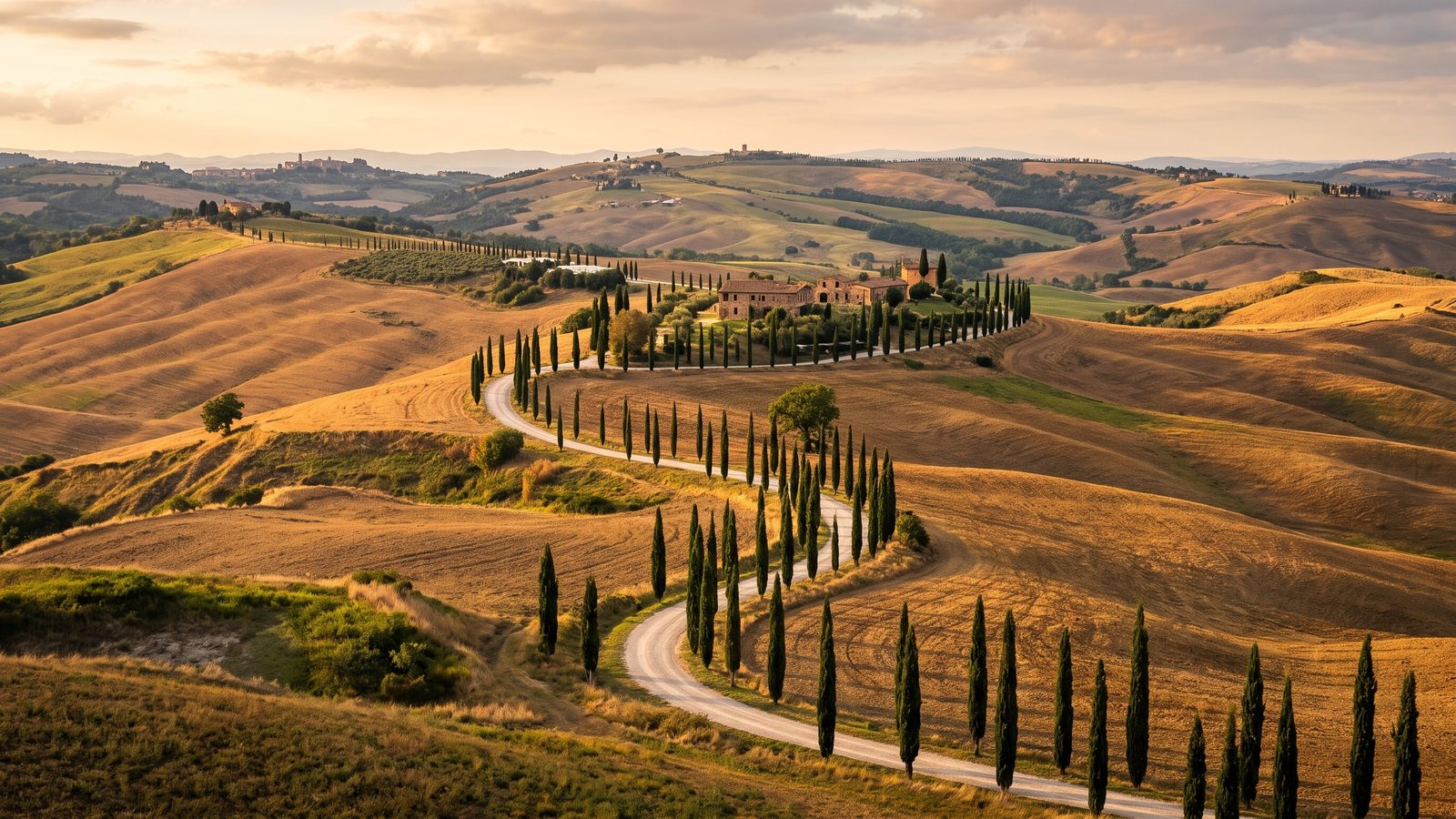
Welcome to Val d'Orcia, a UNESCO World Heritage landscape where rolling hills, cypress-lined roads, and Renaissance harmony meet. Shaped by centuries of agricultural tradition and human vision, this region connects historic hill towns like Pienza and Montalcino. As you explore, you will walk through scenes immortalized by Sienese painters, taking in sweeping panoramas of wheat fields, olive groves, and ancient Etruscan and Roman routes.
This audio tour guides you through the valley's living canvas, from dramatic clay ravines to famous culinary traditions. Immerse yourself in the story of Pope Pius II's ideal city, medieval fortresses, and regional specialties like Pecorino cheese and Brunello wine at your own relaxed pace.
Listen to a sample
The opening of this tour, exactly as AllTours narrates it on site.
What you'll hear on this tour
Stop 1. Iconic Cypress Roads and Rolling Hills
You notice how magnificent cypresses act like precise exclamation points, accentuating the rhythmic undulations of Val d'Orcia. Before you lies a landscape where human hands and natural grace have conspired across centuries to sculpt breathtaking harmony. You observe iconic s-curves of gravel roads tracing gentle hillsides, leading your eye through fields shifting from spring's vibrant green to summer's golden ochre. A living quilt of vineyards, olive groves, and tilled earth stretches endlessly, each color proving the soil's fertility. Tuscan light plays a starring role here, casting long shadows that deepen valleys and highlight rounded hills at dawn and dusk. This is a meticulously crafted visual poem of natural beauty and agricultural artistry.
Stop 2. Flavors of Pecorino, Pici, and Brunello
You awaken your senses to Val d'Orcia's gastronomy, where fertile soil shapes world-renowned flavors. You taste Pecorino di Pienza, crafted from local sheep's milk enriched by aromatic pasture herbs, enjoying delicate fresco or complex stagionato aged in ancient caves. You discover iconic pici pasta, hand-rolled thick from flour and water, absorbing rich sauces like fiery garlic aglione or slow-simmered Chianina beef ragù from cattle grazing these hillsides. To accompany your meal, you sip prestigious Brunello di Montalcino, a renowned wine born directly on these sun-drenched slopes. Every bite and sip provides a direct, delicious connection from the surrounding land to your table, celebrating centuries of simple, rustic Tuscan culinary tradition.
Stop 3. From Medieval Fortresses to Ideal Renaissance Cities
You trace human history deeply etched across these hills, starting with ancient Etruscans and Romans who established vital trade arteries like the Via Cassia. During the Medieval era, strategic importance grows as feudal lords and Cistercian monks build formidable castles at Montalcino and Rocca d'Orcia. You observe how the Sienese Republic transforms the valley into its crucial granary, leaving architectural fingerprints in fortified farm complexes called grance. In the fifteenth century, you encounter a profound Renaissance vision as Pope Pius II transforms his hometown of Corsignano into Pienza, designing an ideal city shaped by humanism. This rich narrative links ancient trade routes, defensive strongholds, and noble agricultural ambitions into one continuous living story.
Stop 4. Geological Wonders and Sculpted Fields
You look closer at a living canvas meticulously sculpted by nature and human ingenuity. Rolling hills reveal ancient seabeds eroded by wind and water into gentle forms. Below, geometric fields transition from spring emerald to summer gold, enacting a Renaissance ideal of agricultural balance. You see solitary cypress trees standing like sentinels along ancient pathways or shading a distant podere. Contrasting with smooth cultivation, you discover ghostly white mounds called biancane and dramatic clay ravines known as calanchi, formed from exposed marine clay over millions of years. This dynamic balance between raw, untamed geology and human order creates the exact harmony that inspired master painters across centuries.
Stop 5. The Renaissance Canvas Come to Life
You stand within a living masterpiece, where the landscape didn't merely inspire art, but became art itself. Long before photography, Sienese School painters meticulously studied these contours and light, embedding idealized vistas into their canvases to express divine order. You imagine artists observing the precise curves of fields and solitary cypresses punctuating horizons to convey humanism and harmony. This aesthetic elevated landscape painting from a simple background setting into a principal subject worthy of dedicated artistic exploration. As you gaze across the rolling valley, you experience the original three-dimensional Renaissance canvas, where nature and human cultivation converge to create enduring, universal beauty.
Stop 6. Raw Cretaceous Clay and River Wildlife
You absorb the raw, untamed essence of a geological marvel forged over millennia. Cretaceous clay bedrock gives rise to dramatic calanchi ravines carved by rain, while white, dome-shaped biancane hills rise like sculpted loaves from marine clay. You spot ancient holm oaks surviving from past forests, alongside scarlet poppies igniting spring fields. Along the Orcia River corridor, a rich sanctuary sustains soaring buzzards and elusive wild boar glimpsed at dawn. You notice how the wide-open expanse and unique atmospheric moisture rising from distinct clay soil shape the famous Tuscan light. Here, wild geological power and vibrant natural biodiversity thrive alongside cultivated slopes.
Planning your visit
- Best time to go
- Spring for vibrant green fields and poppies, or late summer for golden ochre hills, best viewed at dawn or dusk.
- Approximate duration
- About 3 to 4 hours
- Where to start
- Porta al Prato gate in Pienza or scenic viewpoints along the SP146 road.
Access and conditions change seasonally — check the official site before you go.
Frequently asked questions
Is Val d'Orcia worth visiting?
Yes, Val d'Orcia is a UNESCO World Heritage landscape renowned for its quintessential Tuscan scenery, historic hill towns like Pienza, cypress-lined gravel roads, and rich culinary traditions.
How long do you need at Val d'Orcia?
Plan for at least half a day to explore the main sights and drives, or a full day to visit multiple towns such as Pienza and Montalcino while savoring local wine and cheese.
Why is Val d'Orcia historically significant?
Val d'Orcia was shaped by Etruscans, Romans, Sienese rulers, and Renaissance figures like Pope Pius II, who transformed Pienza into an 'ideal city' embodying humanist harmony between nature and human endeavor.
Keep exploring
Header image is an AI-generated illustration of Val d'Orcia. AllTours.ai is an AI audio tour guide — point your camera at any landmark and hear its story.