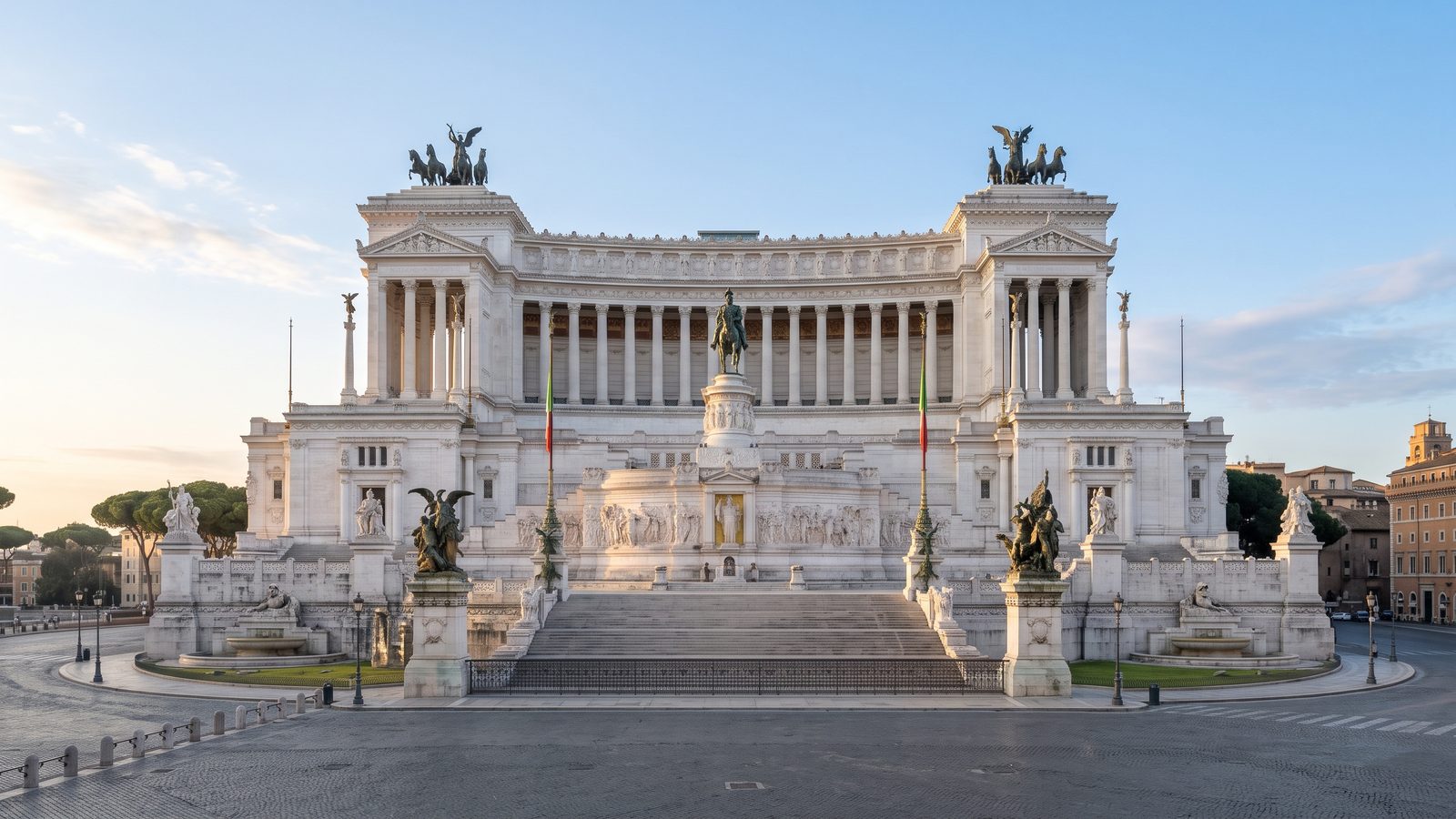
Welcome to the Monumento Nazionale a Vittorio Emanuele II, Rome's striking monument to Italian unification. Rising dramatically above Piazza Venezia against the Capitoline Hill, this brilliant white Botticino marble masterpiece honours the nation's first king and the fallen soldiers of World War I. As you climb its monumental staircases, you uncover the dramatic story of a newly unified Italy asserting its modern identity alongside ancient Roman history.
This self-guided audio tour leads you past soaring Corinthian columns, evocative allegorical sculptures, and sacred memorials. Discover how architect Giuseppe Sacconi transformed this hillside into a powerful national symbol before taking in breathtaking panoramic views across the Colosseum, Roman Forum, and St. Peter's Basilica.
Listen to a sample
The opening of this tour, exactly as AllTours narrates it on site.
What you'll hear on this tour
Stop 1. The Tomb of the Unknown Soldier
You stand before the Altare della Patria, the poignant focal point of national remembrance. Here lies the Tomb of the Unknown Soldier, interred after World War I to honor those who fell without a name. In October 1921, a grieving mother named Maria Bergamas selected a single casket from eleven unidentified bodies recovered from battlefields, giving every bereaved family a son to mourn. An eternal flame burns steadily before you, watched over by a silent military guard. As you gaze at this solemn sanctuary, you feel the profound weight of sacrifice and unity that binds a nation together in everlasting gratitude.
Stop 2. Neoclassical Grandiosity on Capitoline Hill
You look up at an architectural marvel designed by Giuseppe Sacconi to fuse Neoclassical grandeur with the spirit of Imperial Roman forums. Ascending terraces and porticos invite you along a ceremonial path framing brilliant white Botticino marble brought from Brescia. Notice the commanding rhythm of Corinthian columns along the central façade, asserting modern Italy's bold identity against the Roman skyline. Two massive propylaea frame the building, anchoring bronze quadrigae that define its dramatic silhouette. Sculpted bas-reliefs and allegorical statues are woven directly into the walls, ensuring that the marble structure itself tells the enduring story of a newly unified country.
Stop 3. Allegories of Regions and Victory
You explore an open-air gallery of masterfully crafted statues. Along the upper terrace, sixteen carved figures personify the distinct regions of unified Italy, from Lombardy to Sicily, showcasing their individual heritage. Above you, Ettore Ferrari's colossal equestrian statue of Vittorio Emanuele II commands the central terrace. Look higher still to the monument's highest crest, where two majestic bronze chariots ride the sky. On your left, Carlo Fontana's bronze quadriga celebrates Unity, while Paolo Bartolini's quadriga on the right honors Freedom. Their dark bronze forms contrast strikingly against white marble, crowning the edifice with timeless symbols of liberty.
Stop 4. Panoramic Vistas over the Eternal City
You emerge onto the upper terraces to behold one of Rome’s most breathtaking panoramas, connecting ancient origins with modern life. Directly beneath you, the sprawling ruins of the Roman Forum and Palatine Hill unfurl, whispering stories of emperors and gladiators. To your right, the iconic oval of the Colosseum frames the ancient city against today's urban rhythm. Looking northwest across the Tiber River, the grand dome of St. Peter's Basilica pierces the horizon, linking sacred and secular power in a single glance. From this lofty vantage point, you witness millennia of Roman history layered across rooftops, domes, and ancient stones.
Stop 5. Forging a Symbol for Unified Italy
You step into the historical origin of this controversial landmark. Following Italy's unification in 1870 and the death of King Vittorio Emanuele II in 1878, the fledgling nation needed a monumental symbol to cement its identity. Architect Giuseppe Sacconi won the design commission, but construction required clearing centuries of history. You envision the uproar as medieval churches and ancient structures on the Capitoline Hill were demolished starting in 1885 to clear space. Inaugurated in 1911, this audacious act declared modern Italy’s intent to stand proud alongside ancient ruins, asserting its new capital’s strength and permanence.
Stop 6. The Heartbeat of National Identity
You feel the emotional core of the Risorgimento woven into every terrace and staircase. Designed as a physical manifestation of Italian patriotism, this monument inspires a deep reverence for the fatherland, or patria. Every architectural line and sculptured relief reminds citizens of the fierce struggle for sovereignty and self-determination that forged a single kingdom out of fragmented states. Standing here, you participate in a continuous civic tradition where generations gather to honor shared identity, reflect on collective sacrifice, and reaffirm their devotion to unity, freedom, and national pride.
Planning your visit
- Best time to go
- Early morning or late afternoon for gentle light on the white marble and sweeping city views.
- Approximate duration
- About 1 to 1.5 hours
- Where to start
- Piazza Venezia, at the foot of the central staircase.
Access and conditions change seasonally — check the official site before you go.
Frequently asked questions
Is the Victor Emmanuel II Monument worth visiting?
Yes, the monument offers stunning architectural features, national history, the Tomb of the Unknown Soldier, and some of the best panoramic views of Rome.
How long do you need at the Victor Emmanuel II Monument?
Most visitors spend about 1 to 1.5 hours exploring the terraces, viewing the sculptures, and admiring the views across the Roman Forum and Colosseum.
Why was the Victor Emmanuel II Monument built?
It was built to honor Vittorio Emanuele II, the first king of unified Italy, and to serve as a national symbol of Italian unity after the Risorgimento.
Keep exploring
Header image is an AI-generated illustration of Victor Emmanuel II Monument. AllTours.ai is an AI audio tour guide — point your camera at any landmark and hear its story.