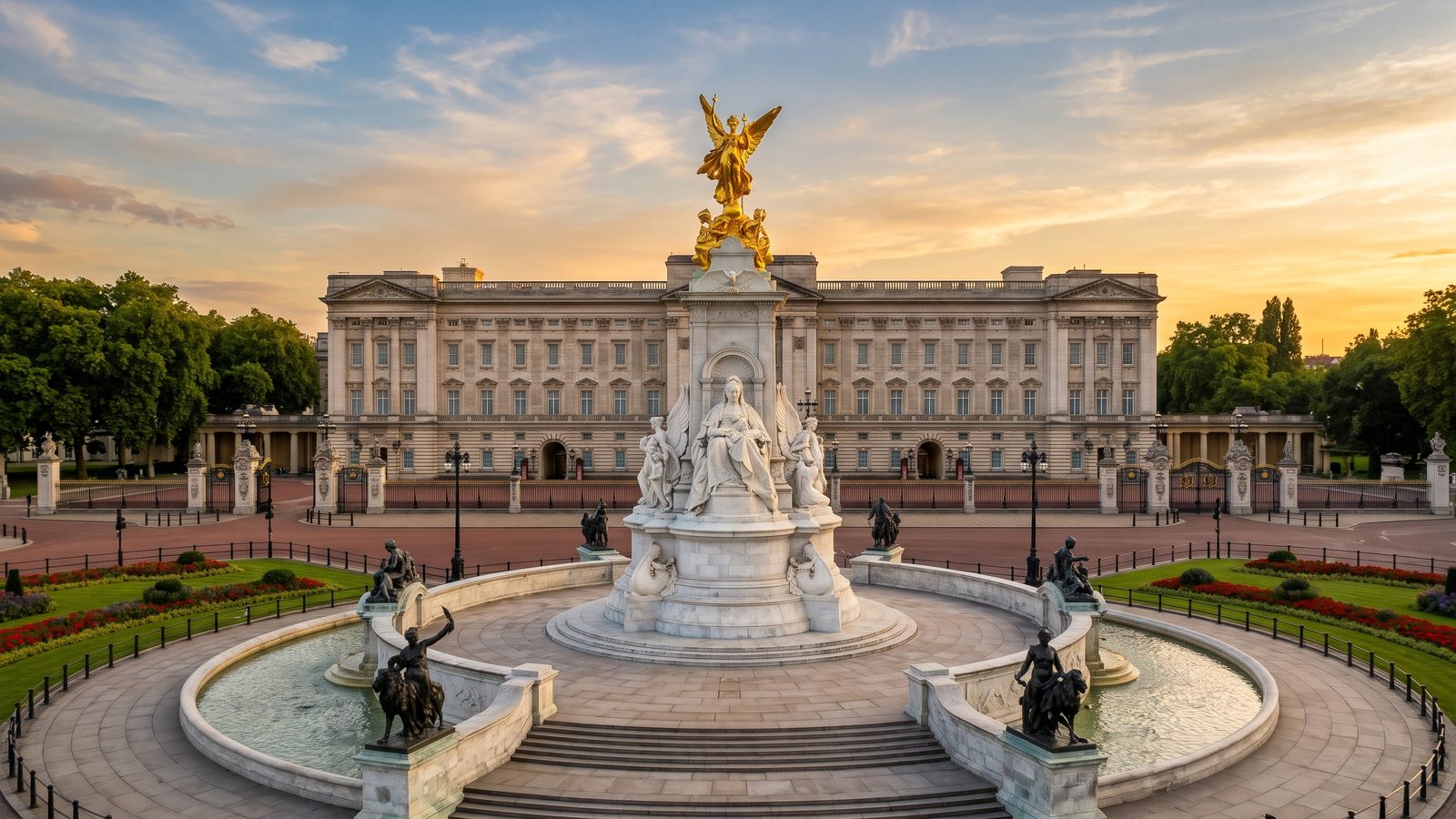
Stand in the Queen's Gardens directly facing Buckingham Palace, where a breathtaking tribute to Queen Victoria dominates the landscape. Unveiled in 1911 following the end of an unprecedented 63-year reign, this colossal memorial captures the grandeur and ambition of an empire at its zenith. From its gleaming marble allegorical statues to the gilded Winged Victory rising overhead, every detail tells a story of national grief, artistic triumph, and sovereign authority.
As you walk around this multi-tiered monument designed alongside Sir Aston Webb's surrounding architectural setting, you will discover intricate bronze figures, sweeping exedras, and lush formal gardens. Let this self-guided tour reveal the deep history and artistic craftsmanship etched into stone and metal.
Listen to a sample
The opening of this tour, exactly as AllTours narrates it on site.
What you'll hear on this tour
Stop 1. Allegories of Empire in Stone and Bronze
Step closer to the colossal monument sculpted by Sir Thomas Brock. You stand before a massive white marble structure anchored by the serene seated figure of Queen Victoria. Look closely at the allegorical figures surrounding the base: on the eastern side, you discover Truth and Justice, while Motherhood and Peace sit to the west. Above them, bronze sculptural groups depicting Naval and Military Power alongside Art and Science frame the sovereign. Lift your gaze to the very top, where the gilded bronze Winged Victory stands triumphantly on a globe, flanked by Courage and Constancy. Every chisel mark across this intricate monument echoes the aspirations and strength of a bygone era.
Stop 2. A Monument Born from Empire-Wide Grief
Imagine the profound national mourning that swept Britain when Queen Victoria passed in 1901 after her historic 63-year reign. Her son, King Edward VII, championed this grand tribute to redefine the ceremonial approach to Buckingham Palace. Rather than relying solely on the Crown, funding poured in through public subscription from every corner of the British Empire. Construction began in 1906, leading to the unveiling of the central sculptures in 1911, with Sir Aston Webb's complete architectural setting finished by 1924. As you admire the scale, you sense the immense effort that created this final, splendid flourish of imperial power before the twentieth century transformed the world.
Stop 3. Edwardian Baroque Magnificence and Symmetry
Notice the monumental Edwardian Baroque style crafted to project classical authority. You are looking at a multi-tiered plinth of robust grey granite, which creates an unyielding base for the brilliant white marble sculptures resting above it. Take in Sir Aston Webb's grand vision: the sweeping semi-circular exedra gracefully embraces The Mall, creating a regal frame for Buckingham Palace. Observe the two colossal pylons flanking the main structure, adding striking verticality and dramatic scale to the composition. The wide semi-circular steps invite you to make a deliberate processional ascent, drawing your eyes along a balanced harmony of classical massing, structural symmetry, and imperial grandeur.
Stop 4. Formal Landscapes and Industrial Virtues
Step out from the base into the formal gardens, thoughtfully arranged by Sir Aston Webb to surround the monument. Before you lies a grand semicircular basin where a central fountain once reflected the gleaming marble structure. As you follow the radial pathways framed by vibrant seasonal flowerbeds, look toward the outer perimeter of the garden. Here, four standalone bronze statues silently guard the grounds. You are seeing representations of the key pillars that built the empire's economic might: Agriculture, Manufacture, Engineering, and Architecture. These manicured lawns and sweeping vistas offer a tranquil vantage point, allowing you to appreciate the memorial's deliberate integration into the surrounding Royal Parks.
Stop 5. Capturing Light and Reflection Across Time
Turn your attention to framing the perfect photograph of this historic landmark. Early twentieth-century photographers once positioned bulky cameras here to document rising scaffolding on sepia-toned plates. Today, you join visitors capturing endless digital perspectives. In the early morning, the sun dramatically strikes the gilded Winged Victory, sending golden light against the sky. As afternoon arrives, soft light illuminates the fine details of the Carrara marble allegories. Try positioning yourself to frame Buckingham Palace through the architectural curves, or look for water reflections in the surrounding basins after a rain shower to capture a lasting visual souvenir of your journey.
Stop 6. A Direct Link to Royal Authority
Reflect on how this monument visually anchors the British monarchy. Commissioned by King Edward VII, the seated figure of Queen Victoria serves as a direct link to the sovereign who defined an entire era. High above, the gilded Angel of Victory symbolizes divinely sanctioned success and royal authority. Nearby allegorical figures such as Truth and Justice highlight the moral virtues expected of a monarch, reinforcing the foundation of the royal institution. Placed directly before Buckingham Palace, the monument visually connects Queen Victoria's historic legacy with the living heart of the Crown today, celebrating an unbroken royal lineage in London's landscape.
Planning your visit
- Best time to go
- Early morning for golden hour light on the gilded Winged Victory, or late afternoon for soft illumination on the marble allegories.
- Approximate duration
- About 30 to 45 minutes
- Where to start
- In front of the Victoria Memorial facing Buckingham Palace at the end of The Mall.
Access and conditions change seasonally — check the official site before you go.
Frequently asked questions
Is Victoria Memorial worth visiting?
Yes, the Victoria Memorial is one of London's most iconic monuments, featuring elaborate marble allegorical statues, gilded bronze figures by Sir Thomas Brock, and a spectacular framing of Buckingham Palace.
How long do you need at Victoria Memorial?
Plan to spend 30 to 45 minutes exploring the monument's detailed sculptures, Sir Aston Webb's surrounding formal gardens, and the four perimeter bronze statues.
When was the Victoria Memorial built and unveiled?
Construction began in 1906 following Queen Victoria's death in 1901. The main sculptural group was unveiled in 1911, and the full architectural setting was completed in 1924.
Keep exploring
Header image is an AI-generated illustration of Victoria Memorial. AllTours.ai is an AI audio tour guide — point your camera at any landmark and hear its story.