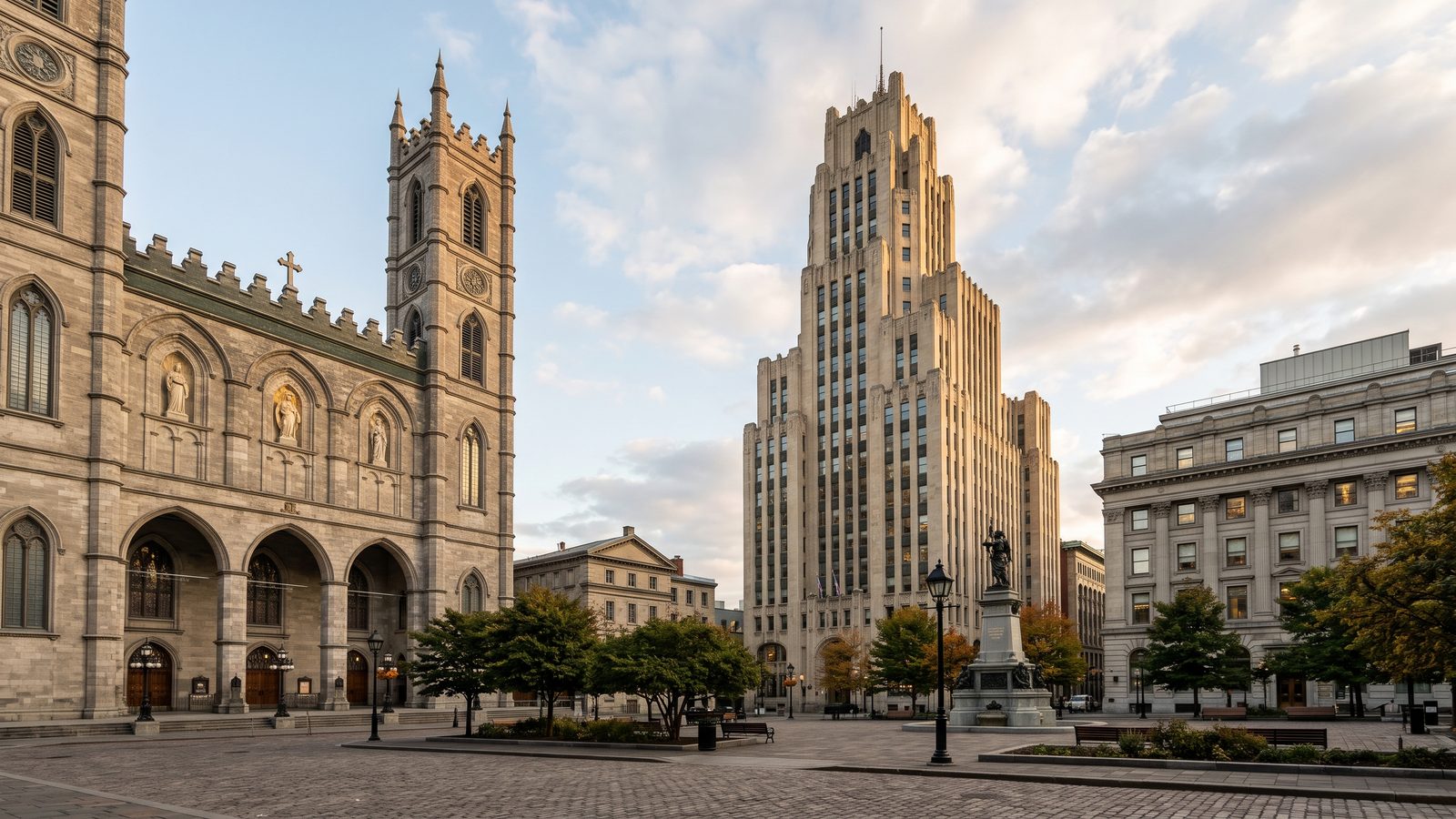
Welcome to Place d'Armes, where Montreal's financial ambition meets architectural brilliance. Completed in 1931 for Aldred & Company, the 23-story Aldred Building stands as a monumental Art Deco masterpiece directly opposite the historic Notre-Dame Basilica. As you gaze up at its limestone facade, you are looking at a living symbol of pre-Depression confidence, designed with dramatic setbacks that bring New York's iconic skyscraper aesthetic to the heart of Quebec.
This self-guided audio tour leads you around the building's striking exterior and historical footprint. You will explore its geometric detailing, skyscraper legacy, and role within Montreal's bustling financial district, discovering how this National Historic Site transformed the city's skyline while establishing an enduring architectural dialogue across the historic square.
Listen to a sample
The opening of this tour, exactly as AllTours narrates it on site.
What you'll hear on this tour
Stop 1. A Stepped Ziggurat on Place d'Armes
You stand on Place d'Armes and look up at the Aldred Building's dramatic stepped profile. Completed in 1931 during the Great Depression, this building stands as a statement of audacious ambition built by the investment firm Aldred & Co. As you trace its three distinct sections rising like a modern ziggurat, you notice how the setbacks allow sunlight to stream down to the narrow streets below. The limestone facade features a symphony of etched chevrons and sunbursts, reflecting the era's obsession with speed and modernity. Directly across the square, the venerable Notre-Dame Basilica stands in captivating dialogue with this towering modern monument.
Stop 2. Montreal's Leap into the Skyscraper Age
You gaze upward at a structure that pierced Montreal's skyline at 23 stories and 117 meters tall upon its completion in 1931. As you admire its soaring height, you are witnessing the city's bold leap into the age of the skyscraper during the uncertain depths of the Great Depression. Notice how the stepped-back profile masterfully balances immense verticality with a graceful ascent, ensuring light still reaches the bustling street level. This steel-framed giant was an engineering marvel designed to integrate seamlessly into the urban fabric. From its commanding presence, the tower redefined the city's silhouette and cemented Montreal's aspiration to rival North America's greatest commercial metropolises.
Stop 3. Limestone, Granite, and Art Deco Craftsmanship
You step closer to examine the meticulous craftsmanship defining this Art Deco masterpiece. Pale limestone cladding rises gracefully from a robust granite base, anchoring the high-rise firmly to the streetscape. As you look at the lower levels and spandrels, you notice intricate geometric patterns etched into the stone alongside stylized chevrons and subtle floral motifs. Terra cotta accents and ornate bronze work celebrate both industrial progress and natural beauty. Designed by Barott and Blackader, every architectural element—from the ornate elevator doors to the grand interior banking hall—was crafted to create a prestigious vertical city within a city, blending form and function seamlessly.
Stop 4. Defying the Great Depression
You reflect on the bold financial vision that birthed this landmark. Construction began in 1929 just as global markets teetered on the brink of collapse, yet completion arrived in 1931 as a testament to pre-Depression financial power. Commissioned by the influential Aldred & Company investment firm, the building rose amidst economic uncertainty as a beacon of progress and unwavering confidence. Architect Ernest Cormier blended emerging Art Deco aesthetics with the city's existing Gothic Revival sensibilities, creating a hybrid style unique to its era. You are looking at a living relic of a bygone financial golden age, embodying the resilience and daring spirit of early twentieth-century Montreal.
Stop 5. A Designated National Historic Site
You are standing before a designated National Historic Site of Canada, an enduring monument to the interwar period. This official recognition highlights the building's central role in shaping Montreal's financial sector during a decade of monumental growth and artistic expression. As you observe the carved stone and polished bronze accents, you see how modernity and opulence converged in urban design. The structure anchors Place d'Armes, reflecting a continuous narrative of the city's ongoing architectural evolution. Master craftsmanship and innovative engineering allow this building to stand firm today, preserving a distinct movement and offering you a tangible link to Canada's golden age of enterprise.
Stop 6. The Pulse of Canada's Financial Heart
You immerse yourself in the historic energy of a neighborhood that served as the undisputed financial heart of Canada in the early twentieth century. Looking down the street grid, you can envision the frantic energy of stockbrokers and shipping magnates navigating these urban canyons created to maximize commercial density. The surrounding Beaux-Arts and Art Deco edifices tell a story of immense economic power where national commerce was forged daily. As you take in the streetscape, you witness the physical legacy of Montreal's 'Manhattanization,' where structures like the Aldred Building formed an ecosystem of corporate strength, leaving a lasting mark on the nation's economic soul.
Planning your visit
- Best time to go
- Morning to late afternoon on clear days to best appreciate sunlight on the limestone setbacks and Place d'Armes.
- Approximate duration
- about 30 minutes
- Where to start
- Place d'Armes square, facing the Aldred Building directly opposite Notre-Dame Basilica.
Access and conditions change seasonally — check the official site before you go.
Frequently asked questions
Is Aldred Building worth visiting?
Yes, the Aldred Building is a must-see for fans of architecture and history. As a designated National Historic Site of Canada, its striking 1931 Art Deco design and dramatic setbacks make it one of Montreal's most captivating urban landmarks.
How long do you need at Aldred Building?
You need about 20 to 30 minutes to view the building's facade from Place d'Armes, appreciate its Art Deco geometric details, and explore its historical context within Montreal's historic financial district.
When was the Aldred Building built and who designed it?
Construction on the Aldred Building began in 1929 and was completed in 1931 for the investment firm Aldred & Company. It was designed in the Art Deco style by Barott & Blackader with contributions blending Gothic Revival sensibilities by Ernest Cormier.
Keep exploring
Header image is an AI-generated illustration of Aldred Building. AllTours.ai is an AI audio tour guide — point your camera at any landmark and hear its story.