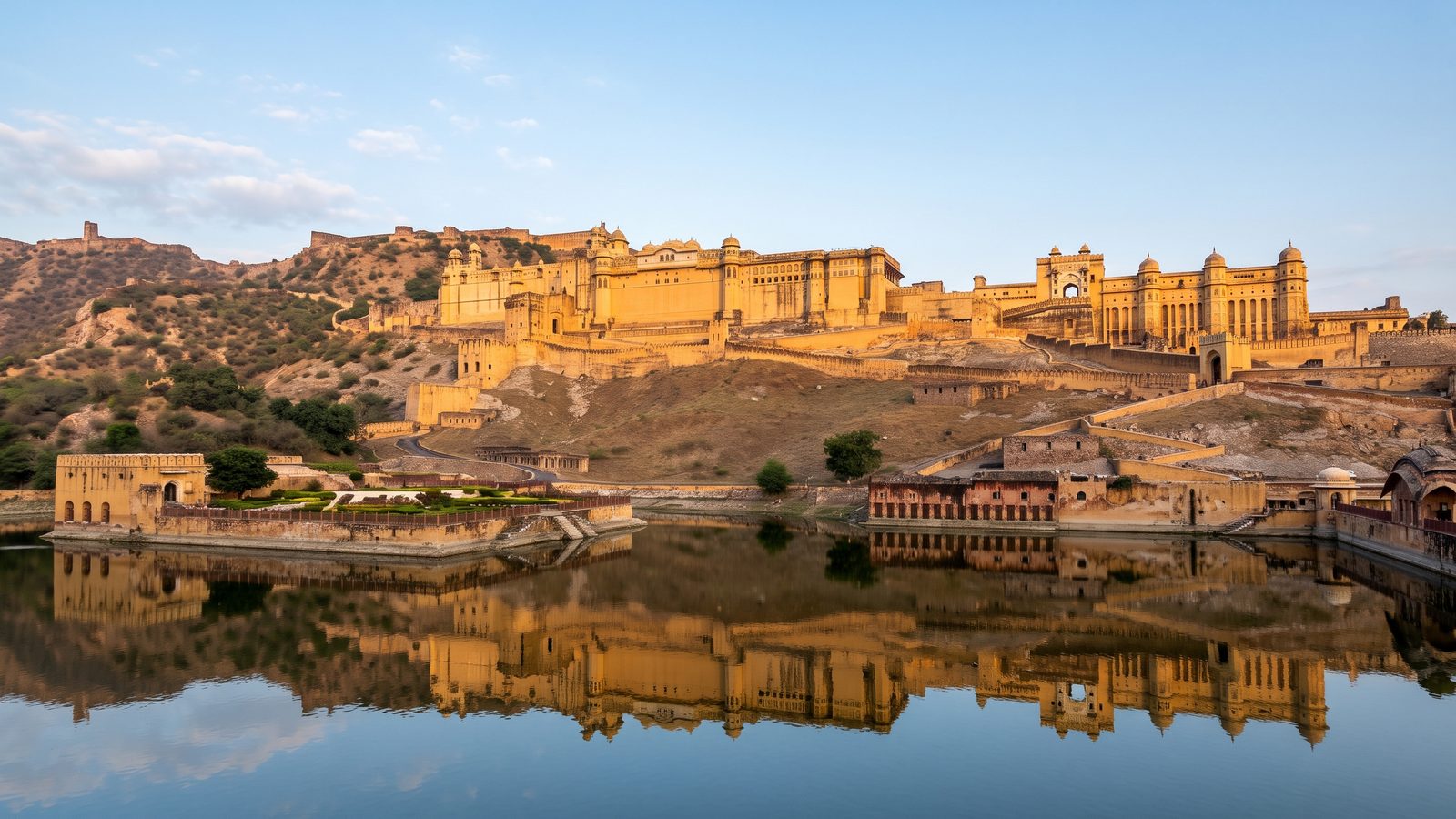
You stand before Amber Fort, a breathtaking expanse of red sandstone and white marble rising high above Maota Lake in the rugged Aravalli hills. Founded originally in the 10th century by the Meenas and grandly expanded by Raja Man Singh I in 1592, this colossal citadel served as the heart of Kachwaha Rajput power for generations. Here, impressive military strength blends seamlessly with imperial opulence and artistic grace.
Step through majestic gateways, admire intricate mirror work inside the Sheesh Mahal, and explore sprawling royal courtyards where Mughal elegance meets Rajput valor. With this self-guided audio tour, you experience the profound history, genius architecture, and panoramic views of Rajasthan's most iconic fortress at your own peaceful pace.
Listen to a sample
The opening of this tour, exactly as AllTours narrates it on site.
What you'll hear on this tour
Stop 1. The Mirror Palace and Masterful Fusion
You step into a world where indigenous Rajput strength seamlessly fuses with delicate Mughal artistry. Around you, red sandstone defensive walls contrast with white marble latticework, geometric patterns, and cusped arches. You pass through the vibrant Ganesh Pol, a gateway adorned with painted frescoes that serves as a colorful prelude to royal opulence. Inside the Sheesh Mahal, or Hall of Mirrors, you witness an extraordinary architectural marvel: thousands of tiny convex mirrors embedded into the walls, engineered to reflect a single candle's flame into a glittering galaxy of stars. Even the water channels in the Sukh Niwas demonstrate advanced environmental design, providing natural cooling centuries before modern air conditioning.
Stop 2. Panoramas of the Aravalli Sentinel
You gaze out from the high ramparts across the ancient Aravalli mountain range, where rugged peaks stand watch over the valley below. Right beneath you, the serene waters of Maota Lake glisten, once mirroring regal processions and supplying vital water to the citadel. Looking toward the adjacent Cheel ka Teela, or Hill of Eagles, you spot Jaigarh Fort perched high, forming an interconnected defensive network with Amber. From this strategic vantage point, rulers once monitored the winding trade routes carved into the landscape, ensuring early warning against approaching forces. Even the royal queens in the Zenana enjoyed discreet, carefully framed views of the outside world from private balconies.
Stop 3. Centuries of Kachwaha Dynastic Ambition
You stand on ground that traces back to the 10th century, when the Meenas first settled this region long before the Kachwaha Rajputs took control. In 1592, Raja Man Singh I, a trusted general of Emperor Akbar, began transforming a modest structure into this grand citadel, establishing the capital of the Dhundhar region. Over the next two centuries, successive rulers like Mirza Raja Jai Singh I expanded the complex, leaving distinct architectural signatures that reflected their evolving political alliances with the Mughals. This dynastic center flourished until Sawai Jai Singh II relocated the capital down to Jaipur in 1727, leaving Amber as an enduring monument to Rajput power.
Stop 4. Frescoes, Craftsmanship, and Courtly Life
You immerse yourself in the rich pulse of Rajput culture expressed through detailed artistic craft. The frescoes framing the Ganesh Pol depict mythological tales and courtly scenes, painted using natural dyes and delicate pietra dura techniques passed down through generations of skilled artisans. You explore the Zenana, where distinct architectural design balanced social hierarchy, privacy, and interaction within the women's quarters. As you walk through these courtyards, you can almost hear the faint echoes of classical music and dance that once entertained the royal court, showcasing a legacy that harmoniously blended Hindu motifs with Persianate artistic influences into a vibrant, unique aesthetic tapestry.
Stop 5. Impenetrable Walls of Sandstone and Marble
You look upon the massive, towering walls of sandstone and marble that wrap along the rugged Aravalli ridgeline for miles. These robust bastions served as silent sentinels, protecting the Kachwaha kingdom through centuries of sieges and military conflicts. As you walk along these battlements, imagine Rajput warriors maintaining a vigilant watch over Maota Lake and the surrounding valleys, ready to defend the royal heartland. The citadel's grand scale and intelligent positioning highlight the military genius of its builders, combining indigenous defensive fortitude with refined architectural details. Every stone block under your feet carries the heavy, enduring weight of ancient battles and defensive resolve.
Stop 6. Legacy of the Royal Kachwaha Dynasty
You walk through the historic spaces where the Kachwaha dynasty forged its lasting political and cultural legacy. In the Diwan-i-Aam, strategic alliances were negotiated, while quiet daily life unfolded within the secluded zenana. Notice how the artistic details, from the delicate mirror work of the Sheesh Mahal to the stately chhatris of the Ganesh Pol, demonstrate sophisticated royal patronage and craftsmanship. Royalty and queens commissioned these designs, ensuring spiritual devotion and daily living were surrounded by beauty. Every archway and courtyard you cross preserves an irreplaceable artistic lineage, telling the story of a powerful era where two great imperial cultures intertwined seamlessly.
Planning your visit
- Best time to go
- Early morning right at opening or late afternoon to avoid peak heat and crowds.
- Approximate duration
- about 2 hours
- Where to start
- The main courtyard (Jaleb Chowk) after entering through Suraj Pol (Sun Gate).
Access and conditions change seasonally — check the official site before you go.
Frequently asked questions
Is Amber Fort worth visiting?
Yes, Amber Fort is one of Rajasthan's most impressive architectural landmarks, famous for its magnificent fusion of Rajput and Mughal styles, the sparkling Sheesh Mahal mirror palace, and striking mountain views.
How long do you need at Amber Fort?
Plan for about 2 to 3 hours to comfortably explore the major courtyards, gates, Sheesh Mahal, Zenana, and elevated view points.
Who built Amber Fort and when?
Constructed on foundations established by the Meenas in the 10th century, the main palace complex was started in 1592 by Raja Man Singh I and expanded by successive rulers over the next 150 years.
Keep exploring
Header image is an AI-generated illustration of Amber Fort. AllTours.ai is an AI audio tour guide — point your camera at any landmark and hear its story.