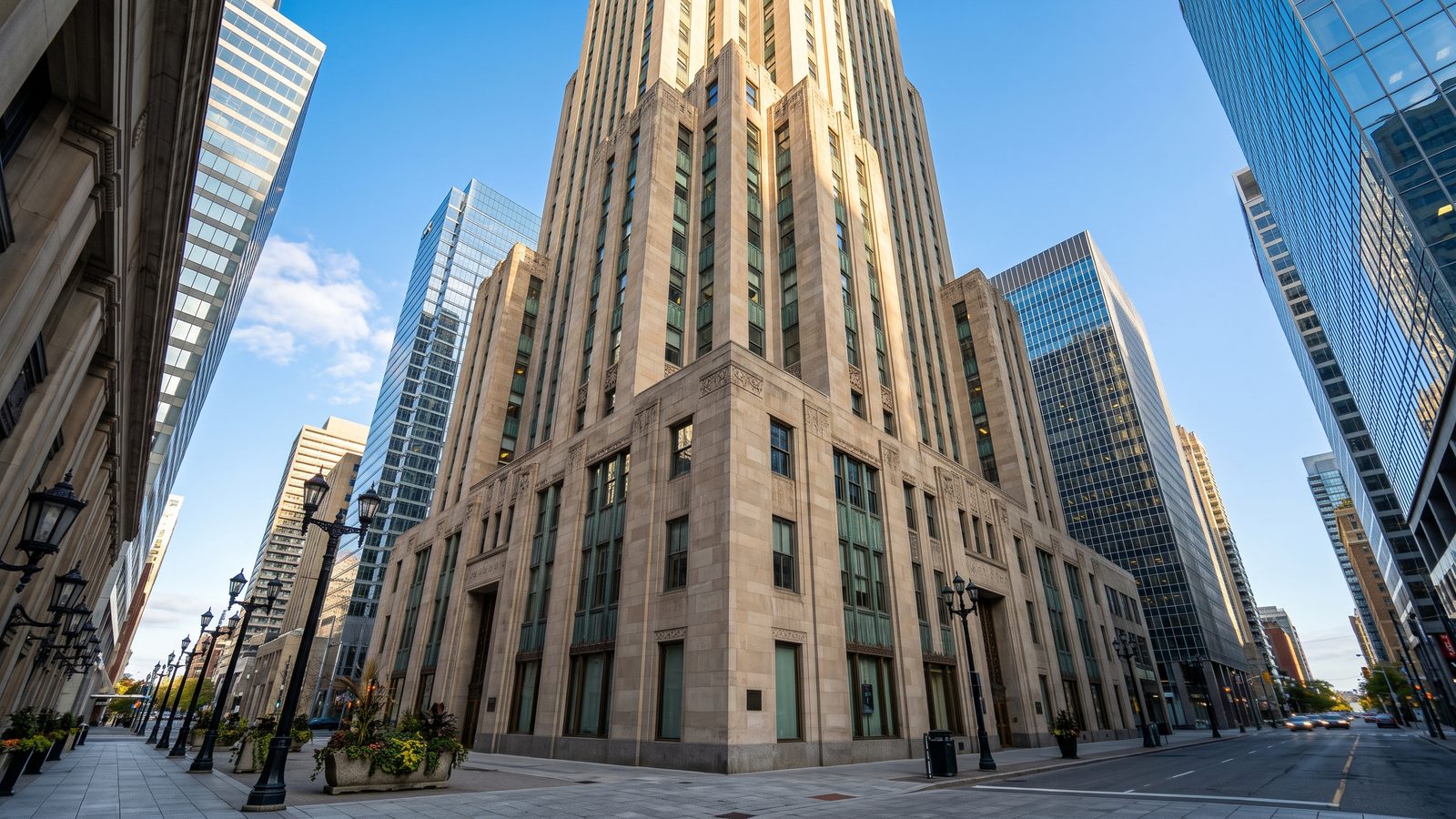
Welcome to the Bank of Nova Scotia Building, an iconic pillar of Toronto's financial district standing proudly at King Street West. Completed in 1951, this impressive limestone structure reflects Canada’s post-war optimism and corporate ambition. As you look up at its soaring facade and detailed craftsmanship, you are standing at the historic crossroads where national banking consolidated and Toronto transformed into a global economic power.
This self-guided audio tour reveals the architectural secrets, financial triumphs, and urban history embedded in these stones. From its subtle Art Deco reliefs to its role on Canada's famed Bay Street, explore how this monumental head office shaped the modern skyline and guided the nation's economic pulse.
Listen to a sample
The opening of this tour, exactly as AllTours narrates it on site.
What you'll hear on this tour
Stop 1. Limestone Setbacks and Art Deco Carvings
You gaze up at the Indiana limestone façade rising with elegant setbacks that draw natural light down to the street. You notice the verticality emphasized by slender pilasters and recessed spandrels, leading your eyes to intricate bronze detailing around window frames and grand entrances. Take a moment to examine the delicate relief carvings depicting allegorical figures of commerce, industry, and finance. Designed by architects Mathers & Haldenby, this building uses the confidence of Art Deco design to project unshakeable economic stability. As you admire these sculpted details, you experience one of the most ambitious and meticulously crafted post-war architectural monuments of its era in Toronto.
Stop 2. A Halifax Bank's Ambition in Toronto
You stand before the site where the Bank of Nova Scotia, originally founded in Halifax in 1832, consolidated its growing Toronto operations in 1951. Before this impressive tower rose on King Street West, the bank operated out of separate city branches that could no longer support its national expansion. Architects Mathers & Haldenby, working alongside Beck and Eadie, designed this monumental head office to reflect the bright optimism of the early 1950s. Its construction pioneered advanced techniques for large-scale office towers in Toronto. As you admire the facade, you feel the bank's lasting commitment to establishing its permanent home in Canada's financial heartland.
Stop 3. Post-War Innovation and Rhythmic Glass
You observe the building's distinctive green-tinted glass panels set inside aluminum spandrels, creating a rhythmic facade that shifts with the changing daily light. Built in 1951 under architects Mathers & Haldenby with Peter Dickinson, this skyscraper represented a bold move into functional elegance and post-war modernism. Its sleek lines broke away from older, overly ornate styles, signaling Canada's rising economic confidence after the war. Imagine how this tower dominated the local skyline when it first opened as a pioneering office building. As you stand here today, you can still feel the lingering impact of its forward-thinking design and innovative materials.
Stop 4. The Command Center of Canadian Finance
You are standing outside the strategic command center that helped direct Canadian commerce. Within these walls, executives gathered in high-stakes boardrooms to plan major international expansions into Latin America and the Caribbean, establishing Scotiabank's global presence. The formidable architectural design was built to project absolute stability, reassuring investors while securing major industrial loans and underwriting complex bond issues. Important corporate mergers were negotiated inside, directly influencing the nation's economic trajectory for decades. As you listen to the hum of the city, you feel the powerful legacy of financial decisions that transformed this address into a titan of national and global commerce.
Stop 5. The Beating Heart of Bay Street
You stand at the lively core of Downtown Toronto, right beside Bay Street—Canada’s financial center. As you look around, you see a rich architectural dialogue between grand historic facades like this one and the soaring modern glass towers nearby. Imagine this area in the early 20th century, evolving from a bustling market district into a dense cluster of financial skyscrapers. Beneath your feet lies the extensive PATH underground network, connecting these massive towers so thousands can navigate the city regardless of winter weather. You feel the constant energy of this financial corridor, where historic ambition and modern commerce seamlessly converge.
Planning your visit
- Best time to go
- Weekday mornings or early afternoons to experience the Financial District's active atmosphere and capture clear daylight on the limestone facade.
- Approximate duration
- About 30-45 minutes
- Where to start
- Corner of King Street West and Bay Street, facing the main building entrance.
Access and conditions change seasonally — check the official site before you go.
Frequently asked questions
Is Bank of Nova Scotia Building worth visiting?
Yes, it is a outstanding example of 1951 post-war skyscraper design and Art Deco detail located at the heart of Toronto's historic financial core.
How long do you need at Bank of Nova Scotia Building?
A self-guided visit takes about 30 to 45 minutes to appreciate the stone carvings, setbacks, spandrels, and surrounding Bay Street architecture.
When was the Bank of Nova Scotia Building in Toronto built?
The building was completed in 1951 by architects Mathers & Haldenby to consolidate the bank's Toronto operations into a new regional head office.
Keep exploring
Header image is an AI-generated illustration of Bank of Nova Scotia Building. AllTours.ai is an AI audio tour guide — point your camera at any landmark and hear its story.