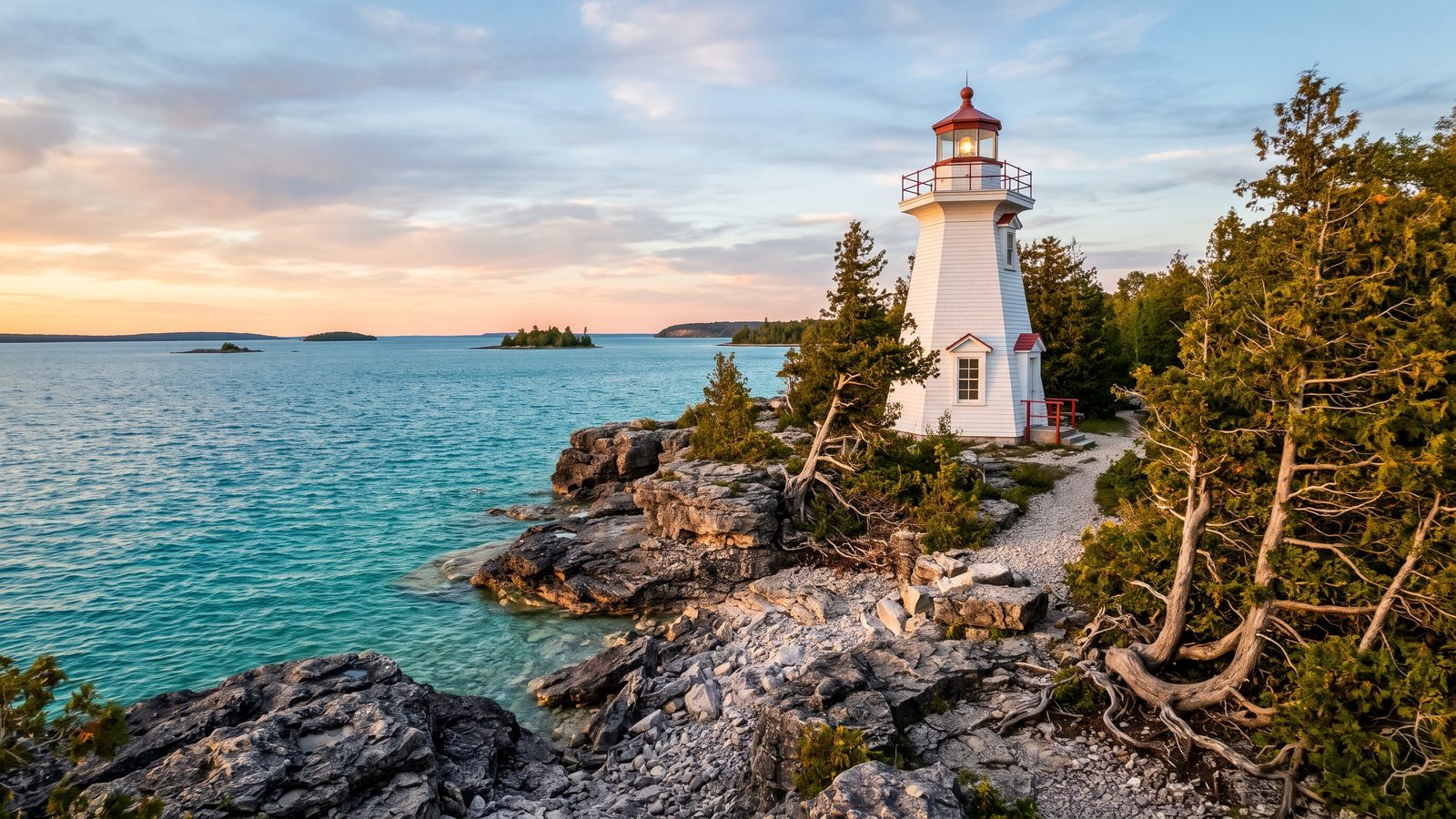
Welcome to Big Tub Lighthouse at the tip of the Bruce Peninsula in Tobermory, Ontario. Standing proudly against the dynamic waters of Georgian Bay, this historic wooden beacon has guided mariners since 1885. As you explore the rocky shoreline, you will discover a rich tapestry of maritime history, clever nineteenth-century architecture, and pristine natural beauty sculpted by ancient forces and crystal-clear lake waters.
This self-guided audio tour leads you along rugged limestone paths surrounding the active lighthouse. Immerse yourself in stories of dedicated keepers, treacherous navigation, and breathtaking vistas while admiring the gnarled cedars and striking turquoise waters that make this solitary beacon an enduring symbol of Tobermory.
What you'll hear on this tour
Stop 1. The Wooden Sentinel of 1885
You stand before Big Tub Lighthouse, an iconic octagonal wooden tower that has stood sentinel since 1885. As you look at its crisp white exterior contrasting with Georgian Bay, you imagine early lightkeepers ascending narrow stairs to tend kerosene lamps. Built using local timber, this tower safely guides ships past perilous shoals into Big Tub Harbour. A fourth-order Fresnel lens still focuses the light today, showcasing enduring Victorian engineering. Encircling the lantern room, the gallery offers panoramic views essential for monitoring passing vessels and sudden squalls. You are gazing upon an active piece of maritime history that continues to safeguard these cold, deep waters after more than a century of service.
Stop 2. A Lifeline in Perilous Waters
You reflect on the late 19th century, when expanding shipping turned Georgian Bay into a bustling maritime highway for grain and timber. The narrow entrance to Big Tub Harbour posed severe hazards, with hidden shoals and sudden squalls causing dangerous shipwrecks. You learn how federal authorities built this beacon in response to desperate pleas from mariners. David McArthur took charge as the first keeper in 1885, embodying immense responsibility. Beyond maintaining the lamp, he maintained constant vigil, rescuing stranded sailors and supporting the isolated Tobermory community. You appreciate how his unwavering dedication set a precedent for future keepers, ensuring safe passage for Canada's growing commercial fleet through decades of treacherous weather.
Stop 3. Crafted for Wind and Weather
You examine the tower's octagonal design, realizing it provides superior structural rigidity against fierce gales compared to a square frame. Constructed from local pine or cedar, meticulous joinery allows the timber structure to endure harsh freeze-thaw cycles. Notice how the tower tapers slightly as it rises, a practical detail designed to reduce wind load and enhance stability on its solid bedrock foundation. Above, a sturdy metal lantern room protects delicate optical equipment, while the surrounding gallery railing allows safe maintenance access. Even the bright white paint serves an architectural purpose: maximizing daytime visibility for offshore vessels while reflecting harsh summer sunlight to protect the wooden structure underneath.
Stop 4. Turquoise Waters and Ancient Limestone
You turn toward the vast horizon where Georgian Bay reveals an extraordinary spectrum of emerald, sapphire, and turquoise. The astonishing clarity of these waters comes from the Niagara Escarpment’s ancient limestone bedrock, which naturally filters the lake to crystalline perfection. Looking along the rugged coast, you see gnarled Eastern White Cedars clinging tenaciously to exposed cliff faces, their roots finding strength in tiny rock fissures. Carved by ancient glaciers and unrelenting waves, dramatic rock overhangs plunge directly into deep, icy depths. As an invigorating freshwater breeze carries the crisp scent of pine, you experience a dynamic, wild landscape where water and rock continually reshape Tobermory's breathtaking coastline.
Stop 5. Capturing Golden and Blue Hours
You look through your camera lens, searching for the ideal perspective of this historic beacon. During golden hour, low warm sunlight illuminates the weathered wooden octagonal tower against the deepening blue sky and bay. Position yourself west in the morning to catch golden light reflecting off the lighthouse face. You can use the natural leading lines of the rugged limestone shoreline or wooden pier to guide the eye toward the light. Incorporating submerged rocks visible through crystal-clear water adds remarkable depth to your foreground. As twilight arrives, long exposures during the blue hour smooth the lake into a reflective mirror, framing the glowing lighthouse against indigo skies.
Stop 6. Traces of the Bruce Trail
You follow the distinctive white blazes of the Bruce Trail leading away from the light, stepping onto the rugged limestone of the Niagara Escarpment. As you navigate the root-strewn path through dense cedar and pine forest, you encounter breathtaking views of Georgian Bay through the canopy. Ancient, wind-sculpted Eastern White Cedars cling precariously to cliff edges, silent witnesses to centuries of natural history. Glacial retreat and erosion have carved hidden grottos and dramatic overhangs into these windswept rocks. Keeping your eyes on the sky, you might spot peregrine falcons soaring along the cliffs, offering you a visceral connection to Tobermory's untamed and secluded wilderness.
Planning your visit
- Best time to go
- May to October during sunrise or sunset (golden hour) for optimal light and pleasant weather.
- Approximate duration
- about 45 minutes
- Where to start
- Big Tub Lighthouse parking area at the end of Big Tub Road in Tobermory.
Access and conditions change seasonally — check the official site before you go.
Frequently asked questions
Is Big Tub Lighthouse worth visiting?
Yes, Big Tub Lighthouse is highly worth visiting for its rich 19th-century maritime history, picturesque octagonal wooden architecture, dramatic views of Georgian Bay's crystal-clear turquoise waters, and access to the scenic Bruce Trail.
How long do you need at Big Tub Lighthouse?
Most visitors spend between 30 and 60 minutes exploring the grounds, walking along the rocky limestone shoreline, taking photographs, and listening to the audio guide.
When was Big Tub Lighthouse built and why?
Big Tub Lighthouse was built in 1885 by the Department of Marine and Fisheries to guide commercial shipping vessels safely past dangerous shoals into Big Tub Harbour during a boom in Great Lakes maritime trade.
Keep exploring
Header image is an AI-generated illustration of Big Tub Lighthouse. AllTours.ai is an AI audio tour guide — point your camera at any landmark and hear its story.