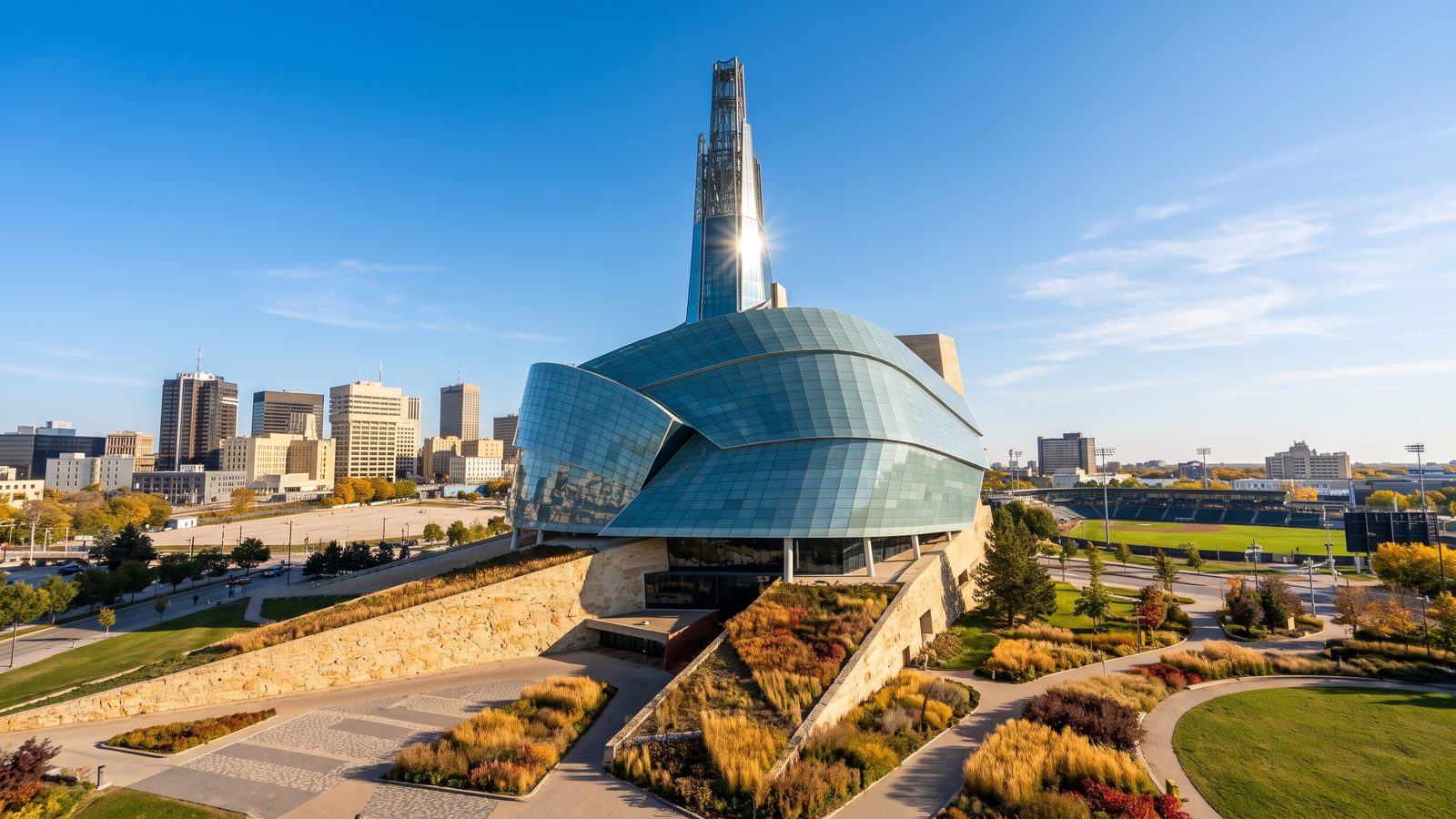
Welcome to the Canadian Museum for Human Rights in Winnipeg at The Forks. Opened in 2014, this groundbreaking national museum marries Tyndall stone roots with a luminous glass cloud. As you ascend illuminated ramps through core galleries, you encounter profound stories of struggle, dignity, and advocacy. Designed by Antoine Predock, the building itself guides your journey from darkness into light, culminating at the iconic 100-meter Tower of Hope.
Conceived by Izzy Asper and brought to life through dedicated public and private support, the museum sits on an ancient Indigenous gathering place. Your self-guided audio tour unpacks interactive exhibits, survivor testimonies, and modern movements, empowering you to reflect on universal dignity and your own role in driving meaningful social change.
Listen to a sample
The opening of this tour, exactly as AllTours narrates it on site.
What you'll hear on this tour
Stop 1. The Vision of Izzy Asper
You stand at the genesis of Canada's national museum for human rights, an institution born not from bureaucratic policy, but from the personal crusade of Winnipeg lawyer Izzy Asper. In 2003, inspired by a visit to the U.S. Holocaust Memorial Museum, Asper envisions a dedicated Canadian space for human rights struggles. He commits millions of his own dollars to launch the project. After his sudden passing, his family, led by his daughter Gail, champions his dream until the federal government establishes it as a national museum in 2008. You reflect on how this transformation from private philanthropy to national heritage connects directly with The Forks' millennia of Indigenous history.
Stop 2. Ascending From Stone to Light
You enter the museum through the grotto, a compressed space built from fossilized Tyndall stone that anchors you in earth and time. As you begin your journey upward, the stark stone recedes and gives way to illuminated glass ramps. These gentle pathways guide you physically and emotionally through an architectural ascent. Natural light diffuses through crystalline glass, replacing heavy walls with increasing transparency. You follow this luminous sequence toward its dramatic climax: the Tower of Hope, a 100-meter glass and steel spire reaching into the Winnipeg sky. The design continuously mirrors your rising journey through human rights narratives.
Stop 3. Voices of Struggle and Reflection
You step into the museum's core galleries to encounter personal narratives woven into interactive displays. Starting at 'What Are Human Rights?', you ascend into 'Indigenous Perspectives,' where First Nations, Inuit, and Métis voices share their unbroken connection to the land. Further ahead, 'Canadian Journeys' immerses you in the Winnipeg General Strike and voting rights battles using compelling artifacts and multimedia touch-screens. In 'Breaking the Silence,' you confront tough realities like Residential Schools through survivor testimonies and reflective installations. Each space—from 'Protecting Rights in Canada' to 'Actions for Change'—invites you to connect personally with the courageous individuals who shaped universal rights.
Stop 4. Grassroots Movements Shaping Our Future
You discover how ordinary citizens spark extraordinary transformation through unwavering determination. Around you, exhibits detail the diverse strategies used by advocates, from public petitions and peaceful protests to difficult legislative battles. You observe how collective actions alter national conversations and establish fundamental rights into law across generations. The museum bridges historical milestones with modern struggles, urging you to identify contemporary injustices and active pathways for engagement. As you absorb these stories, you recognize that individual voices amplified by community hold the power to build a more just world. You leave inspired to take action for dignity and social equity.
Stop 5. An Immersive Journey into Dignity
You experience learning that goes far beyond standard museum facts, stepping into an empathetic educational journey. Interactive digital installations bring legal principles to life through vivid faces and personal accounts of those fighting for justice. You analyze original historical documents and listen to firsthand testimonies that connect global movements with local community action. By examining past injustices alongside modern challenges, you gain critical insight into how individual agency supports universal human dignity. The museum's interactive approach equips you with practical knowledge, reshaping how you perceive the world and encouraging you to reflect on your personal responsibility in defending human rights.
Stop 6. Panoramic Views From the Horizon
You step into the uppermost chambers where a breathtaking 360-degree panorama of Winnipeg unfolds around you. Bathed in natural sunlight, you look down upon The Forks, tracing the historic confluence of the Red and Assiniboine Rivers—an ancient Indigenous gathering site. Across the downtown landscape, you see the daily pulse of the city alongside the gleaming dome of the Legislative Building, a symbol of democratic governance. Beyond the urban grid, the vast prairie horizon stretches endlessly into the distance. This elevated perspective provides a quiet moment of reflection, linking individual human rights struggles to the expansive world outside.
Planning your visit
- Best time to go
- Morning or early afternoon on a clear day to experience the natural light filtering through the glass cloud and clear views from the Tower of Hope.
- Approximate duration
- about 2 to 3 hours
- Where to start
- The main entrance grotto on the ground level near The Forks.
Access and conditions change seasonally — check the official site before you go.
Frequently asked questions
Is Canadian Museum for Human Rights worth visiting?
Yes, it is Canada's first national museum established outside the Ottawa region, featuring world-class architecture by Antoine Predock, inspiring interactive galleries, and panoramic city views from the Tower of Hope.
How long do you need at Canadian Museum for Human Rights?
Most visitors spend 2 to 3 hours exploring the ten core galleries, walking up the illuminated glass ramps, and taking in the skyline view from the Tower of Hope.
Who founded the Canadian Museum for Human Rights?
The museum was conceived in 2003 by Winnipeg lawyer and media executive Izzy Asper. Following his passing, his family, led by his daughter Gail Asper, carried forward the initiative until it became a national museum in 2008 and opened in 2014.
Keep exploring
Header image is an AI-generated illustration of Canadian Museum for Human Rights. AllTours.ai is an AI audio tour guide — point your camera at any landmark and hear its story.