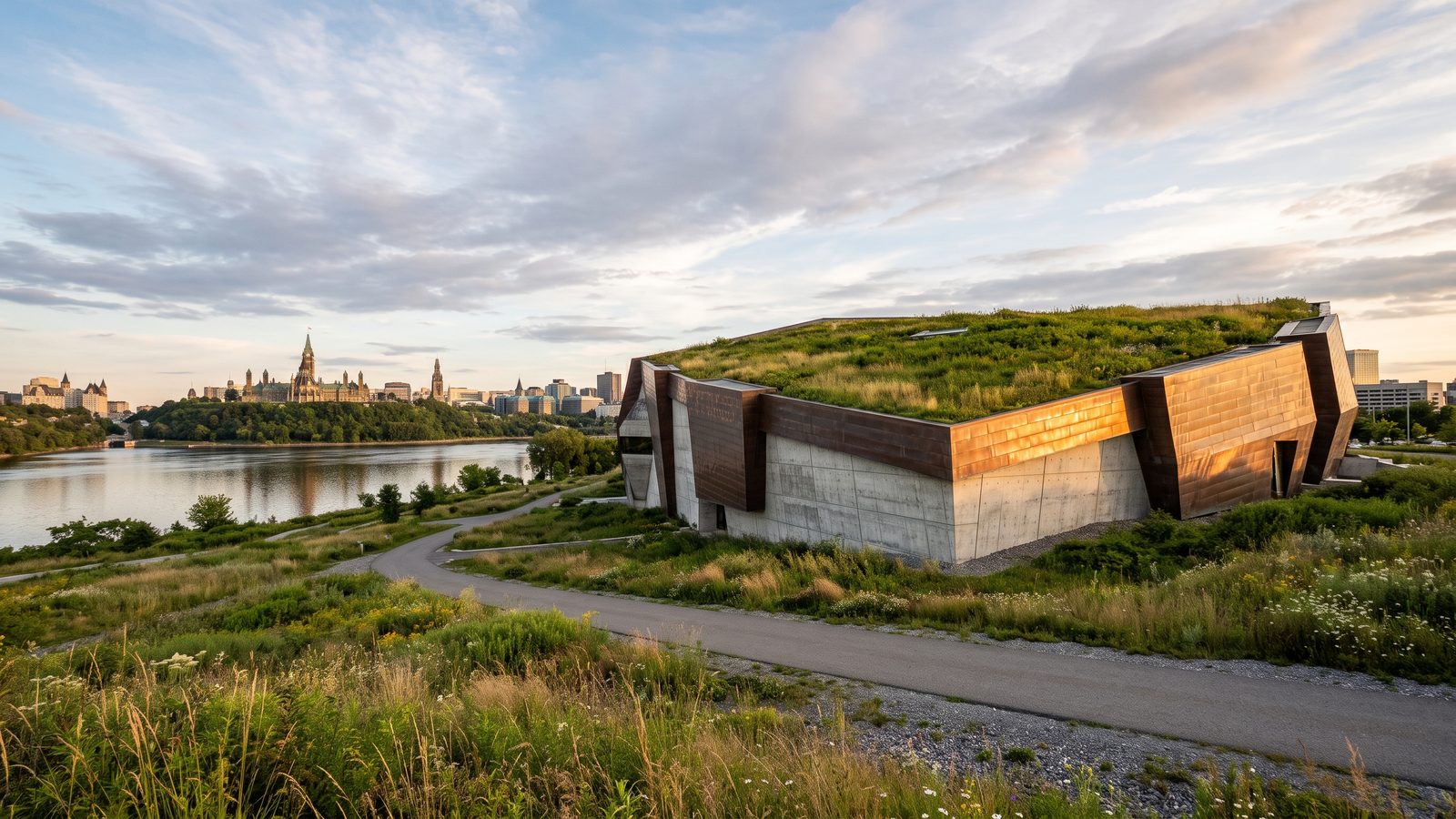
Step into the Canadian War Museum, a striking national landmark in Ottawa designed by Moriyama & Teshima Architects. Opened in 2005, its angular lines and green roof evoke a battlefield landscape giving way to hope and regeneration. Inside, you encounter one of the world's most extensive military collections, weaving together tactical innovations, personal artifacts, and national memory to reveal how conflict forged Canada's modern identity.
This self-guided audio tour walks you through powerful galleries, solemn memorial spaces, and massive military hardware. You explore the deeply human experience behind historical battles, discovering how courage, sacrifice, and global peacekeeping efforts continuously shape the nation's ongoing legacy.
Listen to a sample
The opening of this tour, exactly as AllTours narrates it on site.
What you'll hear on this tour
Stop 1. The Light of Remembrance
You step into the hushed sanctuary of Memorial Hall, where every design choice commands quiet respect. Your attention is drawn immediately to a single, carefully angled window designed to capture a narrow beam of sunlight every November 11th at 11:00 AM. This precise annual light shines directly onto the headstone of Canada's Unknown Soldier, transforming sunlight into a living symbol of memory. As you gaze around the room, you see the names of Victoria Cross recipients carved into the surrounding walls. You stand in a sacred space where individual sacrifices merge into a collective honor, compelling you to reflect on the true human price of freedom.
Stop 2. Concrete, Copper, and Light
As you stand before the museum's exterior, you behold a striking building designed by Moriyama & Teshima alongside GRC Architects. You notice raw, angular concrete slopes that resemble battlefield bunkers and scarred earth, symbolizing both devastation and natural rebirth. Copper cladding wraps around key sections of the façade, crafted to slowly oxidize over time as an evolving metaphor for history's visible scars. High above, you spot the dramatic Victory Beam window rising over the Hall of Remembrance. Non-orthogonal walls and carefully orchestrated shadows guide your path, proving that the structure itself acts as a silent narrator long before you inspect a single artifact.
Stop 3. Walk Through War and Peace
You embark on a sweeping chronological journey through the exhibit galleries. Beginning with 18th-century uniforms and early firearms, you trace the nascent conflicts that shaped a developing nation. You step into First World War trench displays, surrounded by mud-caked boots and heart-wrenching letters from the front lines. In the Second World War galleries, you encounter colossal tanks and heavy artillery inside the LeBreton Gallery, alongside personal keepsakes like lucky charms and battlefield diaries. Moving forward into Cold War and contemporary peacekeeping displays, you witness how modern Canadian service personnel navigate complex international roles, connecting broad geopolitical conflicts directly to individual human courage.
Stop 4. Evolution of Battlefield Strategy
You examine the strategic evolution of Canada's armed forces across major global conflicts. You discover how innovative tactics like the creeping barrage at Vimy Ridge minimized casualties and delivered tactical breakthroughs during the Great War. Standing before the formidable Leopard C2 tank, you appreciate Canada's ongoing commitment to armored warfare from the Cold War through operations in Afghanistan. You study complex planning documents detailing operations like the tragic Dieppe Raid, realizing how its harsh lessons directly informed successful amphibious landings on D-Day. Beyond heavy weaponry, you observe the intricate logistical networks managed by the quartermaster corps, revealing how strategic planning sustains frontline troops.
Stop 5. Foundations of a Nation
You trace the deep historical roots of Canadian conflict, starting long before Confederation with Indigenous alliances and early territorial skirmishes. You explore the brutal War of 1812, where local militias and Indigenous fighters defended their homelands against American invasion, solidifying a distinct North American identity. Moving into the 20th century, you follow Canadian forces to the muddy trenches of Vimy Ridge and the hazardous waters of the Battle of the Atlantic. From Normandy's beaches to the Korean War and modern United Nations missions, you see how these intense struggles transformed a young Dominion into a recognized international power committed to global peace.
Stop 6. Art and Collective Memory
You discover how conflict has reshaped Canadian cultural identity and elevated remembrance into a shared national ritual. Through vivid paintings created by official war artists, poignant poetry, and intimate wartime correspondence, you see how generations have processed trauma and celebrated bravery. You observe how a fledgling colony evolved into a mature nation deeply devoted to international security and peacekeeping. Surrounding exhibits illustrate the artistic and literary expressions that helped the public navigate the moral complexities of war. Surrounded by stark architectural geometry, you find a contemplative space inviting you to consider how personal memories mold collective cultural consciousness.
Planning your visit
- Best time to go
- Morning on weekdays for a quiet experience, or around 11:00 AM to see sunlight filtering through key architectural windows.
- Approximate duration
- about 2 to 3 hours
- Where to start
- The main lobby inside the front entrance of the Canadian War Museum.
Access and conditions change seasonally — check the official site before you go.
Frequently asked questions
Is Canadian War Museum worth visiting?
Yes, it is widely considered one of Canada's finest museums. Its striking architecture, vast collection of military artifacts, and deeply human storytelling make it a compelling destination for visitors of all backgrounds.
How long do you need at Canadian War Museum?
Most visitors spend about 2 to 3 hours exploring the chronological history galleries, the massive LeBreton Gallery, and reflective spaces like Memorial Hall.
When was the Canadian War Museum built?
The current building, designed by Moriyama & Teshima Architects alongside GRC Architects, opened to the public in 2005 at LeBreton Flats.
Keep exploring
Header image is an AI-generated illustration of Canadian War Museum. AllTours.ai is an AI audio tour guide — point your camera at any landmark and hear its story.