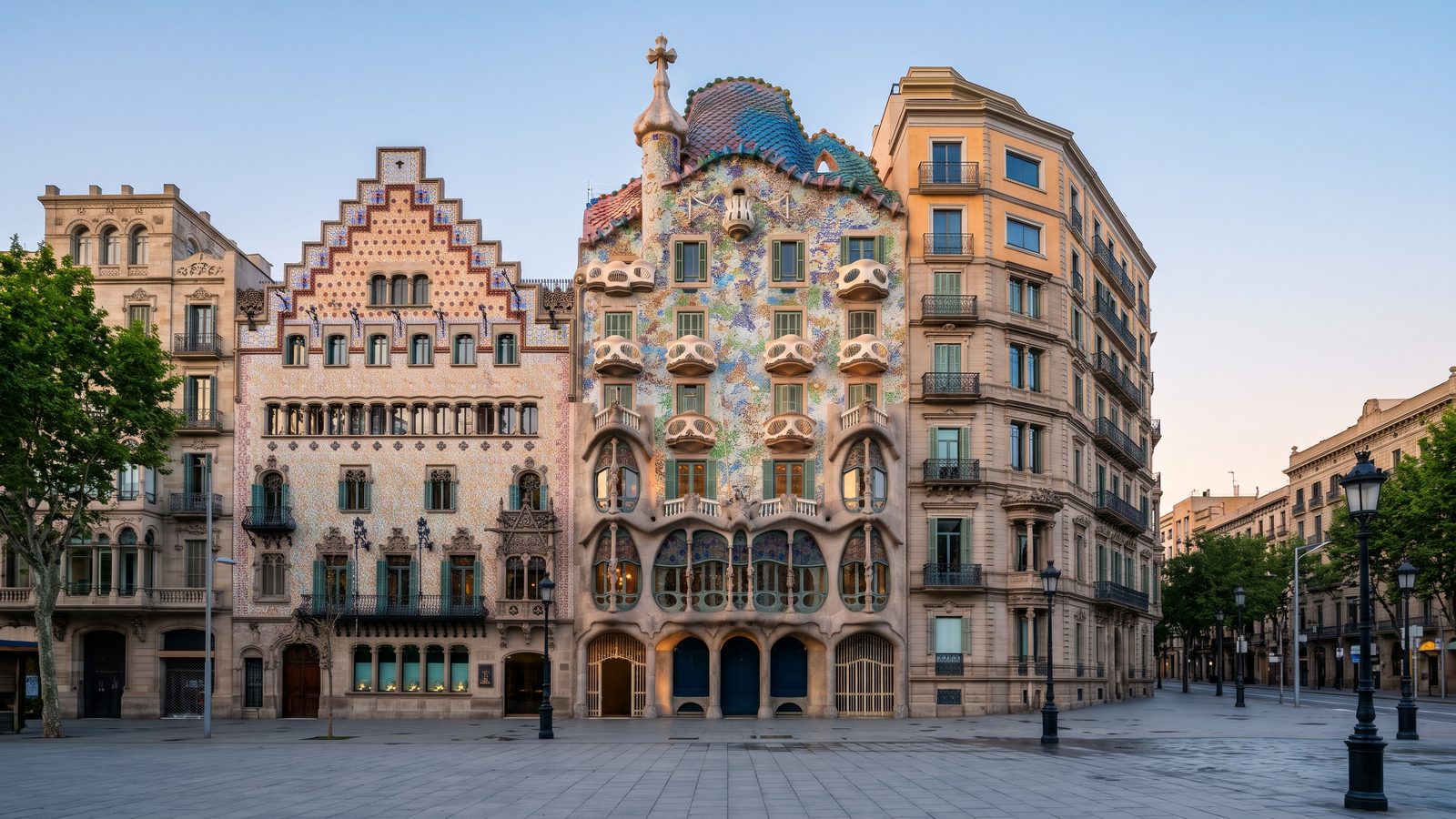
Welcome to Passeig de Gràcia, where you stand before Casa Batlló, one of Antoni Gaudí’s most astonishing architectural achievements. Transformed between 1904 and 1906 for industrialist Josep Batlló, this former 1877 apartment building defies traditional convention. As you gaze at its undulating façade, you see iridescent mosaic tiles, bone-like columns, and skull-shaped balconies. This UNESCO World Heritage site stands as a vibrant, living sculpture at the heart of Catalan Modernisme.
With this self-guided audio tour, you set your own pace while exploring the history, art, and brilliant structural innovations woven throughout the house. Step inside to witness how light, color, and local legend converge inside one of Barcelona’s most celebrated cultural landmarks.
Listen to a sample
The opening of this tour, exactly as AllTours narrates it on site.
What you'll hear on this tour
Stop 1. Living Forms and Skeletal Balconies
You stand before a façade that completely rejects rigid, straight lines, undulating like a living organism. Look closely at the shimmering skin: a dazzling trencadís mosaic of broken ceramic tiles catches the light in countless ways, evoking the scales of a mythical creature. Notice how the skeletal balconies feature wrought-iron railings resembling bones, while skull-shaped openings framing the windows add a playful, whimsical reimagining of architectural forms. Gaudí seamlessly merges form and function here, using structural support elements as artistic expressions. As you observe the oval windows, you see how their varying sizes optimize natural light, creating an innovative approach to natural climate control and interior illumination long before modern systems existed.
Stop 2. Surreal Sculptures and Trencadís Mosaic
Your eyes drift up toward the undulating roof, where Gaudí’s trencadís technique shines brilliantly. Shards of ceramic, glass, and repurposed materials form a shimmering skin across the dragon's back, reflecting Mediterranean blues, greens, and purples that give the surface a liquid quality. As you look higher, observe the rooftop chimneys. Far from simple utility vents, Gaudí elevates these structures into surreal, freestanding sculptures clad in vibrant broken tiles and capped like warrior helmets or mushrooms. Even the four-armed cross piercing the sky stands as a deliberate artistic statement, completing this rooftop canvas. Here, every surface becomes an expressive stroke of genius, turning functional architecture into pure art.
Stop 3. Saint George, the Dragon, and Modernisme
As you step further into the story of Casa Batlló, you encounter a vibrant cultural manifesto of Catalan Modernisme. This movement embodies the Renaixença, a powerful revival reasserting Catalan identity through art and architecture. Notice how the pervasive legend of Saint George and the dragon comes alive across the building. The roof’s iridescent ceramic scales represent the beast's spine, while the cross-topped turret symbolizes the knight’s triumphant lance. By weaving local folklore into avant-garde architecture, Gaudí crafts a bold symbol of Barcelona’s progressive spirit. Josep Batlló’s commission showcases how Barcelona’s industrial elite sought to demonstrate their wealth and modern taste, establishing an enduring cultural landmark that continues to inspire.
Stop 4. Panoramic Vistas Across Barcelona
From this rooftop vantage point, you gaze out across a breathtaking panorama of Barcelona. Looking east, you see the iconic spires of the Sagrada Família rising dramatically above the city, echoing Gaudí’s visionary spirit. Turn north, and the neat geometric grid of the Eixample district unfolds beneath you, offering a striking counterpoint to Casa Batlló’s fluid, organic shapes. Below, you trace the grand boulevard of Passeig de Gràcia, bustling with life alongside other Modernista gems, while green slopes of Montjuïc hill anchor the southern horizon. Gaudí designed this fantastical building to directly engage with its urban surroundings, creating a dialogue between his masterpiece and the vibrant city below.
Stop 5. From Conventional Block to Evolutionary Vision
You are looking at a building with a rich history of transformation. Originally constructed in 1877 by Emilio Sala Cortés as a conventional apartment block, the structure looked dramatically different from the organic landmark you see today. In 1903, wealthy textile industrialist Josep Batlló purchased the property on Passeig de Gràcia. Although he initially planned to demolish the building, Antoni Gaudí convinced him to undertake a radical renovation instead. Between 1904 and 1906, Gaudí transformed the existing framework, demonstrating his revolutionary belief in evolution over destruction. The Batlló family lived here until the 1950s, preserving a key moment in Catalan Modernisme that established Gaudí’s world-renowned reputation.
Stop 6. Light Engineering and Organic Flow
As you explore the interior spaces, you notice the complete absence of straight lines, replaced by gently curving walls that guide your movement like flowing water. Look up into the central light well, a masterpiece of natural environmental engineering. Gaudí arranges the wall tiles in a gradient, transitioning from deep blues at the top to lighter shades below, ensuring even distribution of light throughout every floor. Outside, wrought-iron balconies resemble skeletal Venetian masks, while undulating stone base elements evoke natural marine life. Every curve and material choice reflects Gaudí’s holistic design approach, seamlessly uniting structural physics, light control, and artistic beauty into one harmonious environment.
Planning your visit
- Best time to go
- Early morning or late afternoon for gentle daylight illuminating the façade mosaic and comfortable crowds on the roof terrace.
- Approximate duration
- about 1 to 1.5 hours
- Where to start
- In front of the main façade on Passeig de Gràcia, facing the bone-like lower columns.
Access and conditions change seasonally — check the official site before you go.
Frequently asked questions
Is Casa Batlló worth visiting?
Yes, Casa Batlló is widely considered one of Antoni Gaudí’s ultimate masterpieces and a UNESCO World Heritage site, renowned for its dragon-spine roof, skeletal balconies, and revolutionary light well design.
How long do you need at Casa Batlló?
Most visitors spend between 1 and 1.5 hours exploring the main façade, interior noble spaces, central light courtyard, and rooftop terrace.
Was Casa Batlló built from scratch by Gaudí?
No, the building was originally erected in 1877 by Emilio Sala Cortés. Gaudí radically renovated and transformed the structure between 1904 and 1906 for industrialist Josep Batlló.
Keep exploring
Header image is an AI-generated illustration of Casa Batlló. AllTours.ai is an AI audio tour guide — point your camera at any landmark and hear its story.