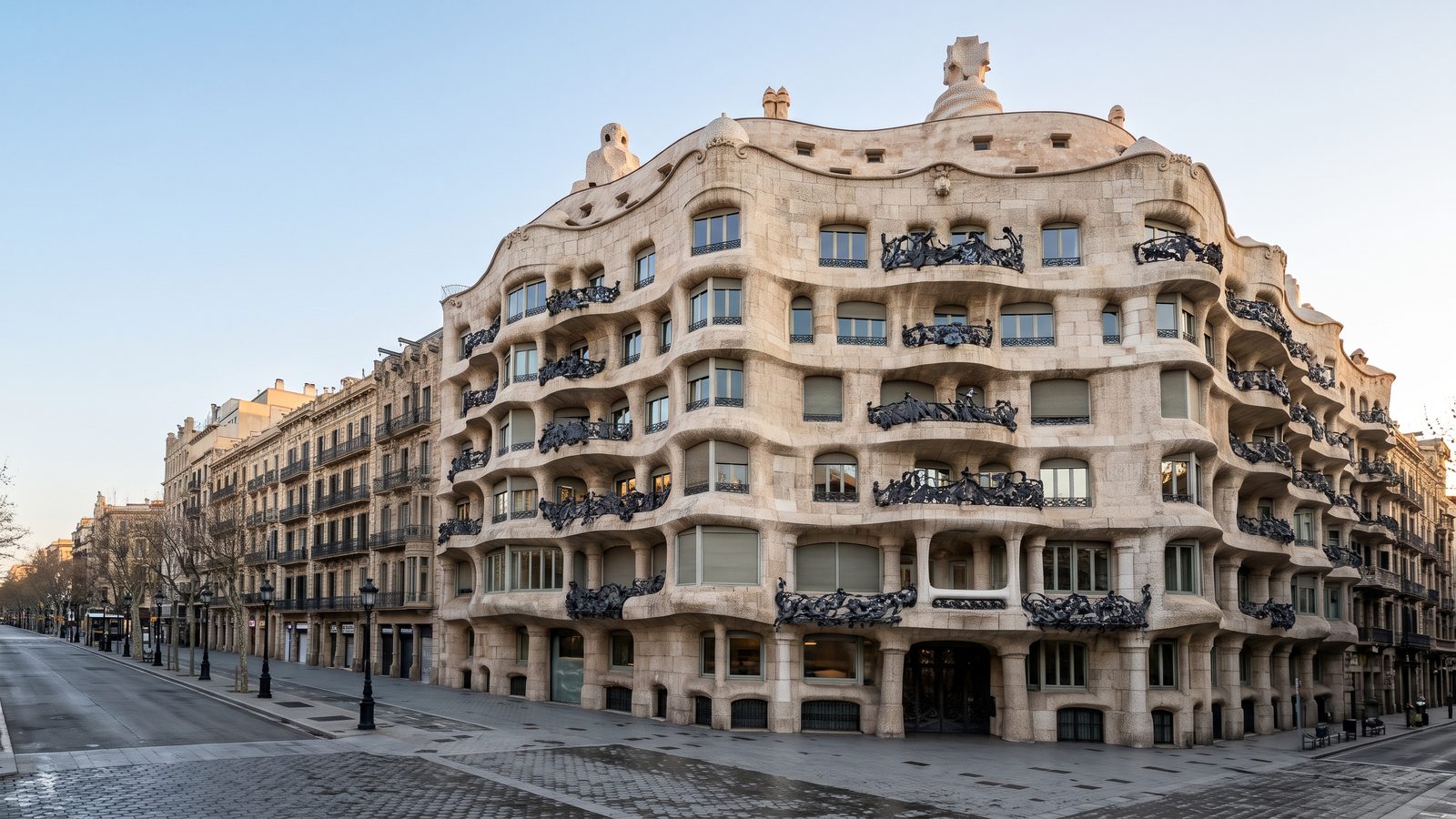
Welcome to Casa Milà, Antoni Gaudí's groundbreaking Modernist residential masterpiece in Barcelona. Affectionately known as 'La Pedrera' or The Quarry, this UNESCO World Heritage site fascinates visitors with its rolling stone façade, intricate wrought-iron seaweed balconies, and surreal warrior-like rooftop chimneys. As you explore its light-filled courtyards and organic interior spaces, you will experience an architectural icon where nature's geometry completely replaces straight lines and rigid conventional rules.
Designed between 1906 and 1912 for the wealthy Milà family, the building initially sparked intense civic controversy and public ridicule. Today, it stands as the ultimate symbol of Catalan Modernisme, showcasing how Gaudí merged revolutionary engineering with pure artistic sculpture to create a living, breathing landmark.
Listen to a sample
The opening of this tour, exactly as AllTours narrates it on site.
What you'll hear on this tour
Stop 1. The Surreal Warrior Roof Garden
As you step onto the roof of Casa Milà, you enter a surreal open-air museum. You stand surrounded by sculpted chimneys resembling helmeted warriors standing guard over Barcelona. Notice how their spiraling stone forms are not merely decorative; Gaudí designed them to optimize smoke expulsion while serving as artistic sentinels. Organic ventilation towers rise around you like giant mushrooms, naturally drawing fresh air into the apartments below. As you navigate the undulating terrain of terraced steps and soft curves, look out across the city skyline. You can spot the distant spires of the Sagrada Família, linking Gaudí’s masterworks across the Catalan capital.
Stop 2. Living Cliffs and Floating Iron
As you stand before the undulating stone façade, you see why locals nicknamed this building 'La Pedrera' or The Quarry. Gaudí engineered a revolutionary self-supporting structure, completely eliminating traditional load-bearing walls. An internal steel frame grants total freedom, creating open-plan interiors without a single straight line. Below you, two vast, light-filled courtyards—one circular and one elliptical—act as natural lungs, channeling fresh air and sunlight deep into every room. Even the wrought-iron balconies, twisting like tangled seaweed or wild vines, blend fine art with structural engineering. You are looking at an architectural organism designed to move, breathe, and live.
Stop 3. Attic Arches and Bourgeois Life
As you ascend into the attic, known as the Espai Gaudí, you walk beneath soaring parabolic brick arches. Here, you discover how the master architect engineered his organic forms without traditional buttresses, using inverted hanging chain models to calculate structural loads. Intricate blueprints, scale models, and original sketches reveal his creative process. Stepping further into the restored 1910s apartment, you enter a living museum of early 20th-century bourgeois life. You see custom-crafted furniture, ergonomic fixtures, and expansive windows flooding every room with daylight, illustrating Gaudí’s holistic belief that every interior detail—from door handles to ceiling frescoes—should form a unified artistic masterpiece.
Stop 4. Ambition, Controversy, and The Quarry
You stand before a building born from intense societal clash and creative ambition. In 1906, industrialist Pere Milà and his wife, Roser Segimon, commissioned Antoni Gaudí to create a flagship mansion on Barcelona’s trendiest boulevard. However, Gaudí’s radical vision sparked immediate conflict. City authorities halted construction when cantilevered structures crossed property boundaries, but Gaudí ignored their orders, triggering legal battles and heavy fines. Even the Milà family grew frustrated over soaring costs and unconventional designs. Mocked by locals who dubbed it 'La Pedrera'—The Quarry—for its raw appearance, this controversial masterpiece eventually emerged as a world-famous monument of Modernisme.
Stop 5. Engineering Nature’s Genius
You see Gaudí’s radical genius operating at every level of Casa Milà. Refusing to settle for standard construction methods, he translated nature’s structural principles into revolutionary building techniques. He utilized catenary arches to distribute weight effortlessly, avoiding rigid internal walls to create flexible, open-plan spaces decades ahead of their time. Look closely at the subtle details around you: natural ventilation channels regulate interior temperatures without artificial energy, while door handles are custom-molded to fit the natural contours of the human hand. Gaudí operated as both sculptor and engineer, holding firm to his vision despite public ridicule and severe client disputes.
Stop 6. Catalan Modernisme as Total Art
You are experiencing the ultimate expression of Catalan Modernisme, a movement that transformed architecture into a philosophical lifestyle. Here, straight lines give way to fluid curves that echo the natural world. The undulating stone exterior mimics a weather-carved sea cliff, maximizing natural light and airflow to create healthier urban living spaces. Hand-forged wrought-iron railings twist like abstract marine plants, highlighting the era's dedication to traditional craftsmanship over industrial mass production. Every functional element, from parabolic roof arches to sculpted ventilation shafts, combines practical utility with artistic elegance, turning a residential apartment building into a living, breathing work of total art.
Planning your visit
- Best time to go
- Early morning right at opening or late afternoon to avoid peak crowd times and capture soft sunlight on the rooftop.
- Approximate duration
- About 1.5 to 2 hours
- Where to start
- Passeig de Gràcia entrance, outside the main façade of Casa Milà.
Access and conditions change seasonally — check the official site before you go.
Frequently asked questions
Is Casa Milà worth visiting?
Yes, Casa Milà is one of Barcelona's most famous UNESCO World Heritage sites. Its unique organic architecture, parabolic attic arches, and iconic warrior-chimney rooftop offer an unforgettable experience of Antoni Gaudí's genius.
How long do you need at Casa Milà?
Most visitors spend between 1.5 and 2 hours exploring the building, including the inner courtyards, the Espai Gaudí attic museum, a restored 1910s apartment, and the famous rooftop terrace.
Why is Casa Milà called La Pedrera?
Locals nicknamed the building 'La Pedrera' (The Quarry) during its construction between 1906 and 1912 due to its raw, unpolished, undulating stone façade, which resembled an open-pit stone quarry.
Keep exploring
Header image is an AI-generated illustration of Casa Milà. AllTours.ai is an AI audio tour guide — point your camera at any landmark and hear its story.