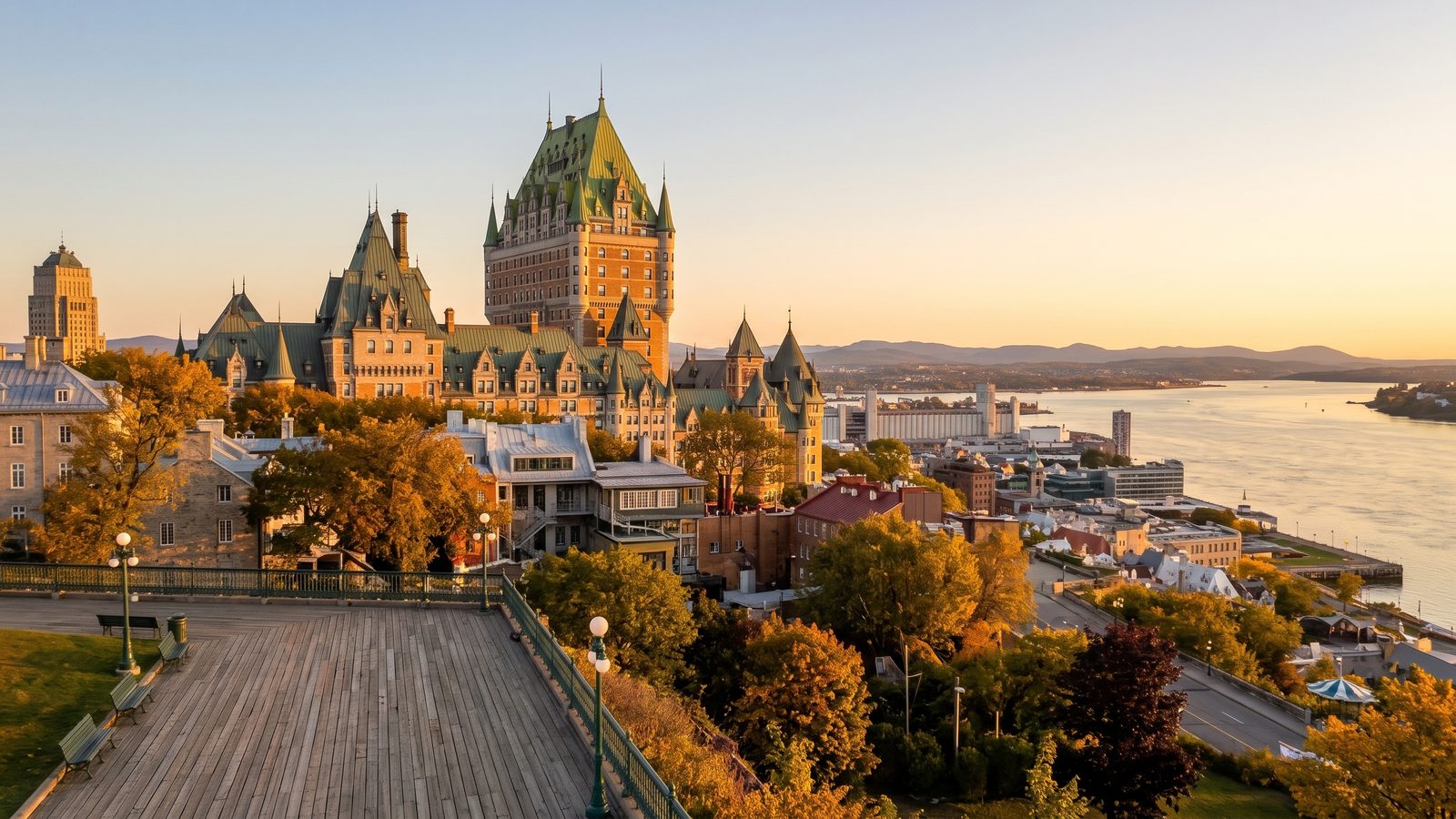
Perched high above the St. Lawrence River on Cap Diamant, Château Frontenac stands as the defining landmark of Quebec City. Opened in 1893 by the Canadian Pacific Railway, this grand castle-like hotel harmonizes French Renaissance majesty with North American ambition. As you walk its historic perimeter and nearby Dufferin Terrace, you follow in the footsteps of world leaders, artists, and travelers who have shaped the cultural fabric of Canada.
This self-guided audio tour reveals the rich history, striking architecture, and dramatic landscapes surrounding Quebec's iconic grand hotel. Experience the stories carved into its stone walls, explore breathtaking river vistas, and immerse yourself in the living heritage of Old Québec at your own comfortable pace.
Listen to a sample
The opening of this tour, exactly as AllTours narrates it on site.
What you'll hear on this tour
Stop 1. Echoes of Empire and World Leaders
You step into a living timeline born in the late nineteenth century, when the Canadian Pacific Railway envisioned a network of grand railway châteaux to draw travelers across the nation. Architect Bruce Price crafted its dramatic silhouette in 1893, drawing deep inspiration from regional French heritage. As you gaze up at the central tower and Citadelle wing, you witness decades of ambitious expansions. Most remarkably, you stand where world history took shape during the secret Quebec Conferences of 1943 and 1944. Here, Winston Churchill, Franklin D. Roosevelt, and William Lyon Mackenzie King gathered within these very walls to plan crucial Allied strategies that defined World War II.
Stop 2. A Masterclass in Chateauesque Elegance
As you examine the grand facade of Château Frontenac, you encounter a triumphant showcase of Châteauesque architecture designed to evoke 16th-century French Renaissance castles. You notice how rough-hewn stone and sturdy red brick masonry contrast with steeply pitched copper roofs oxidized into vibrant verdigris, mirroring the romantic châteaux of the Loire Valley. Elaborate turrets, conical caps, and ornate dormer windows break up the building's massive footprint along Cap Diamant. Designed initially by Bruce Price and expanded thoughtfully by architects like Robert S. Schloss and William S. Painter, the structure blends multiple additions into a harmonious, dramatic crown over Old Québec's historic skyline.
Stop 3. Sweeping Vistas of the St. Lawrence
You step onto the wide wooden boards of Terrasse Dufferin, where the vast St. Lawrence River opens up dramatically below you. From this high vantage point, you track ships gliding along the narrow river channel toward the Atlantic Ocean, reflecting centuries of maritime trade and exploration. Looking across the water, you spot the quiet shores of Lévis offering a subtle contrast to the historic city beneath your feet. Turning your gaze inward, you admire the cascading grey stone and copper rooftops of UNESCO-listed Old Québec tumbling down Cap Diamant, while distant views reveal the historic Plains of Abraham.
Stop 4. The Sentinel on Cap Diamant
Looking outward along the high cliffs of Cap Diamant, you behold the imposing stone ramparts of the Citadel. Designed by British Royal Engineers following the War of 1812, this massive star-shaped fortress was built to defend Quebec against potential American attacks. You are observing North America's largest British-built fortification, which remains an active military installation and the home base for the famous Royal 22nd Regiment, known as the Van Doos. As you take in its formidable position, you also look upon the official secondary residence of Canada's Governor General, where history and modern state ceremonial governance continuously intersect.
Stop 5. The Heartbeat of Quebecois Identity
As you walk among these historic grounds, you realize Château Frontenac is far more than a luxury hotel—it is a powerful cultural emblem for Quebec and French North America. You see its recognizable silhouette immortalized in local art, literature, and photography, serving as an enduring symbol of Québecois identity atop Cap Diamant. Over the decades, this grand castle has functioned as a central gathering place for political figures, celebrated writers, artists, and thinkers. You feel the vibrant intellectual and creative energy that has flowed through its halls, reflecting a rich French legacy that continues to shape modern Canadian culture.
Stop 6. Natural Grandeur and Strategic Heights
Positioned on the edge of Cap Diamant, you appreciate why military commanders and railway visionaries chose this commanding promontory. Looking out toward the horizon, you trace the St. Lawrence River as it broadens eastward into an estuary toward the Atlantic Ocean. Directly below, street performers and strollers animate the bustling wooden boardwalk of Dufferin Terrace, framed by antique cannons that once guarded the harbor against invading fleets. Beyond the promenade, the peaceful green lawns of the Plains of Abraham stretch outward, offering a serene contrast to the dramatic precipice where imperial fates were decided centuries ago.
Planning your visit
- Best time to go
- Late afternoon during summer or fall, leading into dusk when the city lights turn on.
- Approximate duration
- About 1 to 1.5 hours
- Where to start
- Dufferin Terrace near the main entrance of Château Frontenac on Cap Diamant.
Access and conditions change seasonally — check the official site before you go.
Frequently asked questions
Is Château Frontenac worth visiting?
Yes, Château Frontenac is widely considered a must-see landmark in North America. Known as one of the world's most photographed hotels, it offers iconic architecture, rich history from World War II summits, and stunning panoramic views of the St. Lawrence River.
How long do you need at Château Frontenac?
Plan for about 1 to 2 hours to explore the exterior, walk along Dufferin Terrace, take in the river views, and appreciate the historic architecture on a self-guided audio tour.
What historical event took place at Château Frontenac during World War II?
In 1943 and 1944, the hotel hosted the top-secret Quebec Conferences, where Allied leaders Winston Churchill, Franklin D. Roosevelt, and William Lyon Mackenzie King met to strategize key WWII military operations.
Keep exploring
Header image is an AI-generated illustration of Château Frontenac. AllTours.ai is an AI audio tour guide — point your camera at any landmark and hear its story.