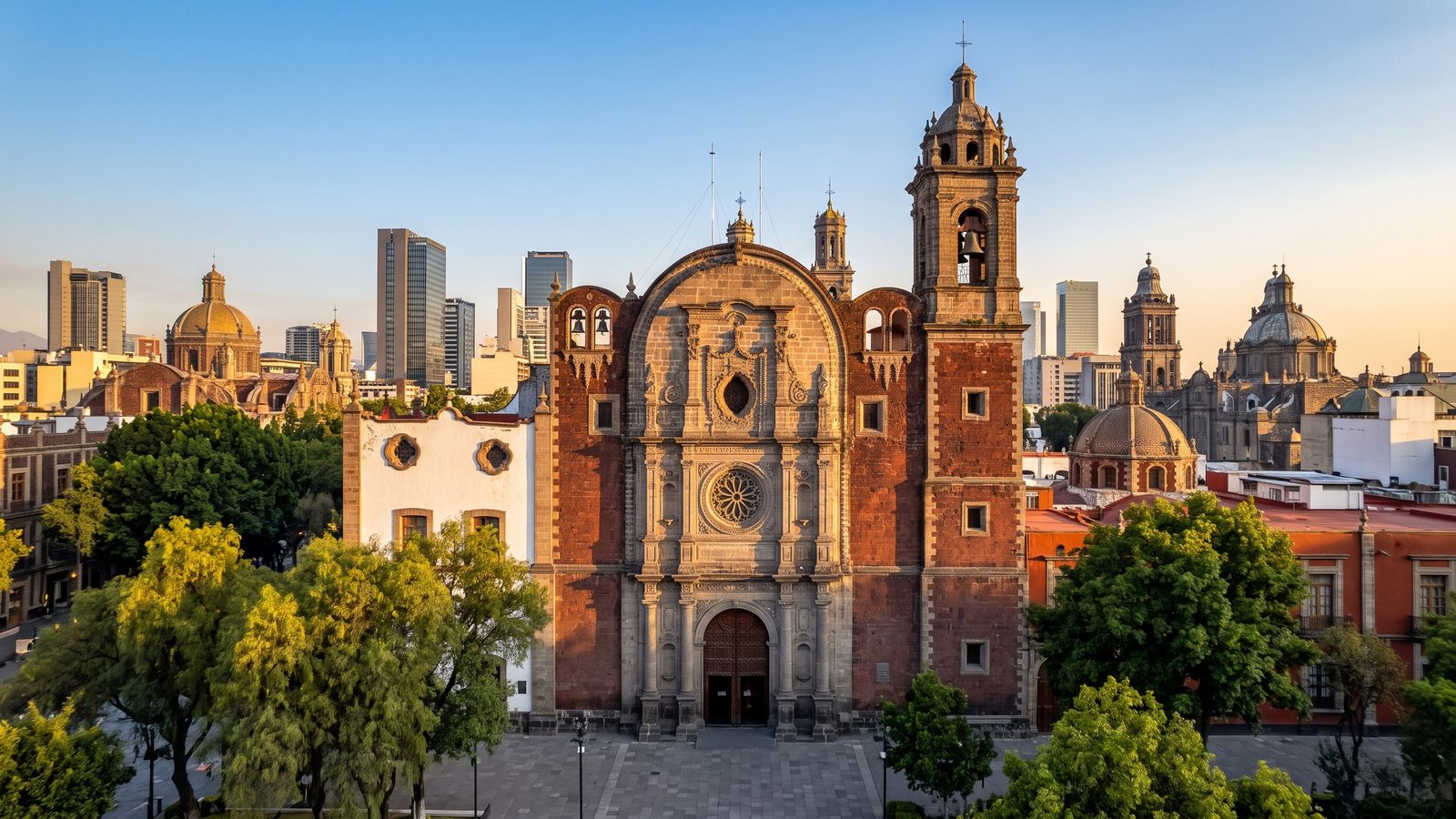
Welcome to the Temple of San Hipólito, a pivotal landmark built directly on the site where Spanish forces defeated the Aztec Empire on August 13, 1521. As you stand before this ultra-Baroque masterpiece, you are touching the foundational history of modern Mexico City. Constructed with volcanic tezontle and gray chiluca stone, it serves as both a historic victory monument and a deeply complex symbol of cultural syncretism.
This self-guided audio experience leads you through the church's dramatic architecture, colonial heritage, and profound religious significance. Discover how indigenous artisans sculpted European styles into a uniquely Mexican identity while reflecting on one of the most transformative moments in world history.
Listen to a sample
The opening of this tour, exactly as AllTours narrates it on site.
What you'll hear on this tour
Stop 1. Foundational Ground of Conquest
You stand on the very site where modern Mexico City was born from the fires of conquest. This church marks the definitive Spanish victory over Tenochtitlan on August 13, 1521. Because this date coincides with the feast day of Saint Hippolytus, the conquerors elevated him to patron saint of the fallen capital. Hernán Cortés himself reportedly laid the first stone of a humble hermitage here to honor the soldiers lost during the Noche Triste retreat. As you look around, you observe a monumental shift in world history: one of the earliest Christian sanctuaries built directly atop the vanquished Aztec heartland, signaling the rise of New Spain.
Stop 2. Baroque Masterpiece in Stone
Gaze up at the façade to admire a striking juxtaposition of dark red tezontle volcanic stone and light gray chiluca. You are observing the Churrigueresque ultra-Baroque style, celebrated for its dynamic energy and elaborate decoration. Look closely at the main portal to spot the estípite pilasters—inverted, truncated pyramids that guide your eyes toward the central relief depicting the martyrdom of San Hipólito. Shadows cast by deep niches add a sense of drama, while the twin bell towers reveal subtle, human variations in their craftsmanship. Tiled domes top the upper levels, catching the sunlight just as they did centuries ago in colonial New Spain.
Stop 3. Syncretism and Living Traditions
You are witnessing a space where indigenous spirituality and Catholic devotion deeply intertwine. Every year on August 13th, the Feast of San Hipólito hosts the Paseo del Pendón, a public procession carrying a symbolic conquest banner through the streets. Rather than celebrating mere military victory, this event represents a complex negotiation of national identity. Families gather to share traditional foods and pass down narratives blending pre-Hispanic myths with Christian traditions. As you explore, you sense how Mexican religiosity transformed imposed beliefs, using community rituals and persistent heritage to adapt and survive, creating a vibrant cultural fabric that continues to define the city today.
Stop 4. Chronicle of New Spain
Step back into the colonial era as you view these formidable walls, constructed as a direct assertion of Spanish rule and Catholic faith. Built shortly after the fall of Tenochtitlan, the church stands as a symbol of the New World reconquista. You can trace lavish Churrigueresque flourishes throughout the façade and interior, reflecting the immense wealth and religious zeal of New Spain. Notice how indigenous artisans, working under Spanish guidance, subtly infused local sensibilities into the intricate stone carvings and gilded altarpieces. This remarkable blending of European design and native skill birthed a uniquely Mexican Baroque style, making this structure a living chronicle of mestizaje.
Stop 5. Divine Signs and Spiritual Transformation
Consider the intense spiritual weight of this holy ground. Spanish conquistadors viewed their August 13th victory as explicit divine intervention, believing Saint Hippolytus had personally granted them favor. The Brotherhood of San Hipólito quickly formed to promote his veneration across the city. However, you also stand upon ground marked by the tragic Noche Triste, where indigenous resistance inflicted heavy Spanish losses. The temple acts as a permanent votive offering, commemorating the dramatic supplanting of one spiritual worldview by another. As you view the main altarpiece, notice how San Hipólito appears as a soldier-saint, forever tying religious devotion to the conquest of Tenochtitlan.
Stop 6. Monument to Empire's Fall
You are examining a physical monument to a civilization's end and a nation's rebirth. Erected to mark the capitulation of the Aztec Empire, this church served to completely reorder the urban and spiritual landscape. Local traditions hold that its very foundations contain repurposed stones taken directly from dismantled Aztec temples, visually concrete proof of physical and religious replacement. As you examine the carved stone around the entry portal, look for subtle indigenous motifs hidden alongside European saints. This site remains a place of deep historical reflection, silently narrating the fall of an ancient empire and the birth of modern Mexican identity.
Planning your visit
- Best time to go
- Morning on weekdays for quiet contemplation, or August 13th to experience the historical feast day festivities.
- Approximate duration
- about 45 minutes
- Where to start
- Outside the main portal of the Church of San Hipólito along Avenida Hidalgo.
Access and conditions change seasonally — check the official site before you go.
Frequently asked questions
Is Church of San Hipólito worth visiting?
Yes, the Church of San Hipólito is highly worth visiting for anyone interested in Mexican history, Baroque architecture, and cultural syncretism, as it stands directly on the historic site of the 1521 Spanish conquest of Tenochtitlan.
How long do you need at Church of San Hipólito?
Most visitors spend between 30 and 45 minutes exploring the church's Baroque facade, interior altarpieces, and historical monuments.
What is the historical significance of the Church of San Hipólito?
Founded shortly after August 13, 1521, the church commemorates the final Spanish victory over the Aztec capital on the feast day of Saint Hippolytus, marking the site of the Noche Triste retreat and the birth of New Spain.
Keep exploring
Header image is an AI-generated illustration of Church of San Hipólito. AllTours.ai is an AI audio tour guide — point your camera at any landmark and hear its story.