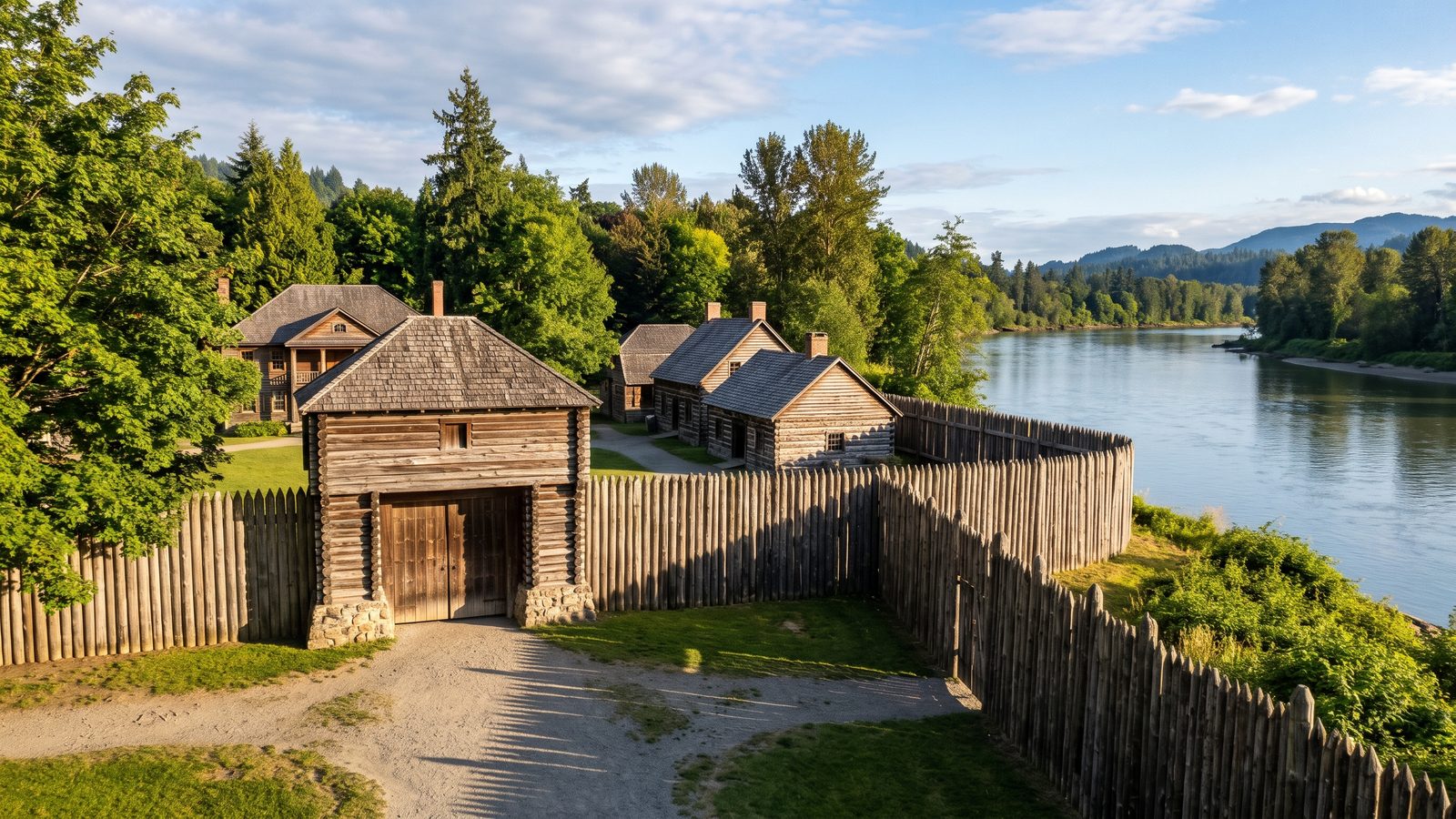
Welcome to Fort Langley National Historic Site, a pivotal frontier post established by the Hudson's Bay Company in 1827 along a strategic bend of the Fraser River. Here on the ancestral lands of the Kwantlen people, European fur traders and Indigenous nations interacted, traded, and shaped the future of Western Canada. As you walk among the wooden structures and palisades, step back into the era that laid the foundations of British Columbia.
This self-guided audio tour leads you through the heart of early colonial commerce, frontier architecture, and cultural exchange. Discover how beaver pelts, Chinook Jargon, and river navigation transformed this wooden fort into the beating heart of the Pacific Northwest trade network.
Listen to a sample
The opening of this tour, exactly as AllTours narrates it on site.
What you'll hear on this tour
Stop 1. Engine of the Frontier Economy
You step into the bustling commercial heart of early British Columbia. Reconstructed workshops, storerooms, and offices reveal where fur trade operations thrive. Piles of beaver, otter, and mink pelts sit packed for export across the Atlantic to fashion European hats. In return, essential European goods like iron pots, blankets, and tools arrive, fundamentally transforming local Indigenous economies. Beyond furs, surveyed farmlands generate agricultural surpluses traded right here to feed both fort workers and settlers. You stand at the very engine of regional trade, where currency, goods, and agricultural produce meet inside sturdy wooden walls.
Stop 2. Ancestral Lands of the Kwantlen
You walk across ground carrying deep spiritual significance long before European fur traders arrive. These ancestral lands belong to the Kwantlen people, whose connection to the Fraser River stretches back thousands of years. You imagine their intimate mastery of river currents and fish migrations that sustain thriving communities for generations. Sustainable craftsmanship shapes their tools and dwellings, harvested directly from surrounding cedar forests and riverbanks. Although the wooden fort marks a symbol of colonial expansion, you remain aware that this entire landscape is rooted in the enduring presence, wisdom, and stewardship of Indigenous nations.
Stop 3. Voices of the Trade Network
You breathe in the Fraser Valley air while listening for echoes of Chinook Jargon, the unique trade language blending Indigenous, European, and North American Indigenous tongues. Inside these palisades, diverse peoples meet to exchange goods, navigate dynamic relationships, and forge new cultural connections. The heavy wooden timbers around you stand as a physical record of those early interactions where separate worlds intertwine. As you explore the grounds, you experience the living canvas of evolving traditions and shared frontier life, revealing how exploration, adaptation, and cultural fusion shape the founding identity of modern British Columbia.
Stop 4. Groundwork of British Columbia
You stand on the exact ground where the foundations of British Columbia take shape. In 1827, the Hudson's Bay Company establishes this strategic outpost along the Fraser River to dominate Pacific Northwest trade. Surrounding wooden palisades remind you of the early defensive measures required during an era of intense competition for land and pelts. Complex relationships form between European traders and First Nations, creating a central hub that drives regional economy and society for decades. As you trace the fort perimeter, you walk through the definitive historical moments that ultimately lead to the proclamation of the colony in 1858.
Stop 5. Robust Timber and Frontier Design
You examine the rugged bones of the fort, where heavy timber framing and rough-hewn logs demonstrate practical colonial craftsmanship. These structures prioritize survival and trade over ornate decoration. Notice the steeply pitched roofs designed specifically to shed heavy coastal rain and winter snow, fighting a constant battle against Pacific Northwest weather elements. The simple layout reflects a straightforward layout meant to store goods, house workshops, and endure daily fur trading operations. As you touch the solid wooden walls, you feel the functional design engineered to withstand both harsh coastal weather and decades of hard frontier work.
Stop 6. Gateway to the Pacific Northwest
You stand at the edge of the fort grounds, imagining fur-laden vessels arriving along the pine-scented riverbank. Fort Langley serves as a vital staging post for legendary explorers charting unknown Pacific Northwest wilderness. You trace the footsteps of figures like Alexander Mackenzie, who push geographic boundaries across rugged river systems and mountain passes. Supported by Indigenous guides and sharp observation skills, these adventurers map vast river routes and trade channels. As you look out toward the Fraser River, you connect with the relentless human drive to explore uncharted horizons and open up wild frontier territories to the world.
Planning your visit
- Best time to go
- Spring through autumn, especially bright mornings when light illuminates the timber buildings.
- Approximate duration
- About 1 to 1.5 hours
- Where to start
- Begin at the main entrance palisade gate of Fort Langley National Historic Site.
Access and conditions change seasonally — check the official site before you go.
Frequently asked questions
Is Fort Langley National Historic Site worth visiting?
Yes, Fort Langley National Historic Site is deeply worth visiting as the birthplace of British Columbia. Visitors can explore authentic wooden architecture, learn about the 19th-century fur trade, and discover rich Indigenous history along the Fraser River.
How long do you need at Fort Langley National Historic Site?
Most visitors spend between 1 to 2 hours exploring the reconstructed timber structures, walking the palisades, and listening to the stories of fur traders and Kwantlen First Nations.
When was Fort Langley established and why was it built?
Fort Langley was established in 1827 by the Hudson's Bay Company along a strategic bend of the Fraser River to serve as a central fur trading post and commercial hub in the Pacific Northwest.
Keep exploring
Header image is an AI-generated illustration of Fort Langley National Historic Site. AllTours.ai is an AI audio tour guide — point your camera at any landmark and hear its story.