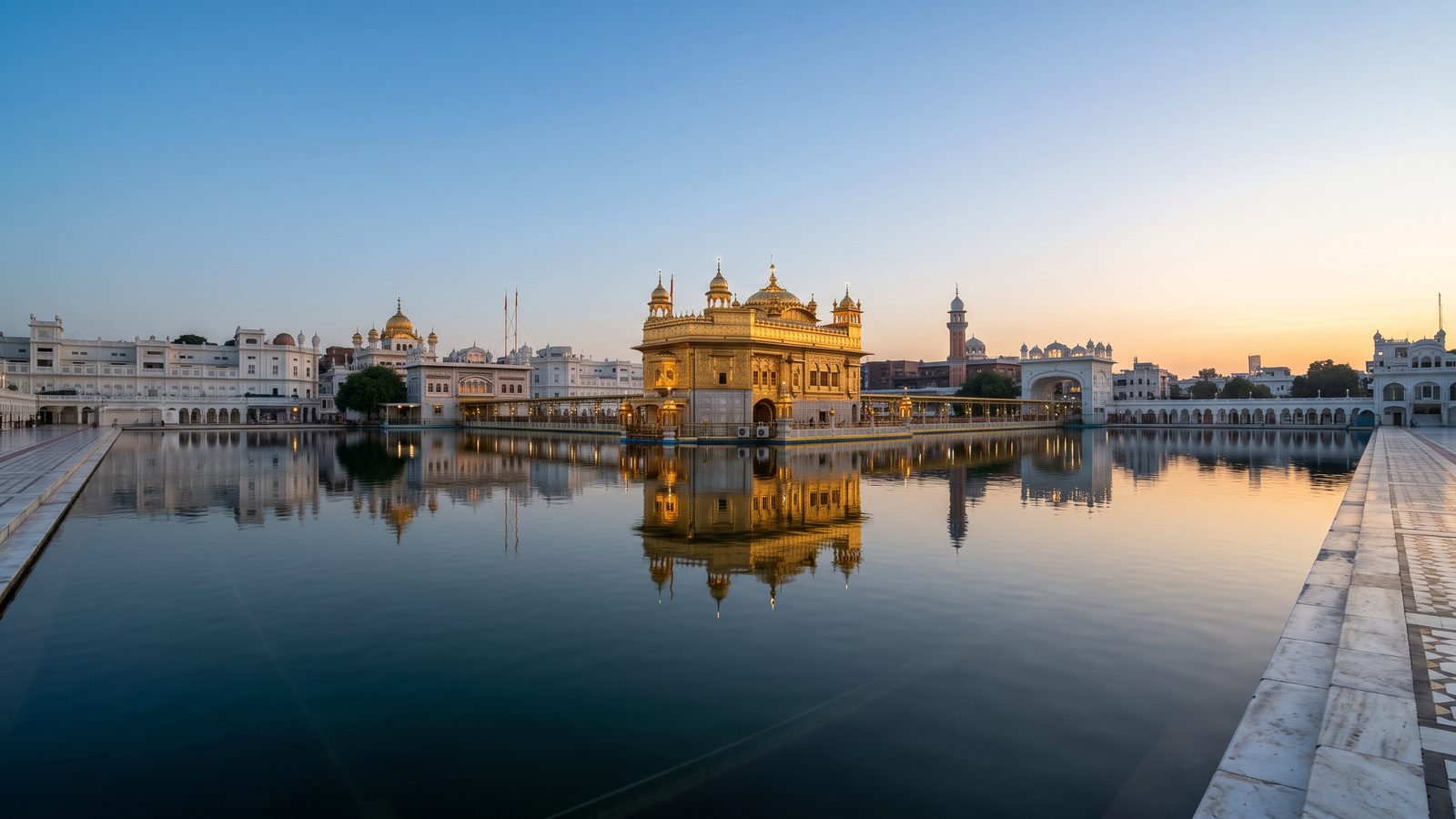
Welcome to Sri Harmandir Sahib, famously known as the Golden Temple, the spiritual center of Sikhism located in Amritsar, Punjab. Founded in the 16th century by Guru Ram Das and completed by Guru Arjan Dev, this magnificent sanctuary sits amidst the tranquil waters of the Amrit Sarovar. As you wander its sacred grounds, you will discover a place defined by profound faith, exquisite architecture, and boundless hospitality.
This audio tour guides you through the complex's inspiring history, striking marble and gold design, and vibrant cultural traditions. From the peaceful reflections on the holy tank to the bustling community kitchen serving free meals to all, experience the enduring spirit of equality, selfless service, and peace that fills this holy shrine.
Listen to a sample
The opening of this tour, exactly as AllTours narrates it on site.
What you'll hear on this tour
Stop 1. Ground Hallowed by Centuries of Devotion
You stand on ground shaped by centuries of resilience and faith. In the 16th century, Guru Ram Das acquired this land and initiated the excavation of the Pool of Nectar, the Amrit Sarovar. Guru Arjan Dev designed the Harmandir Sahib, intentionally placing its foundation lower than the surrounding land to symbolize humility. Demonstrating interfaith harmony, Muslim Sufi saint Mian Mir laid the cornerstone in 1588, and the holy scripture Adi Granth found its home here by 1604. Though Afghan invaders repeatedly desecrated the shrine during the 18th century, the Sikh community rebuilt it each time. Maharaja Ranjit Singh later adorned it with gold leaf and marble in the early 19th century.
Stop 2. Golden Facade and Revolutionary Entrances
As you gaze at the Harmandir Sahib, you notice how its lower level features white marble inlaid with semi-precious stone motifs using the Pietra Dura technique. Above, layers of pure gold leaf cover the upper walls, catching the sunlight and reflecting off the surrounding water. Crowned by an inverted lotus dome symbolizing divine purity, the structure features four distinct entrances—one on each side. You observe how this design serves as an architectural declaration of equality, welcoming visitors from all directions and backgrounds. Connecting the shrine to the shoreline, the marble causeway guides your steps as a symbolic bridge between the temporal world and spiritual devotion.
Stop 3. The Sacred Kitchen and Living Hymns
You enter a space where devotion manifests in daily action. At the langar, the world's largest community kitchen, you witness the Sikh principle of seva, or selfless service. Volunteers prepare and serve warm meals to tens of thousands of visitors every day, seating everyone together on the floor to break down social barriers. As you explore the complex, the melodic sounds of kirtan fill the air—sacred hymns from the Guru Granth Sahib recited continuously by ragis inside the sanctum. By covering your head and removing your shoes upon entering, you participate in a shared gesture of humility and respect that welcomes every visitor.
Stop 4. Mirror of the Unblemished Soul
Look across the still waters of the Amrit Sarovar and observe how the golden shrine seems to emerge directly from the pool. The carefully maintained water reflects every detail of the upper stories, cupolas, and resplendent domes in precise, dreamlike symmetry. As you watch light play across the gilded walls and their watery twin, this visual mirroring invites you into deep contemplation. The double image represents the pure consciousness and unblemished soul sought by pilgrims. It offers a silent invitation for you to look inward, finding divine reflection not only in the physical temple across the water, but within your own spirit as well.
Stop 5. The Journey Around the Pool of Nectar
You walk alongside pilgrims who have traveled vast distances to reach this sacred sanctuary. Here, the parikrama—the circumambulation around the holy pool—becomes your own moving meditation. You see devotees performing ishnan, taking a purifying dip in the Amrit Sarovar to cleanse their souls before approaching the central sanctum. Each step along the marble path serves as a quiet prayer of gratitude and humility. The journey culminates as you queue for darshan, seeking blessings before the holy scripture. Surrounded by thousands sharing the same devotion, you feel the tangible atmosphere of peace and spiritual renewal that makes this complex a global magnetic destination.
Stop 6. The Living Eternal Guru
At the spiritual heart of the temple, you encounter the Guru Granth Sahib, revered not merely as scripture but as the living, eternal Guru. You listen to the continuous chanting of Gurbani, which creates a calming soundscape designed to connect your mind directly to the divine. You witness the sacred daily Prakash and Sukhasan rituals, honoring the presence of the Gurus' wisdom. Throughout the complex, the spirit of selfless service, or seva, reveals how spiritual devotion extends beyond personal prayer into active humility. Whether through cleaning the marble walkways or preparing meals, every action reinforces a deep sense of shared humanity and divine connection.
Planning your visit
- Best time to go
- Early morning near sunrise or evening after sunset for cooler weather and serene reflections of illuminated architecture on the water.
- Approximate duration
- About 1 to 2 hours
- Where to start
- Main Clock Tower entrance (Ghanta Ghar) on the north side of the Golden Temple complex.
Access and conditions change seasonally — check the official site before you go.
Frequently asked questions
Is Golden Temple worth visiting?
Yes, Sri Harmandir Sahib is one of India's most sacred and profound cultural sites, renowned for its stunning gold leaf architecture, tranquil holy pool, and inclusive community kitchen.
How long do you need at Golden Temple?
Most visitors spend about 1 to 2 hours walking the marble circumambulatory path around the pool, taking in the live spiritual music, and visiting the free community kitchen.
Who founded the Golden Temple and when was it built?
Guru Ram Das, the fourth Sikh Guru, initiated the excavation of the holy pool in the 16th century. Guru Arjan Dev designed the shrine, with Muslim Sufi saint Mian Mir laying the cornerstone in 1588.
Keep exploring
Header image is an AI-generated illustration of Golden Temple. AllTours.ai is an AI audio tour guide — point your camera at any landmark and hear its story.