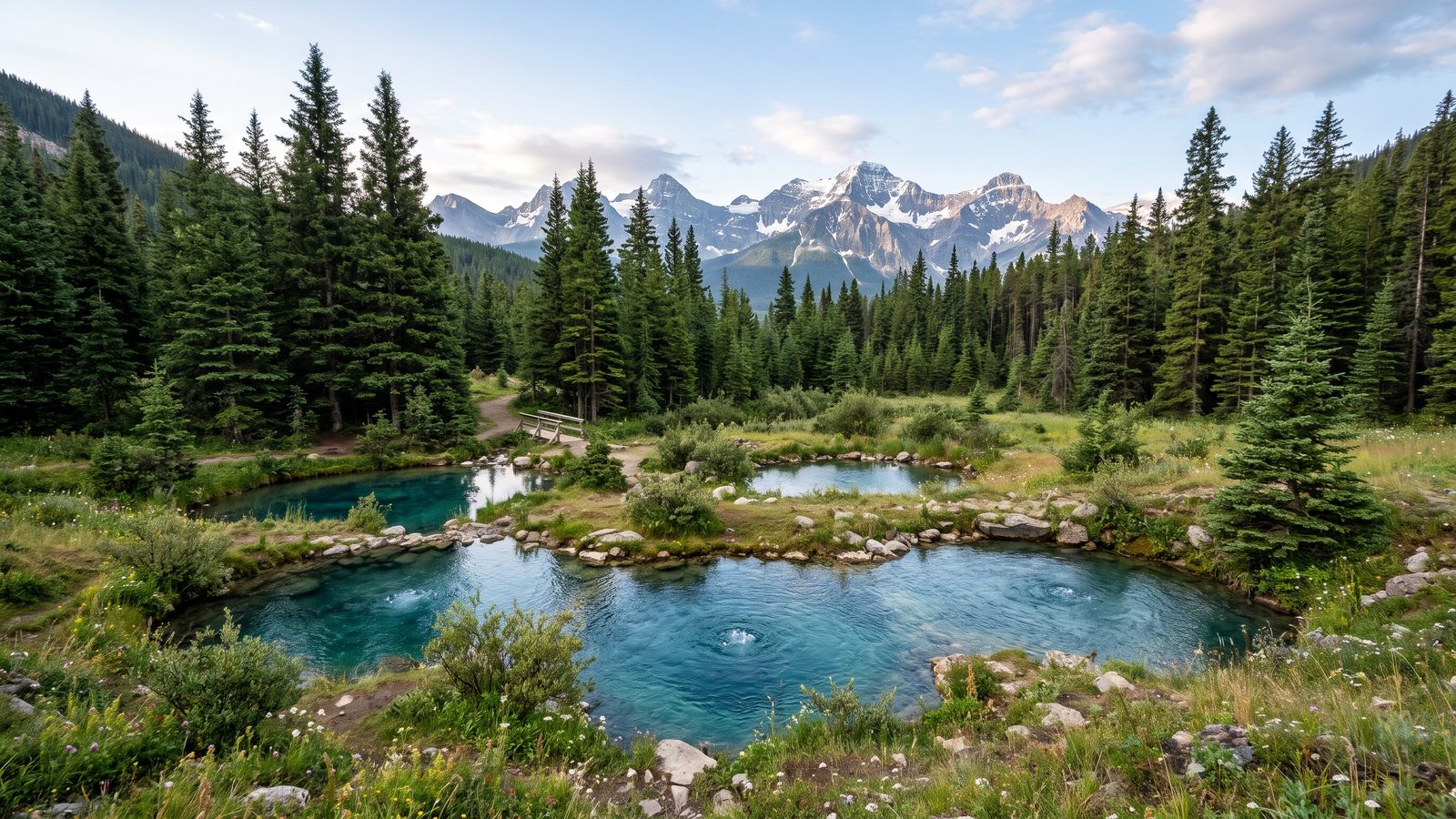
Welcome to the Ink Pots above Johnston Canyon in Banff National Park. Nestled within an ancient subalpine forest, these five unique mineral springs bubble with cold underground water that paints the pools in brilliant shades of green and turquoise. Surrounded by the majestic, snow-dusted peaks of the Canadian Rockies, this peaceful basin offers a tranquil sanctuary where deep subterranean geology meets vibrant wilderness, inviting you to pause, listen, and contemplate.
As you walk along the mountain trail, you step into a dynamic ecosystem nourished by ancient underground flows. This self-guided audio tour reveals how tectonic forces, ancient seafloors, and cold mineral springs work together to shape this pristine Canadian landscape, giving you a deeper connection to nature.
Listen to a sample
The opening of this tour, exactly as AllTours narrates it on site.
What you'll hear on this tour
Stop 1. The Cold Underground Mineral Springs
You stand before the bubbling Ink Pots, watching water that completed a subterranean journey lasting decades or even centuries. Rain and glacial melt seep deep into subterranean limestone fractures before rising here at a constant, icy four degrees Celsius. As this pressurized groundwater surges upward, it carries a fine suspension of microscopic calcium carbonate particles—essentially rock flour. You see how this perpetual flow refracts sunlight, giving the five distinct pools their glowing green and turquoise hues that clear water cannot replicate. This continuous, mineral-rich hydrological cycle sustains a rare micro-environment, revealing the powerful underground forces constantly reshaping Banff's landscape right beneath your feet.
Stop 2. Ancient Seafloors and Tectonic Scars
Look down at the limestone bedrock around you. You are standing on ancient seafloor deposits from the Cambrian and Devonian periods, formed from primeval corals and shelled organisms over hundreds of millions of years. During the Laramide Orogeny, immense tectonic forces uplifted and compressed these marine layers, raising the Canadian Rockies. This mountain-building event fractured the dense limestone, carving intricate faults and joints throughout the bedrock. Groundwater now percolates through these ancient subterranean scars, dissolving minerals as it travels to surface at the Ink Pots. You witness a direct result of deep geological history, brought to life through the endless interaction between water and solid rock.
Stop 3. Microbial Mats and Nascent Tufa
Observe the vibrant microbial mats lining the pool bottoms, where specialized algae flourish despite the icy four-degree Celsius water. Calcium carbonate dissolved from limestone bedrock over millennia creates this distinct hydrogeological environment. Notice the petrified formations slowly solidifying along the edges of the water. You are looking at nascent tufa deposits growing as mineral-saturated water precipitates calcium carbonate onto existing surfaces, gradually reshaping the pools over vast geological timescales. Unaffected by surface weather changes, this steady subterranean flow supports a fragile riparian ecosystem. Delicate mosses and moisture-loving plant species cling to the mineral-rich banks, proving the enduring power of deep underground water to nourish life.
Stop 4. A Cathedral of Mountains and Spires
Cast your gaze across the basin to behold a natural cathedral formed by subalpine firs and Engelmann spruces. Dappled sunlight filters through the high canopy, casting gold and emerald patterns onto moss-covered forest floor. Beyond the tree line, craggy peaks of the Canadian Rockies pierce the sky, their snow-dusted summits providing a dramatic backdrop to the quiet basin. The grand scale of these mountains creates a profound sense of awe and quiet contemplation. Standing here amidst towering trees and rugged grey rock faces, you experience the peaceful wilderness and timeless grandeur that make Banff National Park so unforgettable.
Stop 5. The Forest Canopy and Filtration System
Shift your view from the pools to the surrounding woods, home to lodgepole pines and robust Douglas firs. Their thick bark and dense needle canopies adapt seamlessly to harsh alpine winters and hot summer sun. Beneath your feet, decaying organic matter, mosses, and fungi enrich the soil while acting as a natural filtration system that purifies snowmelt before it reaches the springs. Listen closely for the rustle of red squirrels or woodpecker calls in the branches. For generations, Indigenous peoples drew upon this rich forest for tools, shelter, and medicines, maintaining a deep understanding of its intricate natural balance.
Stop 6. Leaving the Canyon's Roar Behind
As you walk the natural dirt trail beyond Upper Johnston Falls, the roaring canyon gives way to whispering pines and crunching gravel beneath your boots. You navigate exposed roots and gentle ascents, moving deeper into the cooler, resin-scented spruce forest. Leaving behind the busier canyon boardwalks, the steady rhythm of your steps syncs with the calm pulse of the woods. This three-kilometer leg transitions your mind from dramatic cascades to profound tranquility. Walking among ancient trees, you prepare to step into the open meadow basin where cold mineral springs bubble peacefully under the mountain sky.
Planning your visit
- Best time to go
- Spring through autumn during daylight hours, ideally early morning to avoid trail crowds.
- Approximate duration
- About 2 to 3 hours
- Where to start
- Johnston Canyon trailhead parking lot, following the main trail past Upper Falls to the open meadow.
Access and conditions change seasonally — check the official site before you go.
Frequently asked questions
Is Ink Pots worth visiting?
Yes, the Ink Pots offer a peaceful contrast to Johnston Canyon's busy boardwalks, featuring five vibrant cold mineral springs set against dramatic Rocky Mountain peaks.
How long do you need at Ink Pots?
Most visitors spend 2 to 3 hours total hiking from Johnston Canyon Upper Falls to the Ink Pots and enjoying the basin scenery.
How were the Ink Pots formed?
The Ink Pots formed over millions of years as tectonic activity fractured ancient seabed limestone, allowing deep subterranean glacial meltwater to dissolve minerals and bubble to the surface at a constant 4 degrees Celsius.
Keep exploring
Header image is an AI-generated illustration of Ink Pots. AllTours.ai is an AI audio tour guide — point your camera at any landmark and hear its story.