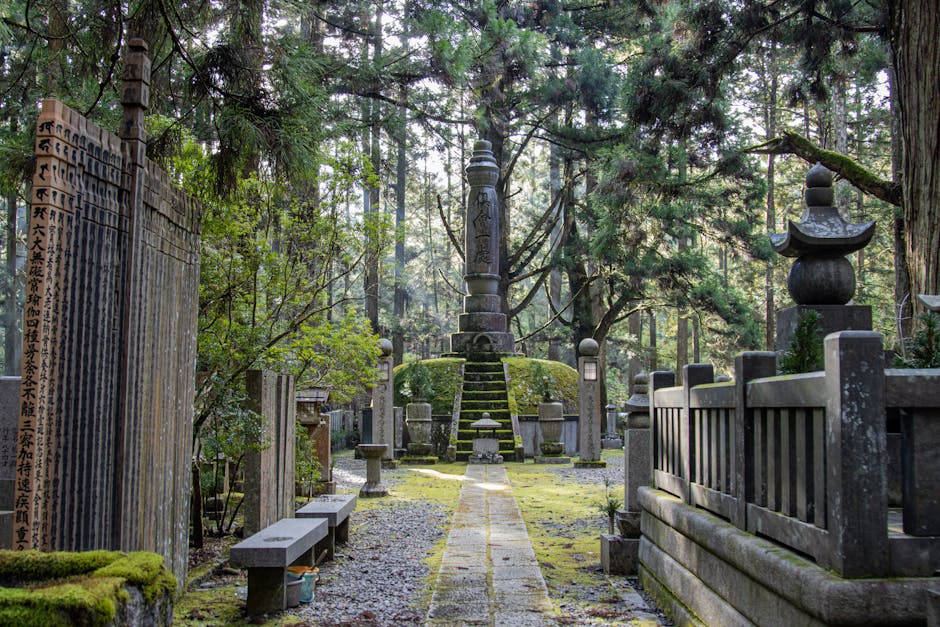
Welcome to Koyasan, a sacred mountain retreat nestled high in the Wakayama Prefecture, Japan. This revered site is the spiritual home of Shingon Buddhism, founded by the revered monk Kūkai (Kobo Daishi) in 816 AD. Prepare to step into a realm of profound tranquility, ancient history, and spiritual mystery.
Our self-guided tour invites you to explore Koyasan's most significant sites, from the atmospheric Okunoin cemetery, where Kūkai is believed to be in eternal meditation, to the vibrant Danjo Garan complex. Let AllTours.ai guide you through moss-covered paths, towering cedar forests, and magnificent temple grounds, revealing the stories and legends that make Koyasan truly unique.
What you'll hear on this tour
Stop 1. Ichinohashi Bridge
Your journey into the sacred realm of Okunoin begins at Ichinohashi Bridge, the traditional entrance to this vast and ancient cemetery. Legend dictates that from this point forward, all visitors are considered equals, sharing the sacred space with Kūkai himself. As you cross, take a moment to bow, signaling your respect for the revered monk and the spiritual energy that permeates these hallowed grounds. It's a symbolic purification before entering one of Japan's most sacred sites.
Stop 2. Okunoin Cemetery Path
Wander along the serene, moss-covered paths of Okunoin, winding through a forest of towering, ancient cedar trees. This vast cemetery is home to over 200,000 gravestones and memorials, many belonging to historical figures, feudal lords, and even corporate employees. The sheer scale and age of the surroundings create an atmosphere of profound peace and deep spiritual mystery. Each stone, often adorned with moss and dappled sunlight, tells an unspoken story, inviting quiet contemplation on life, death, and the passage of time.
Stop 3. Torodo Hall (Lantern Hall)
Deep within Okunoin, just before Kūkai's mausoleum, stands the Torodo Hall, or Lantern Hall. This captivating structure is illuminated by over 10,000 lanterns, many of which have been burning continuously for centuries, some even for over a thousand years. Two of these, the "Poor Woman's Lantern" and the "Lantern of the Former Emperor," hold particularly poignant legends of unwavering faith and devotion. The soft, warm glow creates an ethereal ambiance, symbolizing the eternal light of Buddhist teachings and the continuous prayers of countless pilgrims.
Stop 4. Kūkai's Mausoleum (Gobyo)
The spiritual heart of Koyasan lies within Kūkai's Mausoleum, also known as Gobyo. It is here that Kūkai, revered as Kobo Daishi, is said to be not dead, but in a state of eternal meditation, awaiting the arrival of the future Buddha, Miroku. Pilgrims visit this sacred site believing he continues to provide salvation and guidance to all who seek it. The air here is thick with reverence and devotion, a testament to the enduring legacy of a monk who shaped Japanese Buddhism and whose spiritual presence is still deeply felt today.
Stop 5. Danjo Garan
Step into the Danjo Garan, one of Koyasan's two most sacred precincts and the site where Kūkai first established his monastic complex. This vibrant area features several magnificent temples and pagodas, including the iconic Konpon Daito, a brilliant vermilion pagoda housing a powerful mandala. It represents the cosmic center of the universe according to Shingon Buddhism. The Garan complex is a place of active worship and study, offering a striking contrast to the quiet contemplation of Okunoin, yet equally steeped in history and spiritual significance.
Planning your visit
- Best time to go
- Early morning or late afternoon for the quietest experience, particularly beautiful during autumn foliage or cherry blossom season.
- Approximate duration
- about 3-4 hours, allowing ample time for walking and contemplation.
- Where to start
- Begin your tour at the Ichinohashi Bridge, easily recognizable by its traditional wooden structure and the start of the main path into the Okunoin cemetery.
Access and conditions change seasonally — check the official site before you go.
Frequently asked questions
What is Koyasan most famous for?
Koyasan is renowned as the spiritual home of Shingon Buddhism, founded by Kūkai (Kobo Daishi). It's most famous for the sacred Okunoin cemetery, where Kūkai is believed to be in eternal meditation, and for its numerous ancient temples and temple lodgings.
Can visitors stay overnight at Koyasan?
Yes, many visitors choose to experience a "shukubo" or temple lodging at Koyasan. This offers a unique opportunity to stay in a Buddhist temple, participate in morning prayers, and enjoy traditional vegetarian Buddhist cuisine. It is recommended to book well in advance.
What is the etiquette for visiting Koyasan's sacred sites?
As a deeply sacred site, visitors should dress respectfully, covering shoulders and knees. Maintain a quiet and reverent demeanor, especially in temples and the Okunoin cemetery. Photography may be restricted in certain areas, so always look for signs.
Keep exploring
Photography via Pexels. AllTours.ai is an AI audio tour guide — point your camera at any landmark and hear its story.