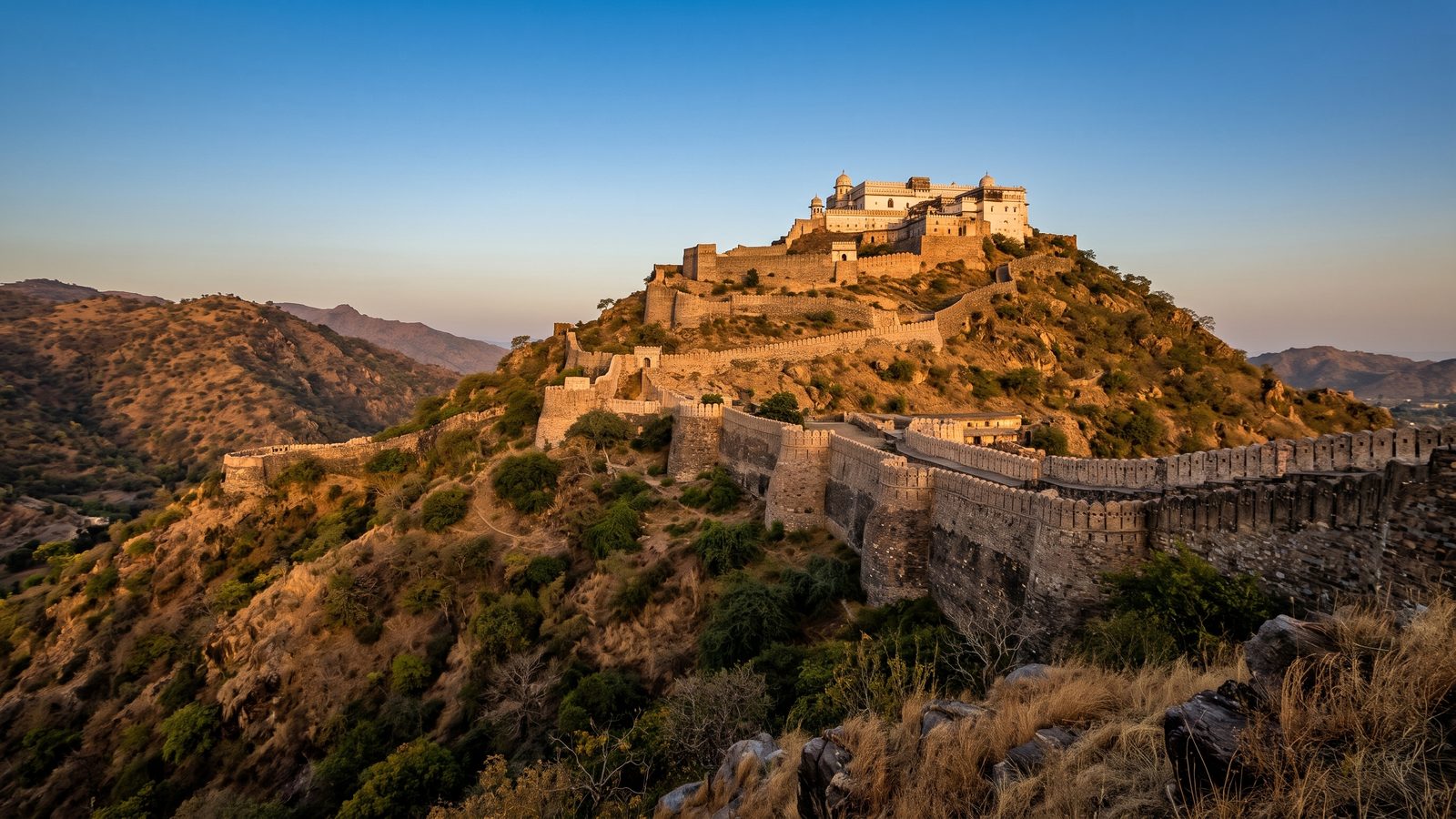
Welcome to Kumbhalgarh Fort, a legendary stronghold perched high in Rajasthan’s rugged Aravalli range. Conceived in the 15th century by Rana Kumbha, this colossal fortress served as an impenetrable sanctuary for the Mewar dynasty. As you explore its expansive grounds, you walk through centuries of defiance, royal refuge, and Rajput architectural grandeur, framed by its world-famous perimeter wall that winds endlessly across the misty mountain peaks.
With this self-guided audio tour, you set your own pace across majestic gates, ancient temples, and lofty palaces. Discover the enduring heritage of Mewar, relive tales of legendary battles, and soak in breathtaking mountain panoramas from the fort's highest ramparts.
Listen to a sample
The opening of this tour, exactly as AllTours narrates it on site.
What you'll hear on this tour
Stop 1. The Great Wall of India
You stand before the legendary perimeter wall of Kumbhalgarh, often called the Great Wall of India. Stretching an astonishing 36 kilometers across the undulating Aravalli hills, this continuous barrier is the second-longest wall in the country. As you trace its serpentine path, notice its incredible width—wide enough in many sections for eight horses to ride abreast along the battlements. Initiated by Rana Kumbha, this defensive masterpiece seamlessly integrates with the natural terrain. Meticulously cut stones fitted without mortar showcase the extraordinary skill of Mewar artisans. This massive barrier once protected the young Prince Udai Singh II, safeguarding the future of the Mewar dynasty behind its unyielding embrace.
Stop 2. Mastery of Rajput Military Design
As you gaze across the complex, you observe an ingenious blend of military defense and aesthetic grace. Over 360 bastions stud the battlements, providing overlapping lines of sight across the rugged landscape. Look closely at the seven fortified gates, or pols, engineered with sharp turns and spiked doors to thwart direct elephant charges. Higher up, the multi-tiered Badal Mahal features delicate jharokhas—projecting balconies that offer panoramic surveillance and cool mountain breezes. Every structure reflects a deliberate design intended to withstand fierce attacks while preserving artistic beauty. You walk through a monumental legacy where intricate stone carvings meet relentless defensive strength.
Stop 3. Cradle of Legend and Defiance
You walk upon ground forged in defiance and royal destiny. Commissioned by Rana Kumbha in 1443, the fort took fifteen grueling years to construct as a sanctuary for the Mewar lineage. Within these formidable walls, the legendary warrior Maharana Pratap was born, his unyielding spirit shaped by this rugged fortress. Throughout its long history, the fort fell only a handful of times. In 1576, Akbar’s general, Shahbaz Khan, breached its defenses not through a direct military assault, but through a calculated siege that severed the fort’s water supply. Standing here, you feel the lingering echoes of strategic genius, royal rescue, and unbroken resolve.
Stop 4. Panoramas from Badal Mahal
You ascend to the highest point of the fortress, the majestic Badal Mahal, where breathtaking vistas unfold in every direction. Your gaze sweeps over the sprawling Aravalli mountain range, an ancient spine rising against the horizon. From this vantage point, you observe the colossal perimeter wall snaking like a stone serpent across rugged peaks and deep valleys. The contrasting colors of dense green forests and ochre rock faces paint a dramatic visual landscape below. You feel the cool mountain breeze carry whispers of ancient sentinels who once scanned these distant hills for approaching armies, commanding absolute authority over the vast wild heart of Rajasthan.
Stop 5. Temples and Cultural Legacy
As you explore inside the massive ramparts, you discover that Kumbhalgarh is far more than a fortress—it is a thriving sanctuary of cultural heritage. Nestled within its shield are over 360 ancient temples, spanning both Hindu and Jain traditions. You admire the intricate stone carvings and distinct architectural styles that showcase the spiritual devotion and artistic patronage of the Mewar rulers. Recognized as a UNESCO World Heritage site, this defensive stronghold successfully preserved an entire civilization’s artistic and religious identity against heavy odds. Each sacred shrine stands as a silent witness to centuries of spiritual practice and enduring Rajput identity.
Stop 6. Impregnable Bastions and Defensive Gates
You examine the sheer audacity of Kumbhalgarh's military engineering, designed to be virtually impregnable. The ramparts follow an ingenious zigzag pattern, deliberate in design to break the momentum of any frontal assault and force invaders into dangerous killing zones. As you pass formidable entry gates like Aret Pol and Hulla Pol, you experience the layered defensive challenges that weary attackers faced. Overlapping fields of fire from hundreds of watchtowers ensured constant vigilance over every approach. Legend whispers that the fortress fell only when its water supply was compromised, proving that its physical walls stood unyielding against traditional warfare for centuries.
Planning your visit
- Best time to go
- October to March offers pleasant weather for walking the ramparts; early morning or late afternoon provides comfortable light and temperatures.
- Approximate duration
- about 2 to 3 hours
- Where to start
- Begin your tour at Aret Pol, the first of the fort's main entrance gates.
Access and conditions change seasonally — check the official site before you go.
Frequently asked questions
Is Kumbhalgarh Fort worth visiting?
Yes, Kumbhalgarh Fort is a UNESCO World Heritage site featuring the second-longest continuous wall in the world, stunning Aravalli views, over 360 ancient temples, and rich Mewar royal history.
How long do you need at Kumbhalgarh Fort?
Most visitors spend 2 to 3 hours exploring the expansive ramparts, visiting Badal Mahal at the peak, and walking among the ancient temples.
Who built Kumbhalgarh Fort and when?
Kumbhalgarh Fort was commissioned by Rana Kumbha, ruler of Mewar, in 1443 and completed in 1458.
Keep exploring
Header image is an AI-generated illustration of Kumbhalgarh Fort. AllTours.ai is an AI audio tour guide — point your camera at any landmark and hear its story.