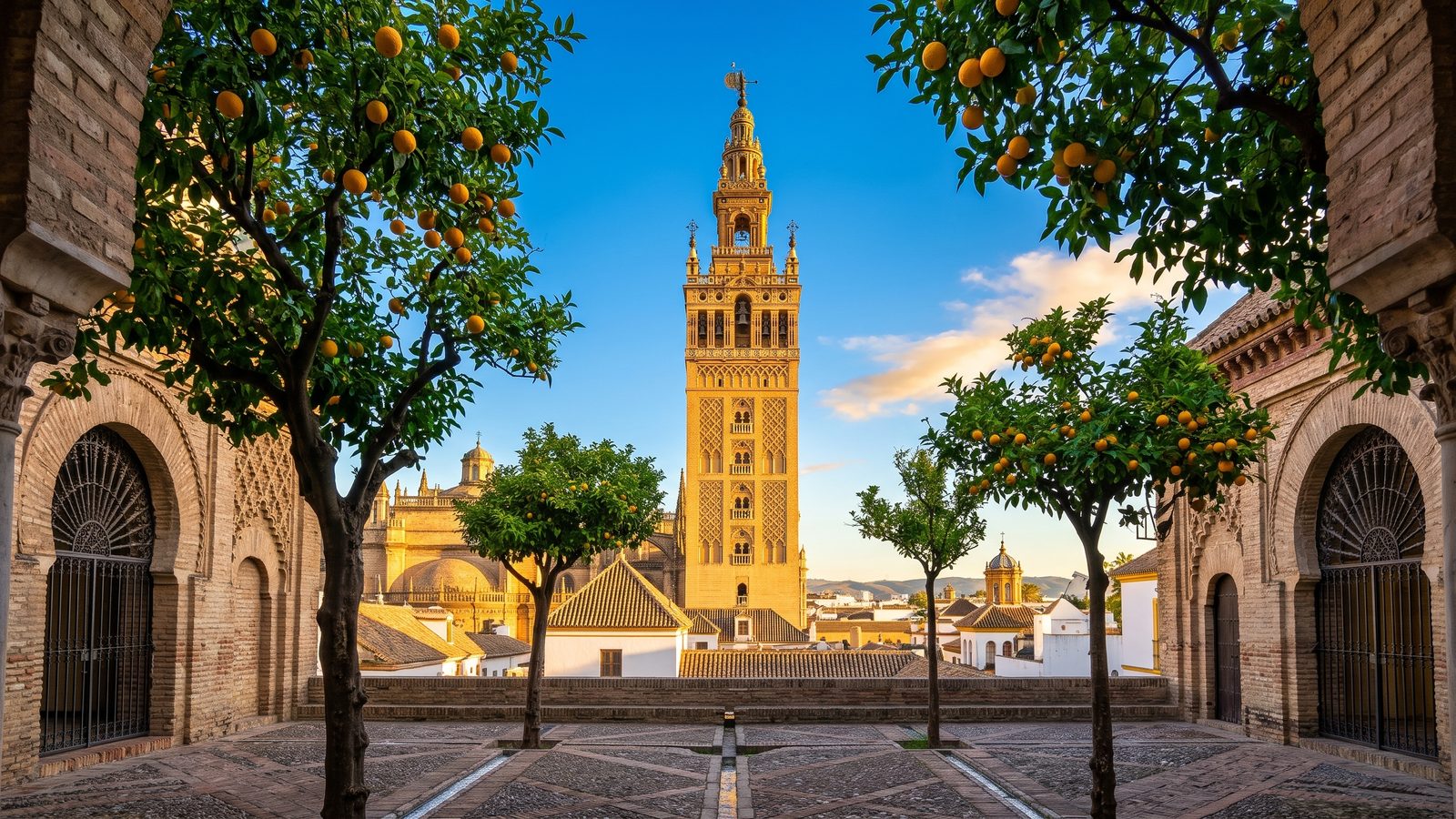
Welcome to La Giralda, the world-famous bell tower of Seville Cathedral and a UNESCO World Heritage site. Standing at the crossroads of civilisations, this architectural marvel began in the 12th century as the minaret for the Almohad Great Mosque. Later crowned with a magnificent Renaissance bell section, the tower represents a breathtaking fusion of Islamic artistry and Christian devotion, remaining the undisputed symbol of Seville.
As you explore its historic ramps and towering heights, you will discover intricate brickwork, sweeping panoramic views of the Guadalquivir River, and the grand Gothic cathedral below. Step forward and experience centuries of rich history brought to life through this self-guided journey.
Listen to a sample
The opening of this tour, exactly as AllTours narrates it on site.
What you'll hear on this tour
Stop 1. Ascending the Muezzin's Historic Ramps
As you ascend the Giralda’s gentle incline, you walk along 35 sloping ramps rather than traditional steps. This brilliant Moorish design originally allowed the muezzin to ride a horse to the summit to call the faithful to prayer. Your steady climb leads you to the pinnacle of this UNESCO World Heritage tower, where the magnificent Giraldillo stands above the city. This Renaissance bronze weather vane and statue serves as Seville's eternal guardian, turning gracefully with the Andalusian winds. From this historic height, you experience a unique architectural masterpiece where Islamic engineering meets Renaissance splendor, marking one of the most famous ascents in Southern Europe.
Stop 2. A Symphony of Brickwork and Vaults
You pause to admire the Giralda’s intricate Almohad brickwork, a display of geometric precision featuring the classic sebka pattern of interlacing blind arches. Look up to see how 16th-century Renaissance master Hernán Ruiz II added the upper bell chamber and crowning statue, creating a seamless dialogue across centuries. Inside the adjoining cathedral, soaring Gothic vaults show unparalleled structural ambition, defining an immense scale. Every carved line on this tower tells the story of two cultures converging into a single architectural icon, bridging medieval Islamic craftsmanship with golden-age Christian artistry right before your eyes.
Stop 3. Inside the World's Largest Gothic Marvel
Stepping into the magnificent interior, you are dwarfed by the sheer ambition of the world's largest Gothic cathedral. Your gaze rises toward the colossal Retablo Mayor, the vast gold-encrusted altarpiece that took over a century to complete. You admire more than 45 intricately carved scenes depicting the life of Christ, glowing under the vast nave's vaulting. This staggering masterpiece reflects the immense wealth and religious fervor of Seville during the height of its global empire, creating a sacred space where soaring stone arches and shimmering gold leaf surround you in quiet grandeur.
Stop 4. Eight Centuries of Architectural Evolution
You stand before a monument rooted in the 12th century, when Caliph Abu Yaqub Yusuf commissioned this great minaret for Seville's Almohad mosque in 1184. Following the Reconquista of 1248, Christians consecrated the site, adapting the minaret into a cathedral bell tower. Between 1558 and 1568, architect Hernán Ruiz II added the Renaissance bell chamber and the turning Giraldillo weather vane, permanently reshaping the city's silhouette. As you explore, you trace six hundred years of dramatic urban evolution, witnessing how royal ambition and shifting faiths transformed a medieval minaret into an iconic symbol of Christian Seville.
Stop 5. Panoramas of Terracotta and Riverways
As you move past the arched openings of the tower, breathtaking vistas of Seville unfold in every direction. From this elevated perspective, you gaze out across a sea of terracotta rooftops, tracing the winding path of the Guadalquivir River toward the distant Aljarafe hills. Poets and military strategists have marveled at this very panorama for centuries. Looking down, you discern the layered history of the city etched into its skyline, spanning from ancient Roman foundations to the vibrant modern metropolis below, giving you a living map of Andalusia's historic capital.
Stop 6. The Living Soul of Mudejar Identity
You observe a profound cultural dialogue carved into stone. The Giralda embodies Seville's distinct Mudejar heritage, where Islamic design and Christian devotion fuse seamlessly into a unified identity. Feel how centuries of shared traditions continue to shape the city's spirit, influencing its colorful festivals, artistic craftsmanship, and the rhythmic soul of flamenco echoing through nearby streets. Standing here, you connect with a rich, layered history that defines modern Seville, proving that this magnificent tower is not merely a monument of the past, but the living heart of Andalusian culture.
Planning your visit
- Best time to go
- Early morning or late afternoon to avoid the mid-day sun and enjoy warm light over the terracotta rooftops.
- Approximate duration
- about 1 to 1.5 hours
- Where to start
- At the base of La Giralda inside the Seville Cathedral complex, near the Patio de los Naranjos.
Access and conditions change seasonally — check the official site before you go.
Frequently asked questions
Is La Giralda worth visiting?
Yes, La Giralda is one of Seville's most iconic landmarks and a UNESCO World Heritage site. Its unique ramp ascent, architectural blend of Islamic minaret and Renaissance bell tower, and panoramic city views make it an essential stop.
How long do you need at La Giralda?
Most visitors spend between 45 minutes to 1.5 hours climbing the tower ramps, taking in the panoramic views at the top, and exploring the connected Seville Cathedral.
What is the history behind La Giralda's construction?
Originally constructed between 1184 and 1198 as the minaret for the Almohad Great Mosque, it was converted into a Christian bell tower after the Reconquista of 1248. In the 16th century, Hernán Ruiz II added the Renaissance bell chamber and the weather vane statue known as the Giraldillo.
Keep exploring
Header image is an AI-generated illustration of La Giralda. AllTours.ai is an AI audio tour guide — point your camera at any landmark and hear its story.