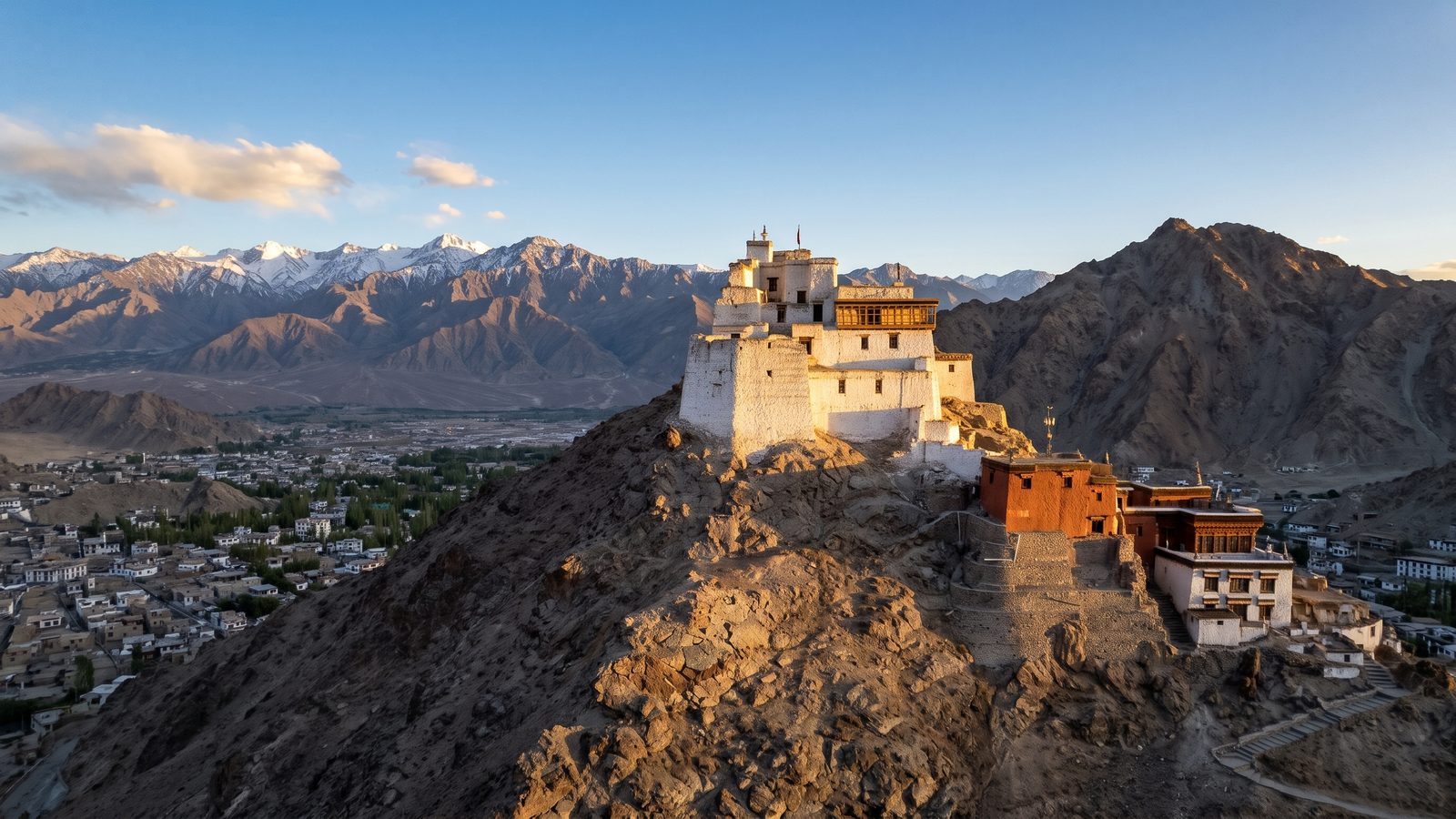
Perched dramatically above the ancient town of Leh, Leh Palace stands as a nine-story testament to the power of the 17th-century Namgyal dynasty. Built under the direction of King Sengge Namgyal, this colossal mud-brick and timber citadel once dominated the valley as its tallest structure. As you explore its historic chambers, you step directly into a realm where royal ambition, Tibetan architectural mastery, and deep Buddhist devotion converged.
Modeled after the famous Potala Palace in Lhasa, this iconic fortress offers an unforgettable journey through Ladakh's royal past. From its high battlements, enjoy breathtaking panoramas of Old Leh, the Indus River, and the snow-capped Stok Kangri range while uncovering centuries of Himalayan history.
Listen to a sample
The opening of this tour, exactly as AllTours narrates it on site.
What you'll hear on this tour
Stop 1. Rise and Fall of the Lion King's Citadel
You stand before a magnificent monument to royal ambition, commissioned around 1600 by King Sengge Namgyal, known as the 'Lion King.' As you gaze up at these nine stories rising from the hillside, you see a grand residence designed to assert the Namgyal dynasty's dominance over Ladakh. For over two centuries, these thick walls serve as the administrative heart, royal court, and private residence of Ladakhi monarchs. However, in 1834, devastating invasions by Dogra forces from Jammu force the royal family to abandon their seat and retreat to Stok Palace. Today, you witness the enduring legacy of a kingdom's rise and fall embedded in these weathered stones.
Stop 2. Mastery of Himalayan Mud Brick and Timber
As you examine the outer walls, you notice a striking architectural tribute to the Potala Palace in Lhasa. Built from local stone, sun-dried mud bricks, and heavy poplar timber, the palace demonstrates brilliant high-altitude engineering. Observe how the massive walls taper upward, providing vital seismic stability against mountain earthquakes. The fortress-like lower floors originally housed royal stables and vast storerooms behind thick, defensive masonry. As your eyes move upward, notice the expanded windows on the upper levels, strategically placed to light sacred prayer halls and royal living quarters. Flat roofs offer protection against snow while serving as communal terraces, showcasing intricate wooden craftsmanship preserved through centuries.
Stop 3. Panoramic Vistas Across the Leh Valley
Step out onto the high upper terrace and take in an extraordinary Himalayan panorama. Look down to see the tightly clustered mud-brick houses of Leh Old Town, bordered by vibrant green barley fields and ochre mountain slopes. To the north, the sharp peaks of the Ladakh Range guard the horizon, while the silver ribbon of the Indus River flows along the valley floor to the east. Facing south, you behold the majestic Stok Kangri range, its glinting glaciers commanding the sky. Imagine Namgyal kings standing on this very balcony, surveying their entire realm, monitoring vital trade routes, and keeping watch over their mountain domain.
Stop 4. The Sacred Height of Namgyal Tsemo
Look upward to the craggy peak above the palace, where Namgyal Tsemo Monastery stands guard. Founded in the 15th century by King Tashi Namgyal, this sacred shrine serves as a spiritual sentinel watching over the valley below. Within its sacred walls rests an impressive three-story golden statue of Maitreya, the future Buddha, radiating quiet serenity. As you picture the interior, imagine centuries-old frescoes of guardian deities and intricate mandalas glowing in the dim light. Monks continue to chant here, sending devotion across the winds as prayer flags flutter against the backdrop of the distant Indus Valley and soaring mountain ranges.
Stop 5. Echoes of Devotion and Royal Court Life
Walk through these sacred halls and feel the vibrant cultural heart of the Ladakhi monarchy. Far more than a royal home, the palace serves as the spiritual center for the kingdom. Imagine incense floating through the air during daily morning prayers as monks and royals perform sacred rituals together. During grand festival celebrations like Losar, the Ladakhi New Year, the courtyard bursts into life with traditional music and masked ritual dances known as Chhams. Faint remnants of painted mandalas and deities still decorate the plaster walls, offering visual prayers crafted by devoted local artisans whose artistic legacy lives on in these quiet chambers.
Stop 6. Guardians of the High Trans-Himalayan Realm
Gaze past the battlements at the staggering mountain ranges surrounding the palace. You are surrounded by the colossal Ladakh Range, formed by the ancient tectonic collision of the Indian and Eurasian plates millions of years ago. To the north, the formidable peaks of the Karakoram range mark ancient trade passes, while the Zanskar range frames the Indus River to the south. These massive stone barriers long provided natural fortification, isolating and preserving Ladakhi Buddhist culture. As sunlight and shadows shift across these stark ochre slopes, you understand why locals revere these peaks not just as rock, but as sacred homes of protective spirits.
Planning your visit
- Best time to go
- May to October during the morning or late afternoon for clear light and comfortable weather.
- Approximate duration
- about 1 to 1.5 hours
- Where to start
- At the main entrance slope at the base of Leh Palace in Old Town Leh.
Access and conditions change seasonally — check the official site before you go.
Frequently asked questions
Is Leh Palace worth visiting?
Yes, Leh Palace is well worth visiting for its rich history, unique 17th-century Tibetan palatial architecture, and sweeping panoramic views over Leh town, the Indus Valley, and the Stok Kangri mountain range.
How long do you need at Leh Palace?
Most visitors spend about 1 to 1.5 hours exploring the nine-story palace structure, its exhibition rooms, prayer halls, and open upper terraces.
Who built Leh Palace and why?
Leh Palace was built in the early 17th century by King Sengge Namgyal, ruler of the Namgyal dynasty, to serve as a grand royal residence and assert dominance over the Ladakh region.
Keep exploring
Header image is an AI-generated illustration of Leh Palace. AllTours.ai is an AI audio tour guide — point your camera at any landmark and hear its story.