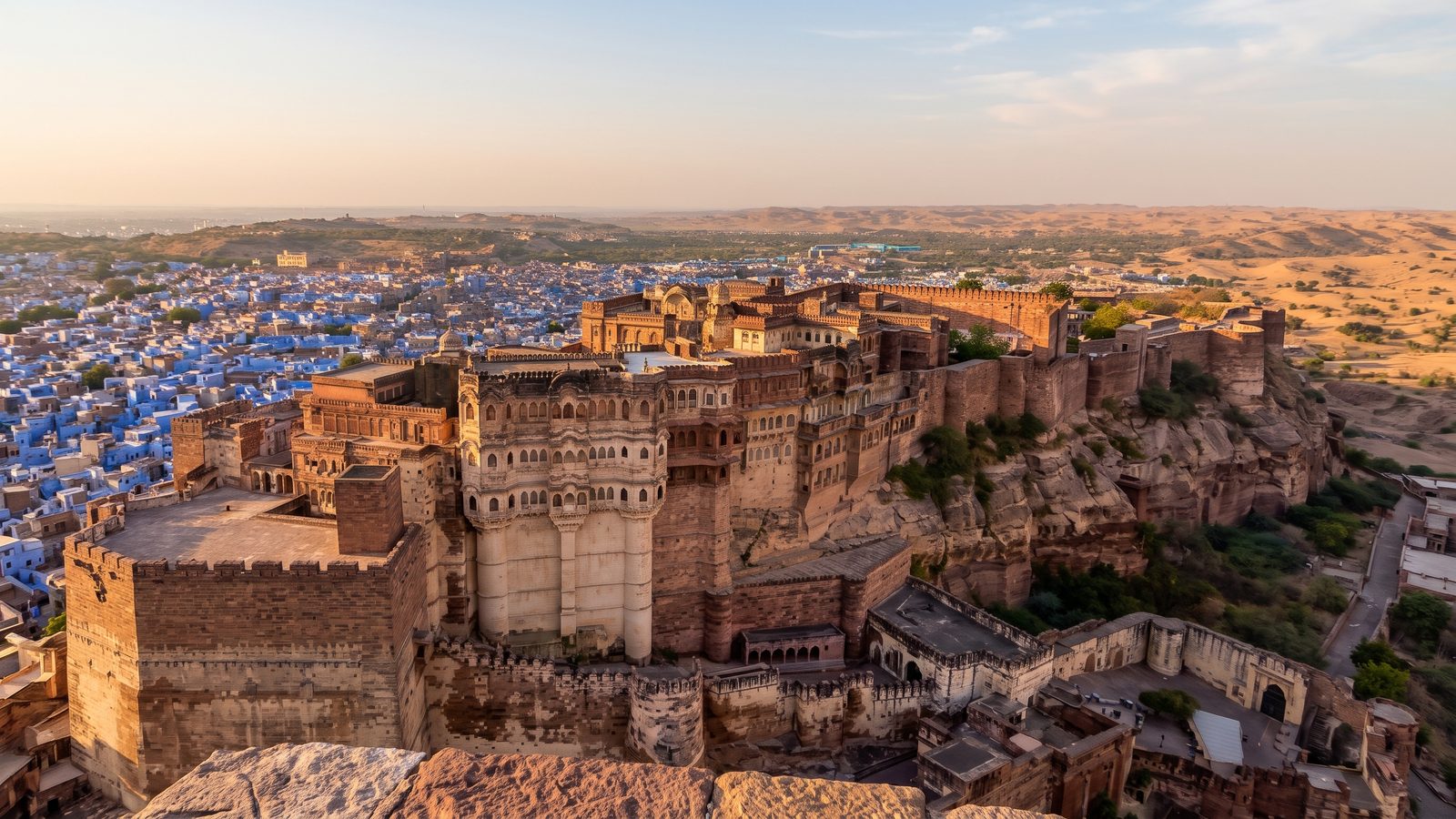
Rising 400 feet above Jodhpur's cobalt rooftops, Mehrangarh Fort stands as one of India's largest and most imposing citadels. Founded in 1459 by Rao Jodha, this colossal sandstone stronghold encapsulates centuries of Rathore valor, architectural mastery, and royal luxury. As you navigate its winding ramparts and opulent palaces, this self-guided audio tour brings alive the legends, sacrifices, and artistic triumphs carved into every sun-drenched stone.
Explore the fortress at your own pace, from its cannon-sloped defensive walls to the gilded ceilings of Phool Mahal. Take in unforgettable panoramas of the Thar Desert and the Blue City below while uncovering the rich courtly traditions that flourished behind these impregnable walls.
Listen to a sample
The opening of this tour, exactly as AllTours narrates it on site.
What you'll hear on this tour
Stop 1. Impregnable Red Sandstone Ramparts
You stand before a colossal citadel rising four hundred feet above the desert floor, its massive walls blending so seamlessly into the Malani Hills that it seems to grow directly from the rock. As you gaze up at the towering ramparts, notice how the reddish-brown sandstone provides natural camouflage against the arid landscape. You trace the winding, uphill ascent past strategic bastions engineered to create overlapping fields of fire and fatal choke points for any invader. These dizzying drops and sheer heights served as a powerful psychological deterrent long before battles even began. Feel the immense scale of this masterclass in defensive architecture, built to keep Marwar's heart forever secure.
Stop 2. Sacred Foundations and Royal Sacrifice
You walk the ground chosen in 1459 by Rao Jodha, who sought a strategic capital atop this precipitous ridge. As you explore the Sun Fort—named for the Rathore clan's mythical descent from the sun god—you tread upon centuries of royal ambition. Legend tells of the hermit Cheeria Nathji, whose disturbed sanctuary brought a curse of water scarcity upon the stronghold. To appease the divine and ensure prosperity, Raja Ram Meghwal voluntarily allowed himself to be buried alive in the fort's foundations. With every step through these sun-drenched courtyards, you encounter the living legacy of successive Rathore rulers who built an unyielding sentinel against desert invaders.
Stop 3. Sloped Ramparts and Intricate Jali
As you study the massive exterior walls, observe the subtle outward slope near the base, a brilliant military innovation designed to deflect incoming cannon fire away from the fort's core. Passing inside, you witness a dramatic transition from rugged defense to delicate royal luxury. Look closely at the hand-carved stone jali latticework adorning the balcony windows; these intricate patterns keep royal women hidden while funneling cool desert breezes inside. In the Moti Mahal, polished lime plaster gives the walls a glowing, pearly sheen, while the Phool Mahal dazzles your eyes with gold leaf ceilings and vibrant stained glass. Every stone balances formidable power with artistic elegance.
Stop 4. Royal Treasures and Deadly Armament
Step inside the museum galleries, where the private world of the Rathore dynasty unfolds around you. In the Palki Khana, you admire silver-plated palanquins and ornate howdahs once carried through grand royal processions. Moving into the Armoury Gallery, you examine deadly weapons inlaid with precious metals, including the distinctive H-shaped Katar push-dagger engineered for lethal close combat. As you wander past colorful displays in the Turban Gallery, you see how intricate folds historically indicated caste and region across Marwar. Intricate miniature paintings and golden royal cradles bring the vibrant daily life, courtly battles, and regal celebrations of Jodhpur's past vividly into focus.
Stop 5. Sweeping Views of the Blue City
Stand along the wind-swept ramparts and look down at the famous Blue City sprawling far below. You gaze upon a sea of indigo-painted houses, a traditional practice designed to deflect searing heat and repel insects. Beyond the rooftops, your eyes trace the vast expanse of the Thar Desert, the formidable natural barrier that guarded Marwar for centuries. Looking toward the horizon, you spot the gleaming white marble of Jaswant Thada resting like a serene lotus, while the imposing Umaid Bhawan Palace stands in the distance. From this breathtaking vantage point, you instantly grasp why rulers chose this commanding peak to oversee their desert realm.
Stop 6. Living Traditions of Marwar Court
As you wander through the inner courtyards, listen closely and imagine the soulful melodies of mand music or the rhythmic steps of the Ghoomar dance echoing off the sandstone walls. These palaces served not only as a fortress but as a thriving haven for master artisans, court musicians, and weavers. Notice how traditional tie-dye bandhani textiles and exquisite stone carvings reflect deep Marwari devotion and aesthetic flair. The fort once burst into brilliant color during grand festivals like Gangaur, blending martial bravery with renowned desert hospitality. Here, you feel the enduring pulse of Rajput culture that continues to shape Jodhpur today.
Planning your visit
- Best time to go
- October to March during early morning or late afternoon for cooler weather and soft sunlight.
- Approximate duration
- About 2 to 3 hours
- Where to start
- Main entrance near Jai Pol (Victory Gate) at the foot of the fort ascent.
Access and conditions change seasonally — check the official site before you go.
Frequently asked questions
Is Mehrangarh Fort worth visiting?
Yes, Mehrangarh Fort is widely considered one of Rajasthan's most spectacular and best-preserved fortresses, renowned for its architectural grandeur, rich museum collections, and breathtaking views over Jodhpur's Blue City.
How long do you need at Mehrangarh Fort?
Most visitors spend between 2 to 3 hours exploring the expansive courtyards, royal palace museum galleries, outer ramparts, and panoramic viewpoints.
Who built Mehrangarh Fort and when?
Rao Jodha, the founder of Jodhpur and chief of the Rathore clan, laid the foundation of Mehrangarh Fort in 1459 atop a 120-meter high hill.
Keep exploring
Header image is an AI-generated illustration of Mehrangarh Fort. AllTours.ai is an AI audio tour guide — point your camera at any landmark and hear its story.