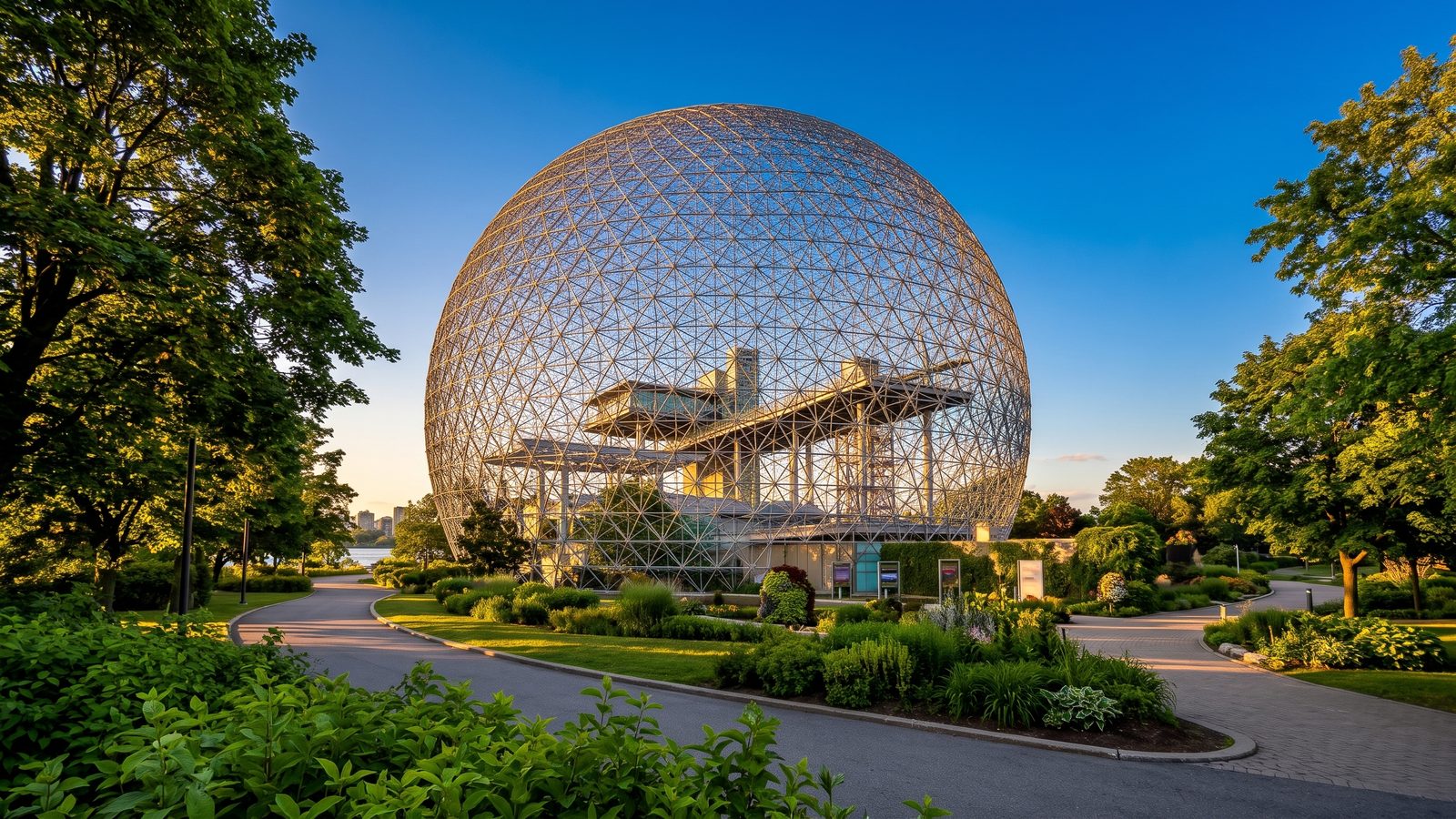
You stand before the Montreal Biosphere, an architectural marvel gleaming against the Quebec sky in Parc Jean-Drapeau. Originally constructed as the United States Pavilion for Expo 67 by visionary architect Buckminster Fuller, this monumental geodesic sphere remains one of the city's most recognizable landmarks. Surrounding you is a living testament to human ambition, mathematical precision, and an enduring commitment to understanding and preserving our planet's delicate ecosystems.
As you walk around and inside this impressive steel framework, you discover its fascinating evolution from a World's Fair sensation to a pioneering museum dedicated to water ecosystems and climate change. Prepare to explore how architecture, history, and environmental science unite in this extraordinary urban oasis.
Listen to a sample
The opening of this tour, exactly as AllTours narrates it on site.
What you'll hear on this tour
Stop 1. Buckminster Fuller's Structural Marvel
You gaze up at the world's largest geodesic dome, an extraordinary structure designed by visionary architect Buckminster Fuller. As you examine the vast sphere, notice the intricate lattice of steel tubes forming a network of interconnected triangles. This revolutionary design creates an incredible self-supporting shell, allowing for an immense, column-free interior without relying on traditional structural supports. Although a devastating fire in 1976 destroyed its original acrylic outer skin, the underlying steel framework stood completely resilient. You see a perfect real-world demonstration of form following function, where geometric precision creates an illusion of weightlessness despite the monumental scale of this enduring Montreal icon.
Stop 2. The World's Fair Sensation of 1967
You step back in time to Expo 67, when millions of visitors gather beneath this iconic dome for the world exposition themed 'Man and His World.' Standing here, you imagine the dome in its original glory as the United States Pavilion, encased in a shimmering transparent acrylic skin. Inside, visitors marvel at space age lunar modules and cutting-edge artwork, celebrating American technological ingenuity. The building quickly becomes the undisputed star of the World's Fair, embodying a spirit of optimism, progress, and global collaboration. As you walk through the surrounding grounds today, you still feel that sense of wonder from when Montreal captivated the entire world.
Stop 3. Interactive Journey Through Our Planet
You step inside the Biosphere's museum space, where immersive exhibits bring ecological science to life. At the dynamic 'Water' exhibit, you watch illuminated global currents flow across a massive map, tracing how every river and ocean links together while inviting you to evaluate your own daily water footprint. Nearby, you enter the climate change section, where personal narratives project onto a spherical screen, sharing stories from communities facing extreme weather and rising sea levels. As you interact with hands-on models displaying urban farming techniques and renewable energy systems, you gain practical knowledge and inspiration to foster meaningful, sustainable change in your own community.
Stop 4. Spaceship Earth and Ecological Stewardship
You immerse yourself in the environmental mission that defines the Biosphere today. This iconic structure acts as a active hub dedicated to addressing critical global challenges, focusing on freshwater systems and the ongoing impacts of climate change. As you explore the open spaces under the lattice, you reflect on Buckminster Fuller's famous concept of 'Spaceship Earth'—the idea that humanity shares a single, fragile planet with limited resources. The exhibits empower you with vital environmental literacy, encouraging you to step into the role of an active steward. Every display reminds you how human ingenuity can work in harmony with nature.
Stop 5. The Audacious Creation of Parc Jean-Drapeau
You look beyond the geodesic dome and take in the expansive greenery of Parc Jean-Drapeau. The ground beneath your feet holds a remarkable story: much of this land, including neighboring Île Notre-Dame, was artificially sculpted using millions of tons of rock excavated during the construction of Montreal's Metro system. Engineers transformed two modest islands in the Saint Lawrence River into a world-class site for Expo 67. Today, you wander along peaceful paths where visitors once celebrated global achievement. The Biosphere sits harmoniously within this human-made landscape, blending engineering ambition with a tranquil public sanctuary.
Stop 6. Mathematics, Tensegrity, and Climate Data
You observe the precise mathematical principles engineered into every triangle of the Biosphere's massive framework. Buckminster Fuller applied principles of structural science and tensegrity, balancing continuous tension and isolated compression to maximize strength while minimizing building materials. Beyond this structural ingenuity, you discover how the Biosphere operates as a center for environmental research. Exhibits present rigorous scientific data on air quality, ecosystem health, and water conservation, converting complex ecological monitoring into clear, accessible concepts. As you study these scientific findings, you learn how researchers gather environmental data to forecast ecological trends and develop innovative solutions for our planet's future.
Planning your visit
- Best time to go
- Late spring through early autumn offer ideal outdoor weather in Parc Jean-Drapeau, while morning visits ensure quieter museum exhibits.
- Approximate duration
- about 1.5 to 2 hours
- Where to start
- Begin your tour outside the Biosphere's geodesic dome in Parc Jean-Drapeau on Île Sainte-Hélène.
Access and conditions change seasonally — check the official site before you go.
Frequently asked questions
Is Montreal Biosphere worth visiting?
Yes, the Montreal Biosphere is worth visiting for its iconic Buckminster Fuller architectural design, rich Expo 67 history, and engaging museum exhibits focused on climate change and water ecosystems.
How long do you need at Montreal Biosphere?
Most visitors spend between 1.5 and 2 hours exploring the dome's architecture, indoor interactive exhibits, and surrounding Parc Jean-Drapeau trails.
What happened to the Montreal Biosphere in 1976?
In 1976, a major fire burned away the Biosphere's original acrylic skin, but the steel geodesic structural framework designed by Buckminster Fuller survived intact and was later repurposed into an environmental museum.
Keep exploring
Header image is an AI-generated illustration of Montreal Biosphere. AllTours.ai is an AI audio tour guide — point your camera at any landmark and hear its story.